Beijing Parks & Gardens
Beijing Olympic Park: Bird’s Nest, Water Cube and Olympic Forest Park
The park built for two Olympics: what is free, which stadiums are worth paying to enter, the Olympic Tower and Forest Park, the best time of day to come, and getting there on Line 8.
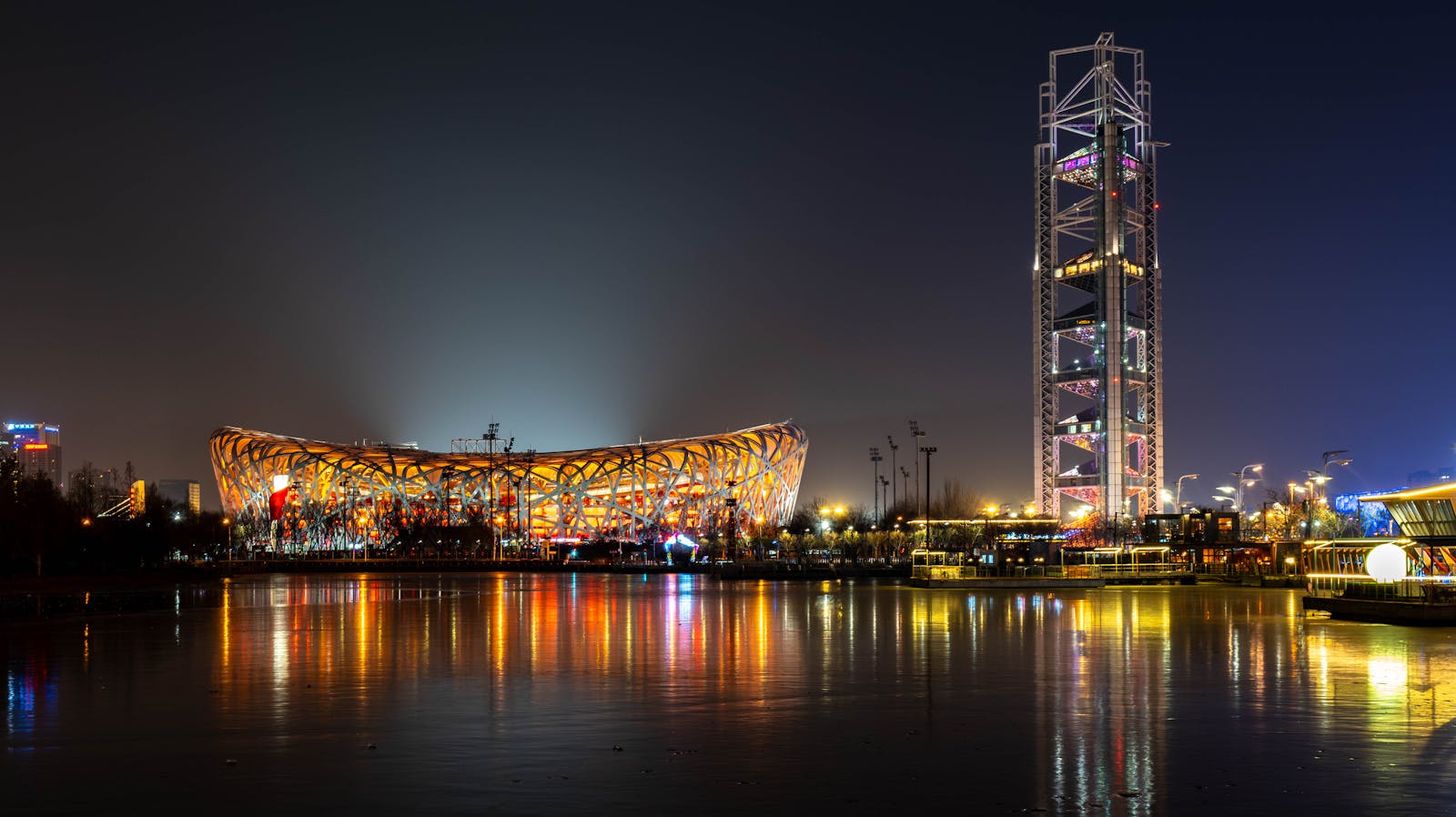
On a warm evening the Olympic Green fills up with people who have not come for the sport. Grandparents push prams along the wide granite promenade, children wobble past on roller skates, a man flies a kite strung with lights so high that it looks like a slow-moving satellite, and at the far end the Bird’s Nest glows red through its steel lattice while the Water Cube across the way turns blue. The Beijing Olympic Park was built for the Summer Games of August 2008 and used again for the Winter Games of February 2022, and in between it has become something more ordinary and rather more likeable: the place where north Beijing goes for a walk.
This guide covers what is free and what is not, which of the famous buildings are worth paying to go inside (fewer than you might expect), the Olympic Tower and the huge Olympic Forest Park to the north, the best time of day to come, and how to get there on Line 8 straight up from the city centre. Prices and opening hours were checked in October 2026 against current listings; treat them as the right order of magnitude, and remember that the stadiums close to sightseers on event days.
Beijing Olympic Park at a glance
| Sight | Cost | Hours | Worth paying for? |
|---|---|---|---|
| Olympic Green (the central promenade) | Free | Open access | Yes, especially at dusk |
| Bird’s Nest (National Stadium) | ¥50 basic; about ¥80 with the rooftop walkway; about ¥110 VIP | 10:00–22:00, last entry 21:00; closed on event days | For the rooftop walkway, or if you love stadiums |
| Water Cube (National Aquatics Center) | About ¥48, including the evening light show | 10:30–20:30, last entry 20:00 | With children, or to swim; otherwise admire it from outside |
| Olympic Tower | From about ¥118 | 09:00–22:00 | Only on a properly clear day |
| Olympic Forest Park | Free | Daytime into the evening | Yes, for a long walk or a run |
| Skating at the Ice Ribbon or the Ice Cube | Priced per session | Varies with the event calendar | If you skate |
The short version: the outside is the attraction. The Olympic Green, the views of the two great buildings and the Forest Park are all free, and you can spend a very pleasant two or three hours here without buying a ticket. Of the paid options, the Bird’s Nest rooftop walkway is the one most people remember afterwards, and the rest depend on who you are travelling with and how clear the sky is.
Two Olympics, one park
Beijing is the only city to have hosted both the Summer and the Winter Olympics, and the Bird’s Nest is the only stadium to have staged the opening ceremonies of both. The first began at eight in the evening on 8 August 2008, because eight is the luckiest number in Chinese, and it was directed by the film-maker Zhang Yimou with a cast of thousands of drummers that anyone who watched still remembers. Zhang directed the 2022 ceremony too, on a February night in the middle of the pandemic, to a much smaller crowd. Several of the 2008 venues were adapted rather than replaced for the Winter Games, which is why the park now has a swimming pool that turns into a curling rink.
The layout is more deliberate than it looks from the ground. The park lies on the northern extension of Beijing’s great north–south axis, the line that runs from Yongdingmen through Tiananmen, the Forbidden City and the Drum and Bell Towers, and which was inscribed as a UNESCO World Heritage Site in 2024. The Olympic planners simply carried it on. Stand in the middle of the Green facing south and the Forbidden City is straight ahead of you, some eight kilometres away behind the apartment blocks. The two famous buildings sit either side of the line, the round Bird’s Nest to the east and the square Water Cube to the west, a pairing that Chinese commentators like to read as the old cosmology of a round heaven and a square earth. A long ribbon of water runs down the eastern side of the Green, said to trace the shape of a dragon when seen from the air, and to the north the axis dissolves into the woods and lakes of the Olympic Forest Park.
The Forbidden City guide covers the far end of the line. If you have walked the old axis already, coming up here completes the picture of a city that has spent six centuries arranging itself along a single line.
The Bird’s Nest
The National Stadium, known to everyone as the Bird’s Nest (鸟巢, Niǎocháo), was designed by the Swiss architects Herzog & de Meuron with the artist Ai Weiwei as a consultant, and built around a lattice of twisting steel members. The original design had a retractable roof, dropped during construction to save money and steel, which is why the bowl is open to the sky. It held 91,000 people in 2008 with temporary seating and about 80,000 now, and these days it earns its keep as a venue for football, athletics and major concerts.
What the tickets get you
The basic ¥50 ticket lets you into the stands to look down over the field, with exhibitions on the building’s construction and on the 2008 and 2022 ceremonies. It is interesting for about half an hour, and then it is a very large empty stadium. The ticket worth buying is the one that adds the rooftop walkway (about ¥80 in recent listings), which takes you up in a lift on the north side to a path along the top of the steel structure. You walk on mesh flooring among the girders, look straight down into the bowl, and get long views over the Olympic Green and, on a clear day, south towards the city centre. A VIP ticket at about ¥110 adds lounges and hospitality areas, and most people can skip it.
Ticket names and bundles change from season to season, and the stadium is sometimes sold as a combination with the Water Cube. Buy through the stadium’s official WeChat account or through Trip.com, and check the event calendar before you go: on concert and match days the stadium is closed to sightseers, and the area around it is fenced off for crowd control.
The honest verdict: if you are not a sports or architecture enthusiast, the outside of the Bird’s Nest is the better half of the experience, and it is free. Walk all the way round it, look up through the lattice from underneath, and come back after dark when it is lit from within. If you do go in, pay the extra for the walkway.
The Water Cube
The National Aquatics Center, the Water Cube (水立方, Shuǐlìfāng), is the cleverer of the two buildings and the one that photographs better. Its walls are made of air-filled plastic cushions arranged in a pattern taken from the geometry of soap foam, which is why the building looks as if it has been built out of bubbles. In 2008 it was the scene of Michael Phelps’s eight gold medals, and 25 swimming world records fell in its pool in a little over a week.
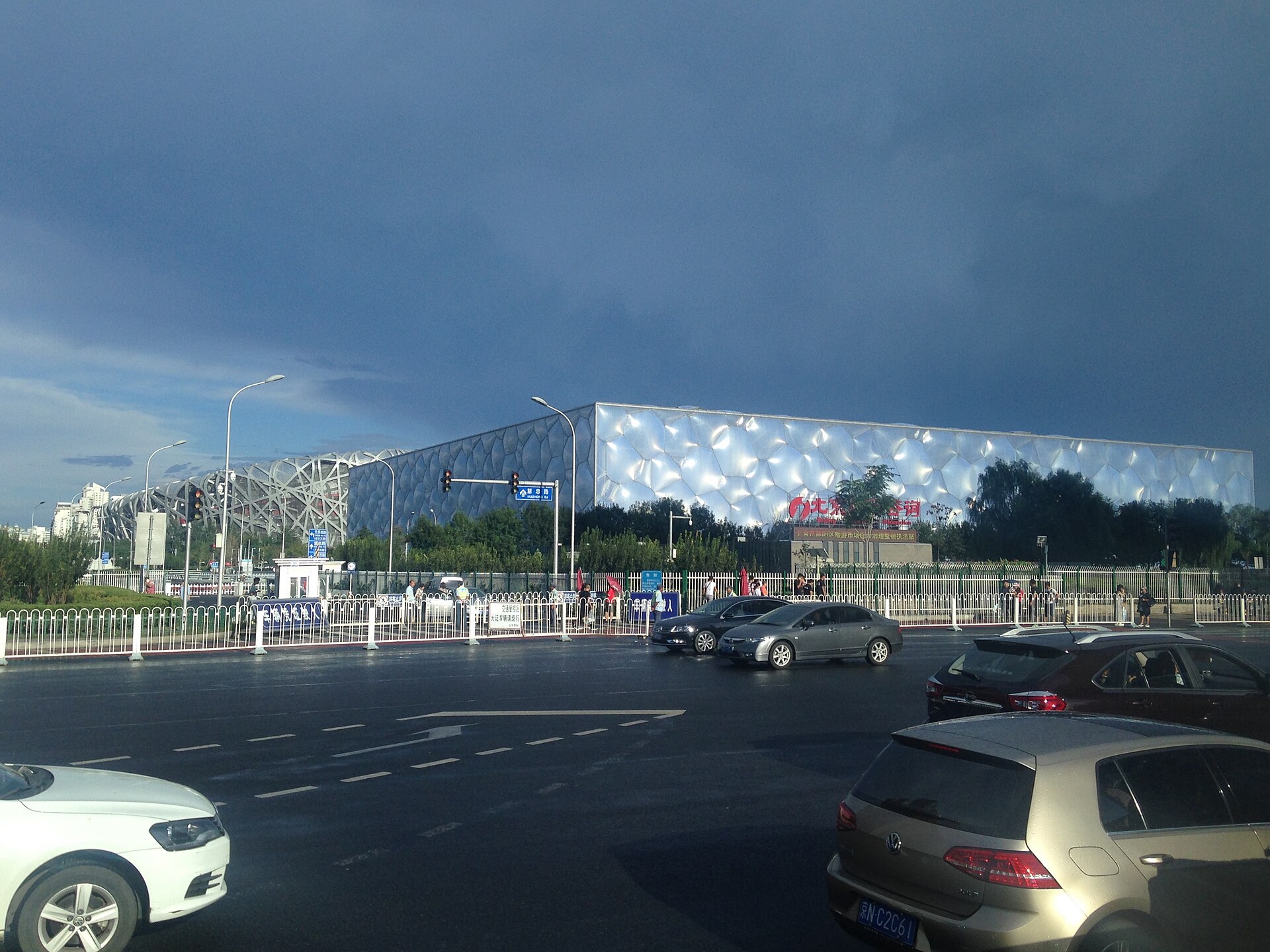
For the 2022 Winter Games the competition pool was covered with a removable frame and laid with curling sheets, and the building was rebranded the Ice Cube. It can still switch between water and ice, and in August 2022 a purpose-built ice sports centre opened beside it with public skating sessions. On a normal day a visitor’s ticket costs about ¥48 and includes an evening light-and-water show; a two-hour public swim costs about ¥55; and the indoor water park inside the building is ticketed separately.
The honest verdict: the Water Cube is at its best from the outside, and at its very best at dusk, when the bubbles light up blue and slowly change colour. The visitor ticket is a pleasant hour with children, especially if the light show is on, but for adults without an interest in swimming it adds little to what you have already seen through the glass. If you want to go inside, the most memorable way is to bring a swimming costume and swim where Phelps did.
The Olympic Tower
The Olympic Tower, just under 250 metres tall, is five slim shafts of different heights that open out at the top into platforms like the canopies of trees, with the Olympic rings on the highest of them. It opened after the Games, and its observation decks look out over the Forest Park, the stadiums and the long straight line of the axis running south into the city. On a clear day you can see the Western Hills, and occasionally the line of the mountains beyond them that carry the Great Wall.
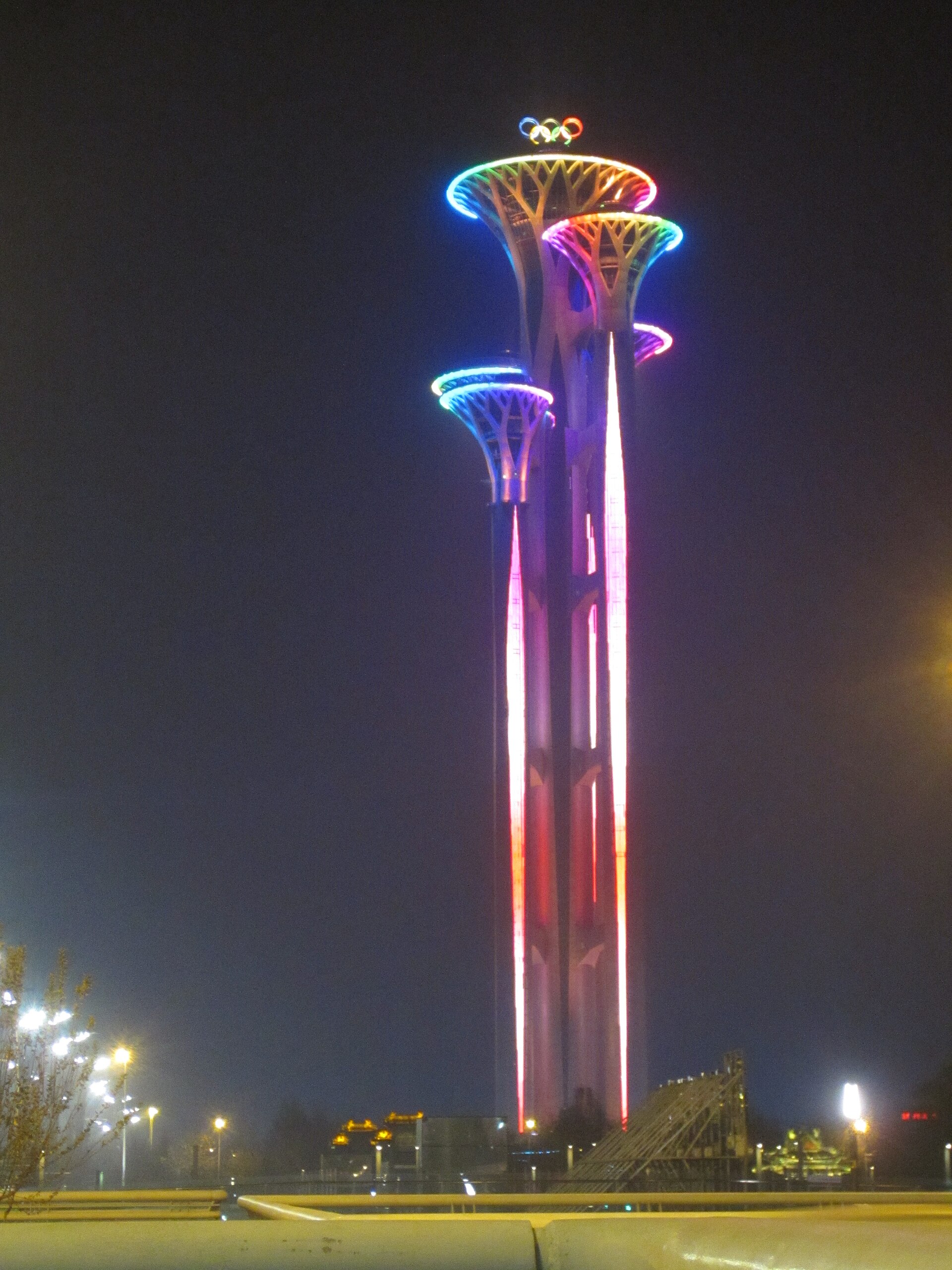
Tickets are listed from about ¥118, and the tower is open from 09:00 to 22:00. Whether it is worth that depends entirely on the sky. Beijing’s air is far cleaner than its reputation (2025 was the cleanest year on record, with 311 days of good or moderate air), and clear days are now common, particularly in autumn and after a strong north wind. On one of those days the view is excellent. On a hazy day you are paying to look at a grey blur, so check the forecast and the air quality before you buy. And for the view that matters most in Beijing, the golden roofs of the Forbidden City spread out below you, Jingshan Park does it for ¥2.
The other venues
The Olympic Green has more stadiums than the two everyone knows, and a walk the length of it takes you past most of them.
- The National Indoor Stadium, with its roof shaped like an open folding fan, near the Water Cube on the western side of the axis. It hosted gymnastics in 2008 and ice hockey in 2022, and now holds concerts and sports events.
- The Ice Ribbon, formally the National Speed Skating Oval (国家速滑馆), on the western side of the park. Its glass walls are wrapped in 22 bands of light, and it was the only newly built ice-sports venue in central Beijing for the 2022 Games. It runs public skating sessions when the ice is not booked for competitions and training, priced per session.
- The Linglong Tower, the slender broadcast tower from 2008, and the China National Convention Center beside it, which are worth a look on the walk north but not a detour.
- The China Science and Technology Museum, near the north end of the Green, a large hands-on science museum that is one of the best rainy-day options in Beijing for children. It has its own booking system, and it is a separate half-day rather than something to squeeze in.
The Olympic Forest Park
North of the stadiums, the axis runs out into the Olympic Forest Park (奥林匹克森林公园), and this is the part of the Olympic legacy that Beijing residents actually use every day. It covers about 680 hectares, roughly twice the size of Central Park in New York, and it is free. The Fifth Ring Road cuts it into a southern and a northern park, joined by a planted bridge over the traffic. The southern park has the landscaped centrepiece, a lake called Aohai and an artificial hill, Yangshan, built from the earth dug out to make it; the northern park is wilder and quieter, with more woodland, reed beds and wetland.
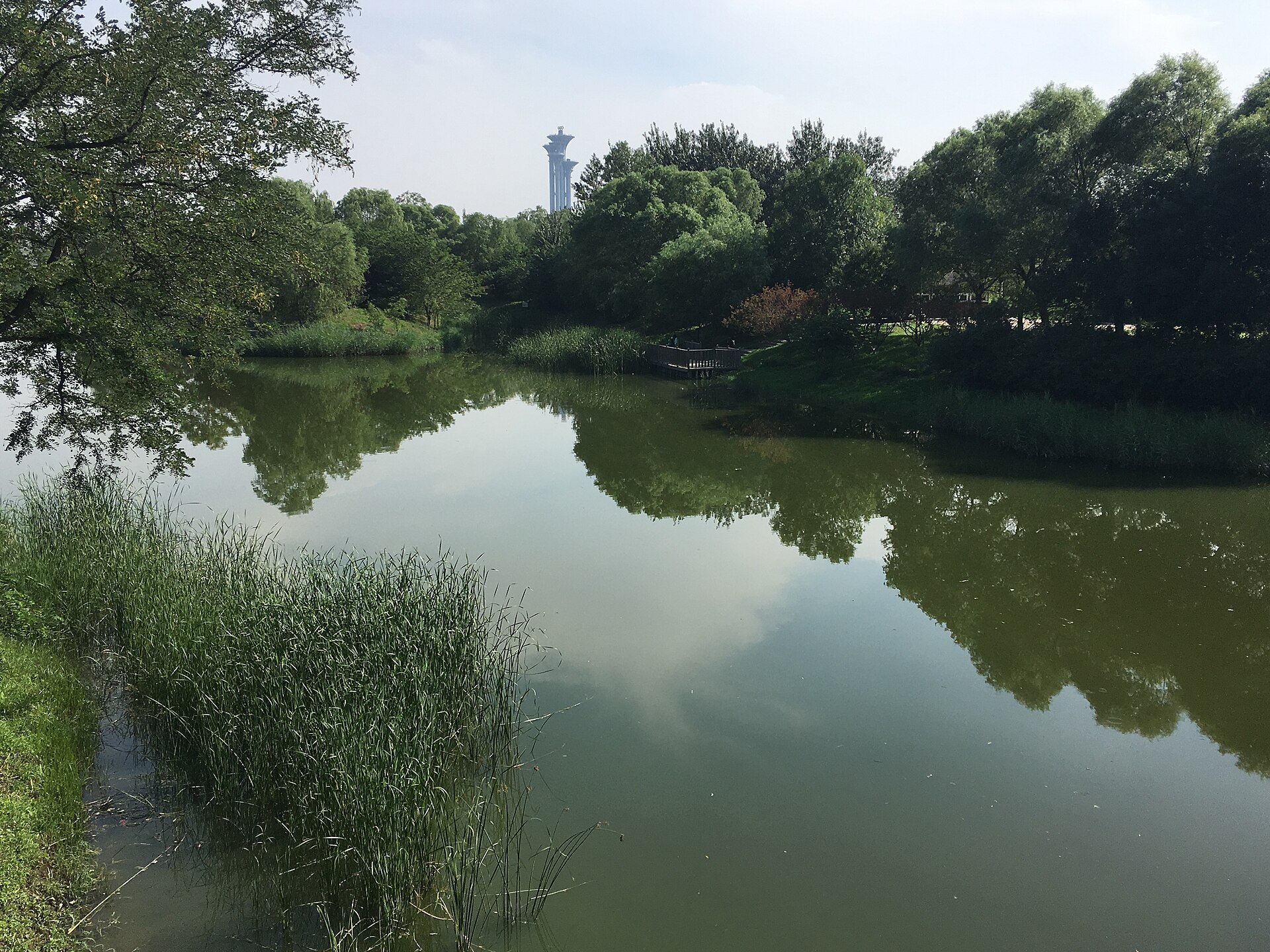
The park is best known for its running routes, rubberised loops of roughly five and ten kilometres that fill with Beijing’s runners at dawn and in the evening; if you run, there is no better place in the city to do it. For everyone else it is a long, easy walk among trees and water, with benches, toilets and the occasional snack stall, and in late October the colour in the woods is very good. The autumn leaves guide covers the season around the city.
It has no historic sights, and it is not trying to. Enter at the South Gate, by Forest Park South Gate station on Line 8, walk to the lake and back, and you will have seen the best of the southern park in an hour or so. The guide to Beijing’s parks sets it beside the city’s older green spaces, from the imperial gardens to the neighbourhood parks where the morning dancing happens.
Day or night: when to come
The Olympic Green is one of the few places in Beijing that is clearly better in the evening than in the day. At noon in summer it is a vast expanse of pale granite with almost no shade, and the heat comes up off the paving as much as down from the sky. From an hour or so before sunset the temperature drops, the families arrive, the light goes soft on the Bird’s Nest, and then the buildings come on one by one. Lighting times vary with the season and with events, so arrive before dusk rather than after and you will see the change.
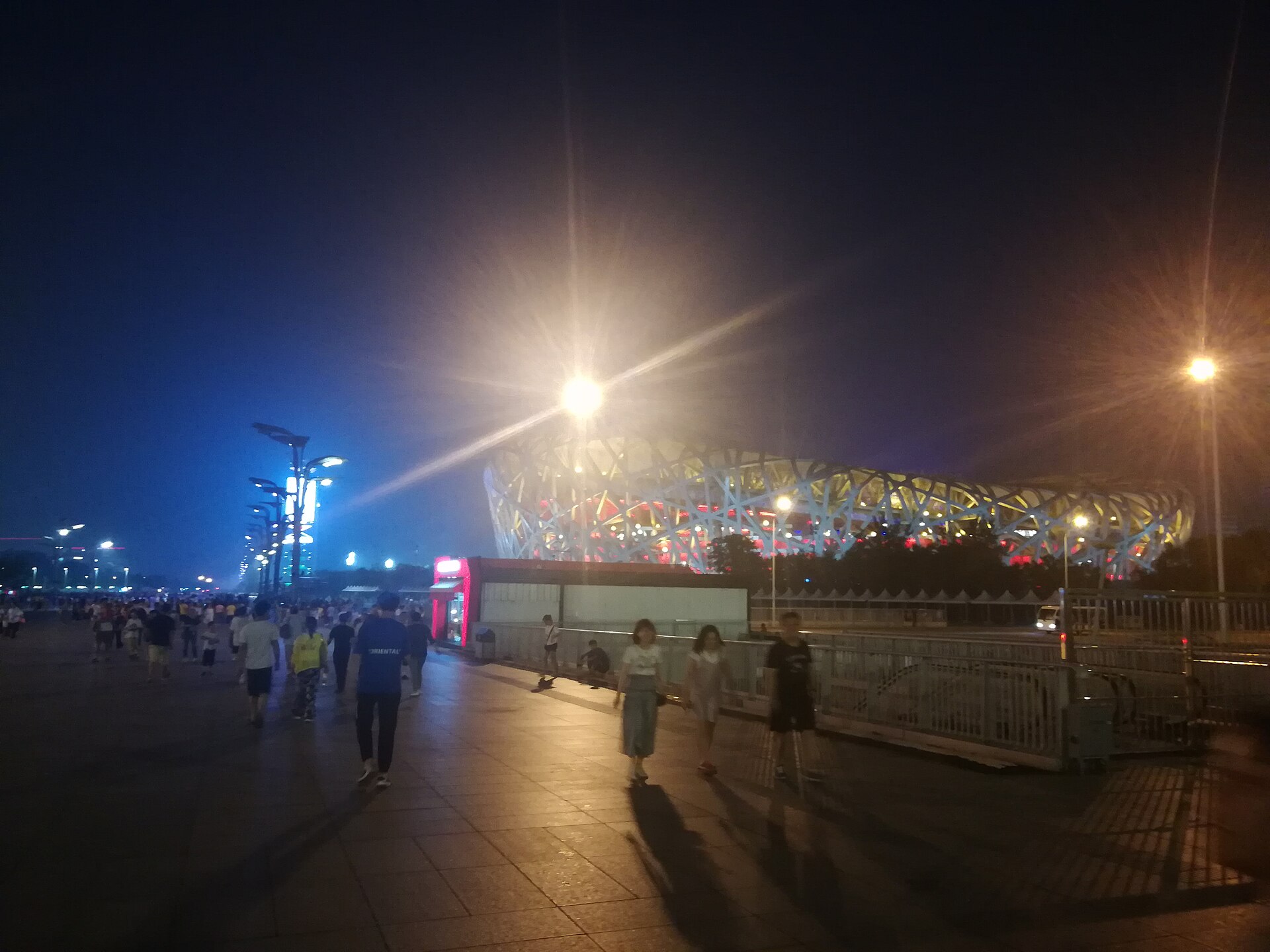
By season, spring and autumn are best for walking, with April to May and September to early November usually mild and clear. Summer works if you come late in the day. Winter is cold and the wind crosses the Green unimpeded, but it is also skating season, and the empty promenade under a hard blue January sky has its own appeal. Avoid the Golden Week holiday at the start of October and the May Day break if you can; the Green itself absorbs crowds easily, but the queues for the stadiums and the tower do not.
Getting there
Line 8 is the one to use. It runs north from the city centre through Qianmen, Wangfujing, Nanluoguxiang and Shichahai and continues straight up the axis to the Olympic Park, so from any of those stations you ride direct with no change. Journey time depends on where you start. The Beijing subway guide explains tapping in with a foreign contactless card. Three stations serve the park:
- Olympic Sports Center (奥体中心, Line 8), at the southern end, a short walk from the Bird’s Nest.
- Olympic Green (奥林匹克公园, Lines 8 and 15), in the middle, for the Olympic Tower, the National Indoor Stadium and the Science and Technology Museum.
- Forest Park South Gate (森林公园南门, Line 8), at the northern end, for the Olympic Forest Park.
The Green is a couple of kilometres long from the Bird’s Nest to the Forest Park gate, flat and easy on foot, so a good plan is to arrive at one end and leave from the other. By taxi or DiDi, ask for 鸟巢 (Niǎocháo); every driver knows it, and on event nights it is better avoided entirely, because traffic around the stadium is tightly controlled.
A half-day that works
- Mid-afternoon: Line 8 to Olympic Sports Center. Walk round the outside of the Bird’s Nest and the Water Cube, then go into the Bird’s Nest and up to the rooftop walkway while it is still light.
- Late afternoon: walk north up the Green past the National Indoor Stadium and the Linglong Tower. If the sky is clear, go up the Olympic Tower for the view in the golden hour.
- Around sunset: carry on to the Forest Park’s South Gate for a lakeside walk, or simply stay on the Green to watch the lights come on.
- Evening: catch the Water Cube’s light show if you have a ticket, then take Line 8 back south. Shichahai is on the same line, and the Shichahai lakes and hutongs make a good place to end the night with dinner by the water.
That is four or five hours with plenty of walking, much of it free. If you have only an evening, skip the paid sights, come at dusk, walk the Green from the Bird’s Nest to the tower and back, and you will have had the best of it.
The Olympic Park with children
Children tend to like this part of Beijing more than the palaces, and it is easy to see why: wide car-free spaces to run and scoot, kites, the light shows, the Water Cube’s pool and water park, skating at the Ice Ribbon or the Ice Cube, and the China Science and Technology Museum close by. Bing Dwen Dwen, the panda-in-an-ice-suit mascot of the 2022 Games, was so popular during the Olympics that people queued for hours to buy a plush one, and merchandise has been sold around the park. The Beijing with kids guide and the family itinerary show where it fits in a longer trip.
Is the Olympic Park worth it? The honest verdict
On a short first trip, the Olympic Park is an evening add-on rather than a priority. It tells you a great deal about modern China’s idea of itself, and it is a fine place for a walk, but it is not where the character of Beijing lives, and with two or three days you will get more from the hutongs, the Temple of Heaven and the Wall. If you do come, come at dusk, and do not feel obliged to buy tickets.
On a longer stay it earns more time. Sports fans will want the Bird’s Nest and its walkway. Families get a whole afternoon out of the Water Cube, the skating and the science museum. Runners should not miss the Forest Park. Anyone interested in architecture will find the two great buildings rewarding up close, particularly the way the Bird’s Nest’s lattice reads differently from every angle. And for anyone who has walked the old axis through the Forbidden City, seeing where the planners of 2008 carried it on is a satisfying end to the story.
The weakest value is the Olympic Tower on a hazy day and the VIP stadium ticket on any day. The best value is free: the Green at dusk.
Practical tips
- Check the event calendar before planning around the Bird’s Nest. Concerts and matches close it to sightseers and fence off the surrounding area.
- Bring water and a hat in summer. Shade on the Green is scarce, and kiosks are spaced out.
- Carry your passport. Bookings for the venues are made in your own name, and there are bag checks at the entrances.
- Book ahead in the holidays. On ordinary weekdays tickets are easy to get on the day; around Golden Week and the summer holidays they are not.
- Toilets are plentiful around the Green and in the Forest Park.
- Leave the drone at home. All of Beijing is controlled airspace, and an Olympic venue is the last place to test that.
- Access: the Green is flat, wide and step-free, about as good as Beijing gets for wheelchairs and pushchairs, and the stadium walkway is reached by lift. The accessibility guide covers the rest of the city.
- Food: there is little inside the park beyond snack stalls. Eat in the shopping centres around the Olympic Sports Center and Olympic Green stations, or back in town.
Frequently asked questions
Is Beijing Olympic Park free?
Yes. The Olympic Green, the views of the stadiums and the Olympic Forest Park are all free to walk around. You pay only to go inside the Bird’s Nest, the Water Cube or the Olympic Tower, or to skate or swim.
How much does it cost to go inside the Bird’s Nest?
The basic ticket is ¥50. The ticket that adds the rooftop walkway is about ¥80, and a VIP ticket about ¥110. The walkway is the part worth paying for. The stadium closes to visitors on event days.
Can you go inside the Water Cube?
Yes. A visitor’s ticket costs about ¥48 and includes an evening light show, a two-hour public swim about ¥55, and the indoor water park is ticketed separately. In winter the building can switch to ice, and the ice sports centre next door runs public skating.
What is the best time to visit the Olympic Park?
Late afternoon into the evening, in spring or autumn. Arrive an hour before sunset, walk the Green while the light is soft, and stay to see the Bird’s Nest and the Water Cube lit up. Avoid midday in summer, when the granite promenade is hot and shadeless.
How do I get to the Bird’s Nest by subway?
Take Line 8 to Olympic Sports Center, a short walk from the Bird’s Nest. Line 8 runs directly from Qianmen, Wangfujing, Nanluoguxiang and Shichahai, so journey time depends on where you start. Olympic Green station, on Lines 8 and 15, is one stop further north.
How long do I need at the Olympic Park?
Two hours for a walk round the outside of the main buildings at dusk. Four to five hours to add the Bird’s Nest walkway, the Olympic Tower and a stroll in the Forest Park. A full day only if you are adding the science museum, a swim or skating.
Is the Olympic Tower worth it?
On a clear day, yes: the view over the Forest Park and down the axis into the city is excellent. On a hazy day, no. Check the air quality before you buy, and remember that Jingshan Park gives you the classic view over the Forbidden City for ¥2.
Did the Olympic Park host the Winter Olympics too?
Yes. The 2022 Winter Games used the Bird’s Nest for the opening and closing ceremonies, the Water Cube for curling, the National Indoor Stadium for ice hockey and the new Ice Ribbon for speed skating, making Beijing the first city to host both Summer and Winter Olympics.