Beijing Imperial Landmarks & Historical Sites
Jingshan Park: Best Views of the Forbidden City
Get the best panoramic views of the Forbidden City from Jingshan Park. Sunset timing, the peony festival, and visit tips.
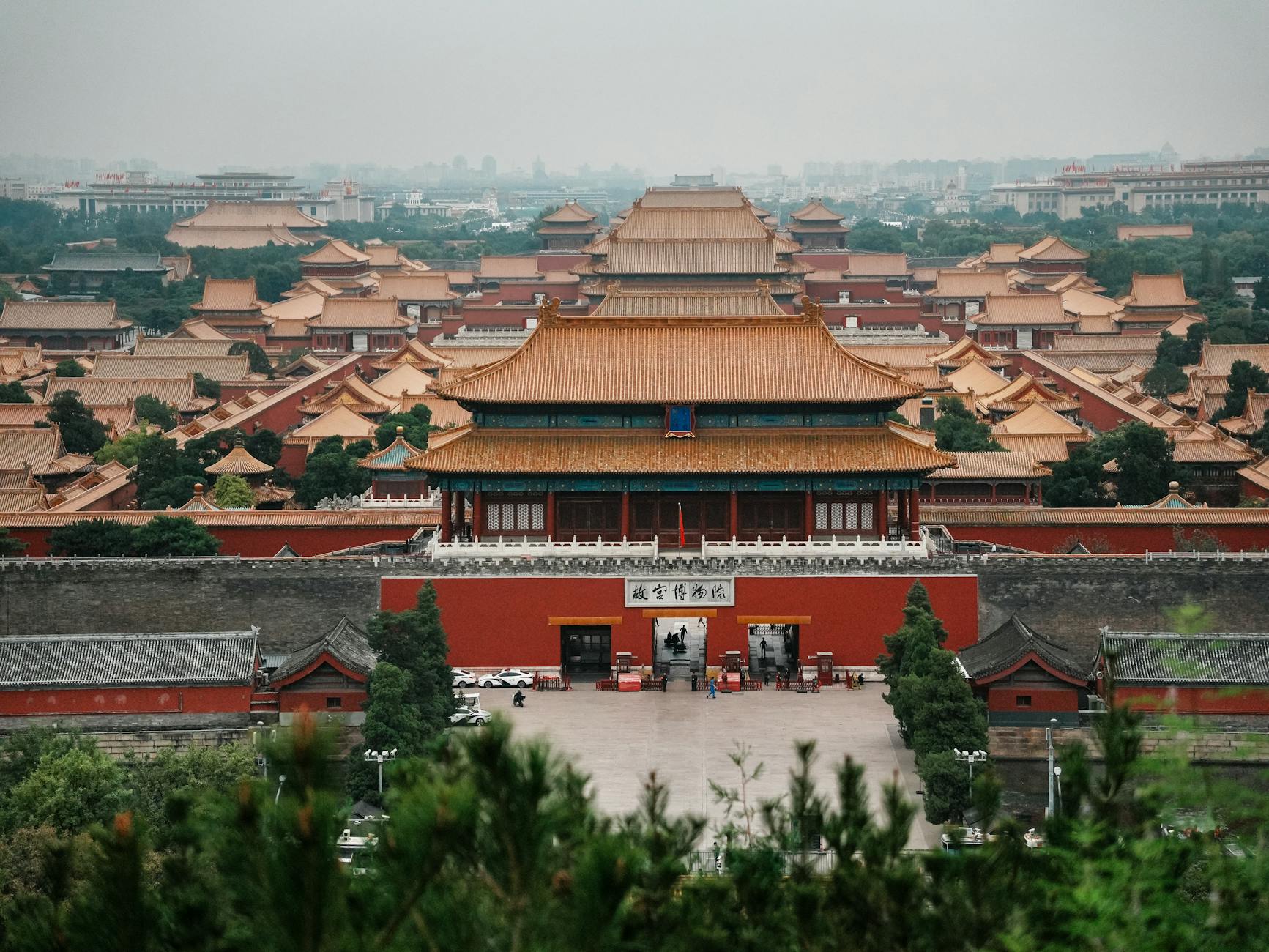
Jingshan Park gives you the single best view in Beijing, and it costs almost nothing. Directly north of the Forbidden City, this compact park is built around an artificial hill — raised from the earth dug out to create the palace moat — and from the Wanchun Pavilion at its summit you look straight down the city’s central axis over the golden sea of Forbidden City rooftops. It’s the photograph that defines imperial Beijing, and reaching it takes a ten-minute climb. As of 2026, entry is a token ¥2 (rising to ¥10 during the spring peony festival), the park opens 6:00am–9:00pm in peak season, and — good news — the mandatory online reservation has been scrapped, so you can simply buy a ticket at the gate with your passport or a QR code.
Save Jingshan for the end of your Forbidden City visit, because you exit the palace at the north gate and the park entrance is right across the street — and the view back over everything you’ve just walked through is the perfect finale. This guide covers the climb and the view, the best timing for sunset and photography, the spring peony festival, the park’s dark historical footnote, tickets and hours, and how to combine it with the palace. For a ¥2 ticket, here’s how to do it. Planning a day trip beyond the centre? The Sacred Way and underground palace at the Ming Tombs, about 42km north, pair beautifully with the Great Wall at Badaling for a full day of imperial history outside Beijing proper.
Jingshan Park at a glance
- Admission
- ¥2 normally; ¥10 during the peony festival (roughly late April–May) and peak summer.
- Hours
- 6:00am–9:00pm peak (last entry 8:30pm); 6:30am–8:00pm off-season (last entry 7:30pm).
- Reservation
- no longer required — buy at the gate by QR code or window with your passport.
- The view
- from the Wanchun Pavilion at the summit, straight down the central axis over the Forbidden City.
- The climb
- about 10 minutes up stone steps to the top of the 45-metre hill.
- Nearest metro
- Line 8 to Shichahai (Exit A2), then a 10-minute walk; or walk straight from the Forbidden City north gate.
- Time needed
- 45–90 minutes.
- Best for
- photographers, sunset chasers, anyone finishing a Forbidden City visit.
The view: why everyone climbs the hill
Jingshan Hill sits on Beijing’s central axis, the great line of symmetry that runs through the heart of the old city, and the Wanchun Pavilion on its summit is the highest point on that axis. Climb up and the city arranges itself around you. Look south and the entire Forbidden City unfolds below — courtyard after courtyard of golden roofs, the only angle from which you grasp the sheer scale of the palace. Turn north and the axis continues to the Drum and Bell Towers; look east to the modern CBD skyline; and west to the White Dagoba of Beihai Park rising above the trees. On a clear day the Western Hills frame the horizon.
This is the view you’ve seen on a hundred postcards and travel posters, and it lands even harder in person — especially right after you’ve spent a morning walking the palace, because now you see the whole of it at once. The climb is short, on stone steps with rest points and lower pavilions along the way, taking around ten minutes at a steady pace.

Best time for the view and sunset
Timing is everything here. For photography, the golden hour before sunset is unbeatable: the low sun lights the Forbidden City roofs gold and the sky deepens behind the palace. But the summit pavilion is small and the railing space is limited, so on clear evenings it gets genuinely crowded — to claim a spot at the south-facing railing you’ll want to be up there at least 45 minutes before sunset, and 30 minutes before for the lovely blue-hour light afterwards.

The quieter alternative is early morning, right at the 6:00am (or 6:30am) opening, when you may have the summit almost to yourself and the air is at its clearest. Morning haze can soften the view, but the calm is worth it. Whatever time you choose, an air-quality check the day before pays off — the view depends entirely on visibility, and Beijing’s clearest days come after wind or rain. For seasonal patterns, see our guide to Beijing’s weather through the year.
The peony festival and the gardens
Jingshan is more than a viewpoint. The lower slopes hold Beijing’s largest peony garden — over 20,000 plants in more than 200 varieties — which bursts into bloom each spring, usually from late April into May, in a riot of pink, white, crimson and gold. The peony festival is one of the loveliest seasonal events in the city, and it’s the one time admission ticks up to ¥10. The peony is China’s traditional “king of flowers,” a symbol of wealth and honour, so the festival has real cultural resonance. Beyond the peonies, the park’s five pavilions on the ridge, ancient cypresses and quiet corners make it a pleasant green space year-round, and like every Beijing park it fills with locals doing tai chi, singing and dancing in the mornings.
A dark footnote: the last Ming emperor
Jingshan carries one of the most poignant stories in Chinese history. In 1644, as rebel armies stormed Beijing and the Ming dynasty collapsed, the last Ming emperor, Chongzhen, climbed this hill and hanged himself from a tree on its slopes rather than be captured — ending 276 years of Ming rule. A marker on the eastern side of the hill commemorates the spot. It’s a quiet, sobering counterpoint to the glorious view: from the same hill where you photograph the palace at its most magnificent, an emperor watched his dynasty fall. The park was an imperial garden, off-limits to the public, until it opened in 1928. To set this moment in the broader sweep of dynastic Beijing, see our overview of the capital’s historic sites.
Getting there and combining your visit
The easiest approach for most people is no transport at all: walk straight out of the Forbidden City’s north gate (the Gate of Divine Prowess) and cross the road — the Jingshan south entrance is right there. This is exactly why the two pair so perfectly, and why it works best to do the palace first and finish on the hill. If you’re coming separately, take Line 8 to Shichahai station (Exit A2) and walk about ten minutes, or grab a taxi or DiDi to the south or east gate. The full network is in our rundown of the subway system.
From Jingshan you’re also a short walk from the imperial garden at Beihai to the west, with its lake and White Dagoba, and from the Shichahai lakes and hutong district to the north. A lovely half-day strings together a morning inside the palace, Jingshan for the view, and Beihai for a relaxed lakeside finish.
Visitor tips
- Do the Forbidden City first, Jingshan last — you exit the palace right at the park gate, and the view back is the perfect ending.
- For sunset, arrive 45 minutes early to claim a railing spot at the summit pavilion.
- Check air quality the day before; the view lives or dies on visibility.
- It’s a real (if short) climb — wear comfortable shoes; there are rest points on the way up.
- Visit in spring for the peony festival, or early morning any time of year for solitude.
- No reservation needed, but carry your passport for ticketing.
The five pavilions and the rest of the hill
The hill is crowned by five pavilions strung along its ridge, built in 1751 under the Qianlong Emperor. The central Wanchun Pavilion (“Pavilion of Everlasting Spring”) is the summit and the prime viewpoint, but the four flanking pavilions — two to each side, descending the ridge — are worth a look too, each once housing a bronze Buddha (most were looted in 1900). Walking the full ridge spreads out the crowds and gives you the view from slightly different angles, including westward over Beihai’s White Dagoba. At the foot of the hill, the Qiwang Lou (Hall of Imperial Longevity) and other halls host occasional exhibitions, and the grounds are dotted with ancient cypresses and, in spring, the famous peonies. It’s a small park, but giving it a full hour rather than a rushed dash up and down lets you enjoy it properly.
Getting the perfect Forbidden City photo
This is the most photographed viewpoint in Beijing, so a few pointers help you come away with the shot. Shoot south from the Wanchun Pavilion for the full palace laid out along the axis — a wide-angle lens captures the whole sweep, while a longer lens compresses the rows of golden roofs into that dense, layered look you see in magazines. Golden hour (the hour before sunset) bathes the roofs in warm light; stay for blue hour afterwards, when the sky turns deep blue and the palace lights begin to glow. Crucially, the view depends on visibility — Beijing’s haze can flatten everything — so pick a clear day, ideally after wind or rain has scrubbed the air. Arrive 45 minutes early to secure railing space, and bring a compact tripod or brace against the railing for the low-light shots (full-size tripods can be awkward in the crush).
A perfect imperial-city afternoon
Jingshan is the linchpin of central Beijing’s best walking day. String it together like this: tour the Forbidden City in the morning, exit the north gate and climb Jingshan for the view around midday or — even better — return for sunset; then walk west to Beihai Park for a boat ride, or north toward the Shichahai lakes and the pair of towers at the axis’s northern end for a hutong dinner. Everything here is within a comfortable walk, all strung along the historic central axis. There’s little food inside Jingshan itself beyond a kiosk or two, so plan to eat in the surrounding neighbourhoods — see our guide to the city’s food scene.
Jingshan and Beijing’s central axis
Standing at the Wanchun Pavilion, you’re at the literal high point of one of the world’s great pieces of urban planning: Beijing’s central axis, a 7.8-kilometre line of symmetry that runs from the Yongding Gate in the south, through the ceremonial square at Tiananmen and the Forbidden City, over Jingshan, to the Drum and Bell Towers in the north. For centuries this axis ordered the entire imperial capital — every important building was arranged along it or balanced symmetrically around it, expressing the Confucian ideals of order, hierarchy and harmony between heaven, emperor and people. In 2024 the axis was inscribed as a UNESCO World Heritage Site in its own right, recognising it as a masterpiece of Chinese capital design. Jingshan was deliberately built at its centre, and the artificial hill was raised partly for feng-shui reasons — to shield the Forbidden City from harmful northern influences. From the summit you can literally trace the axis with your eyes, the Forbidden City to the south and the towers to the north, which makes the view not just beautiful but historically legible.
Practicalities and nearby food
Jingshan is a small park and an easy visit, but a few practicalities help. There are several gates — the south gate (opposite the Forbidden City), the east, west and north — so check which suits your route; the south gate is the obvious choice if you’re coming from the palace. Toilets and a couple of drink kiosks are near the main entrances, but there’s little proper food inside, so plan to eat in the surrounding neighbourhoods. Just north and west lies a wealth of options: the hutongs around Shichahai are full of cafés and small restaurants, and the lanes toward Beihai’s north gate have everything from cheap noodles to courtyard teahouses. For roast duck or a sit-down meal, our Beijing food guide points to the best spots in the area. Allow a little buffer at sunset, too, since the park closes not long after — you don’t want to be hustled down the hill just as the light turns golden.
It’s also worth visiting Jingshan more than once if your schedule allows, because the same view changes completely with the light and weather. A crisp morning gives sharp, clear panoramas; golden hour drenches the roofs in warm colour; and after a snowfall the contrast of gold roofs against white courtyards is unforgettable. Locals treat the park as a daily fixture — you’ll see the same retirees singing in the pavilions and exercising on the slopes whatever the season — and there’s something lovely about experiencing this world-famous viewpoint as part of the rhythm of ordinary Beijing life rather than as a one-off tourist tick-box.
It is worth arriving with a plan if photographs are the point of the climb. The summit pavilion is three deep with tripods by late afternoon, the terraces just below give almost the same angle with a fraction of the people, and a moderate telephoto compresses the roofline in a way a wide lens simply cannot. Our guide to where to point a camera in Beijing sets this viewpoint alongside the moat at dawn, the hutong lanes worth walking and the modern architecture most visitors miss. Jingshan is also the last stop of our one-day Beijing route, for exactly that reason.
From the pavilion you can see several of the city’s other great parks at once: Beihai’s White Dagoba just to the west, the Shichahai lakes to the north-west, and on a clear day the Western Hills beyond. The full guide to Beijing parks covers what each of them costs, how tickets work, and the best season to go.
Jingshan Park FAQ
Is Jingshan Park worth visiting?
Absolutely — it offers the best panoramic view of the Forbidden City anywhere, for just a couple of yuan, and it’s right next to the palace. It’s one of the highest-value stops in Beijing.
Do I need to book in advance?
No. The mandatory online reservation has been removed — you can buy a ticket at the gate by QR code or at the window with your passport.
How hard is the climb?
It’s a short climb of about 10 minutes up stone steps to the 45-metre summit, with pavilions and rest points along the way. Most reasonably mobile visitors manage it comfortably.
When is the best time for sunset photos?
Arrive at least 45 minutes before sunset to secure a spot at the south-facing railing, and stay 30 minutes after for the blue-hour light over the palace. Clear days after wind or rain give the sharpest views.
When is the peony festival?
Roughly late April into May, when the park’s 20,000-plus peonies bloom. Admission rises slightly to ¥10 during the festival, and it’s one of the prettiest seasonal sights in the city.
How does Jingshan combine with the Forbidden City?
Perfectly. You exit the Forbidden City at its north gate and the Jingshan entrance is directly across the road, so finish the palace and climb the hill for the panoramic view back over it.
The bottom line on Jingshan Park
Jingshan Park is the best-value stop in Beijing: a couple of yuan, a ten-minute climb, and the finest view of the Forbidden City in existence. Pair it with the palace — exit the north gate, cross the road, climb the hill — and time it for golden hour if you can, arriving early to claim a railing spot. Come in spring for the peonies, pause at the marker where the last Ming emperor met his end, and you’ll leave with both the iconic photograph and a deeper sense of the city’s history.
Continue west to Beihai Park for a lakeside afternoon, look back over everything from here after touring the Forbidden City, and see the full set of imperial sights in our guide to Beijing’s historical attractions. New to the city? Start with our big-picture guide to Beijing.