Beijing Imperial Landmarks & Historical Sites
Beijing Photo Spots: Viewpoints, Hutongs and the Rules
The viewpoints worth the journey, the imperial corners that actually photograph well, modern Beijing at its most dramatic, and where pointing a camera will get you into trouble.
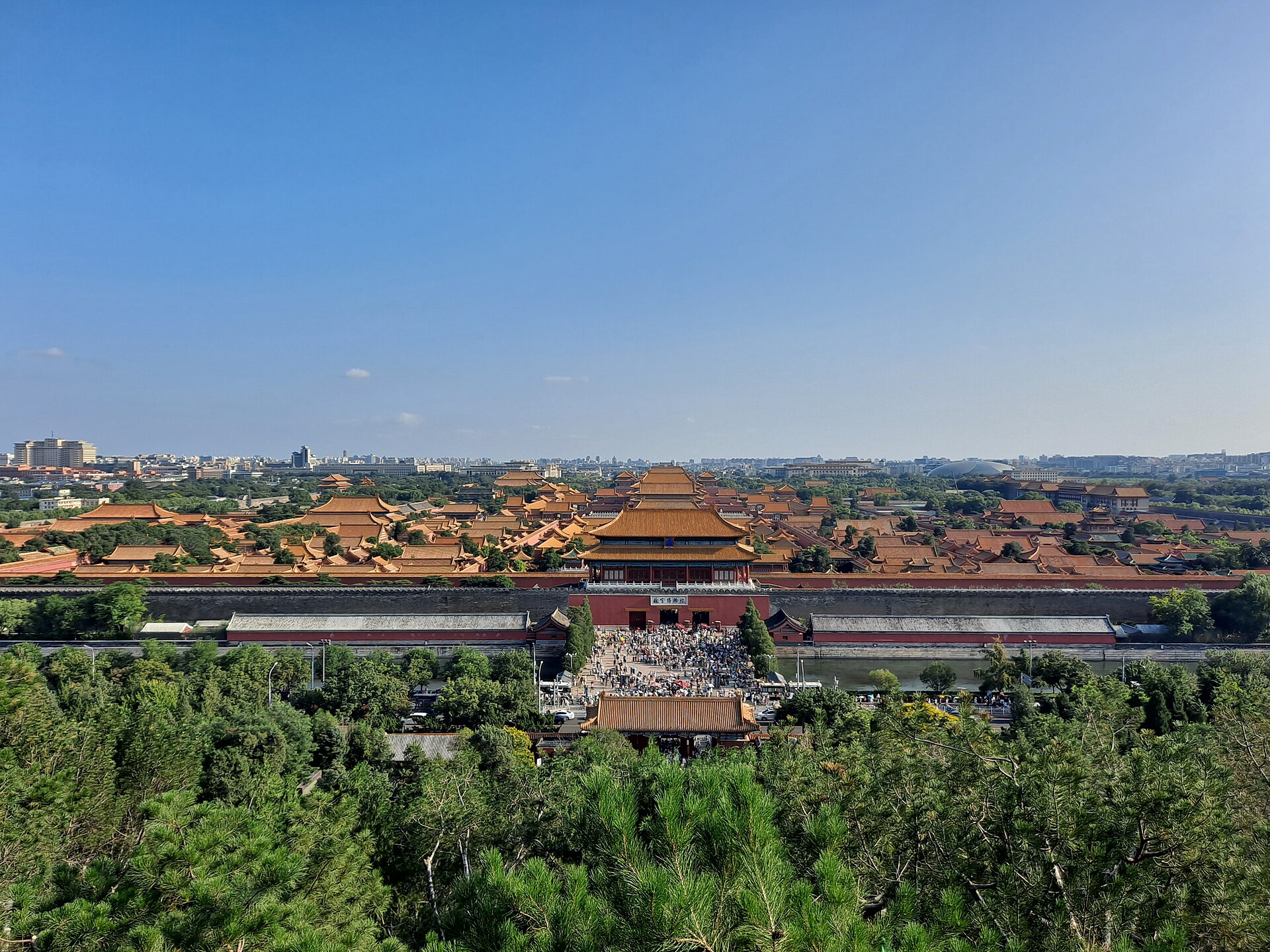
By four o’clock on a clear October afternoon there is a line of tripods along the railing at the Wanchun Pavilion on top of Jingshan, and the people behind them have been there since three. What they are waiting for costs two yuan to reach and takes ten minutes to climb: the entire Forbidden City laid out below in ranks of gold roof, the Western Hills behind it, and about twenty minutes when the light turns everything the colour of the tiles. It is the single best of the Beijing photo spots, and the fact that hundreds of people already know that does not diminish it in the least.
This guide covers the viewpoints worth the journey, the corners of the imperial city that are actually photogenic rather than merely famous, where to find modern Beijing at its most dramatic, how the light and seasons behave, and — importantly — the places where pointing a camera will get you into difficulty. Prices were checked in September 2026; treat them as indicative rather than a quotation.
The ten that earn the journey
- Jingshan Park, for the Forbidden City roofline at sunset.
- The Forbidden City’s north-east corner tower, reflected in the moat at dawn.
- Beihai Park, for the White Dagoba across the lake in late afternoon.
- The Seventeen-Arch Bridge at the Summer Palace, especially in winter.
- The Drum and Bell Towers from the square between them, at blue hour.
- Yandai Xiejie and the Yinding Bridge, where Shichahai narrows.
- Temple of Heaven’s Long Corridor, first thing, full of dancers and card players.
- 798 Art Zone, for Bauhaus sawtooth roofs and painted slogans.
- Galaxy SOHO, for curved white shells and vertiginous atriums.
- The CBD skyline from a rooftop bar, on a day the mountains are visible.
What it costs to shoot the city
| Location | Entry | Notes |
|---|---|---|
| Jingshan Park | ¥2 (¥10 peony festival) | The best value in Beijing. Arrive 90 min before sunset |
| Forbidden City moat and corner tower | Free | Outside the walls. No ticket, no booking |
| Forbidden City interior | ¥60 Apr–Oct, ¥40 Nov–Mar | Online only, 7 days ahead, closed Mondays |
| Beihai Park | ¥10 peak / ¥5 off | Through ticket ¥20 adds Jade Island |
| Summer Palace | ¥30 peak / ¥20 off | Through ticket ¥60 peak / ¥50 off |
| Temple of Heaven | ¥15 park / ¥34 through | The park-only ticket misses the main hall |
| Drum and Bell Towers | Around ¥20–30 each | The square between them is free |
| 798 Art Zone | Free; galleries ¥0–60 | Weekdays much better than Sundays |
| Galaxy SOHO | Free | Public atrium. Subway Line 6, Chaoyangmen |
| Rooftop bar, CBD | ¥80–130 a drink | The view is the cover charge |
| Hanfu rental and shoot | ¥200–600 | Costume, hair and a photographer at a park |
The imperial city
Jingshan Park
Jingshan is the artificial hill built from the earth dug out of the Forbidden City’s moat, directly north of the palace, and it exists — as far as photographers are concerned — to give you the one elevated view of the complex. Two yuan. Ten minutes up.
The pavilion at the summit is where everyone goes and it will be three deep with tripods by late afternoon. Two things help: come up the eastern path, which is quieter, and remember that the terraces just below the summit give you almost the same angle with a fraction of the people. Shoot at a moderate telephoto — 50 to 100mm — to compress the roofs; a wide lens turns the palace into a distant smudge with a lot of foreground trees.
The corner towers and the moat
The best-known photograph of the Forbidden City is not taken inside it. The Jiaolou corner towers — nine-beam, eighteen-column, seventy-two-ridge structures at each corner of the wall — reflect in the moat, and the north-east one at Donghuamen is the classic. It is free, outside the ticketed area, and best at dawn when the water is still and the light comes from the east. In autumn the trees along the moat turn and the whole thing improves considerably.
Inside the walls, the central axis is crowded and shot flat. The rewarding frames are in the eastern courtyards, the Treasure Gallery halls and the narrow lanes between consort palaces, where the crowd is thin and the light falls in slabs between high red walls. Tripods are not permitted inside; a fast lens matters more than a support.
Beihai and the White Dagoba
Beihai Park gives you a Tibetan-style white stupa on an island, reflected in a lake, with willows in the foreground — a composition that works in every season and is at its best in the last hour of light from the eastern shore. ¥10 in peak season, ¥20 for the through ticket that gets you onto Jade Island itself. Rowing boats from the piers put you low on the water, which is a different and better angle than the shore.
The Summer Palace
The Seventeen-Arch Bridge across Kunming Lake is the Summer Palace’s signature, and there is a well-known winter-solstice phenomenon when low sunset light passes through all seventeen arches and lights their undersides. That draws a serious crowd. On ordinary days, late afternoon from the eastern shore is enough. In deep winter the lake freezes solid and people walk out onto it, which gives you foreground and scale that summer cannot.
Temple of Heaven at opening
Go for the people, not the building. The Long Corridor and the surrounding cypress groves at 7am belong to retired Beijingers — ballroom dancing, choirs, card schools, a man writing calligraphy on the flagstones in water that evaporates as he works. It is the most photogenic hour anywhere in the city and it is over by nine. Ask before photographing individuals; almost everyone agrees, and several will want to talk. The full guide covers the ticket options — buy the ¥34 through ticket, not the ¥15 park-only one.
Hutongs and lanes
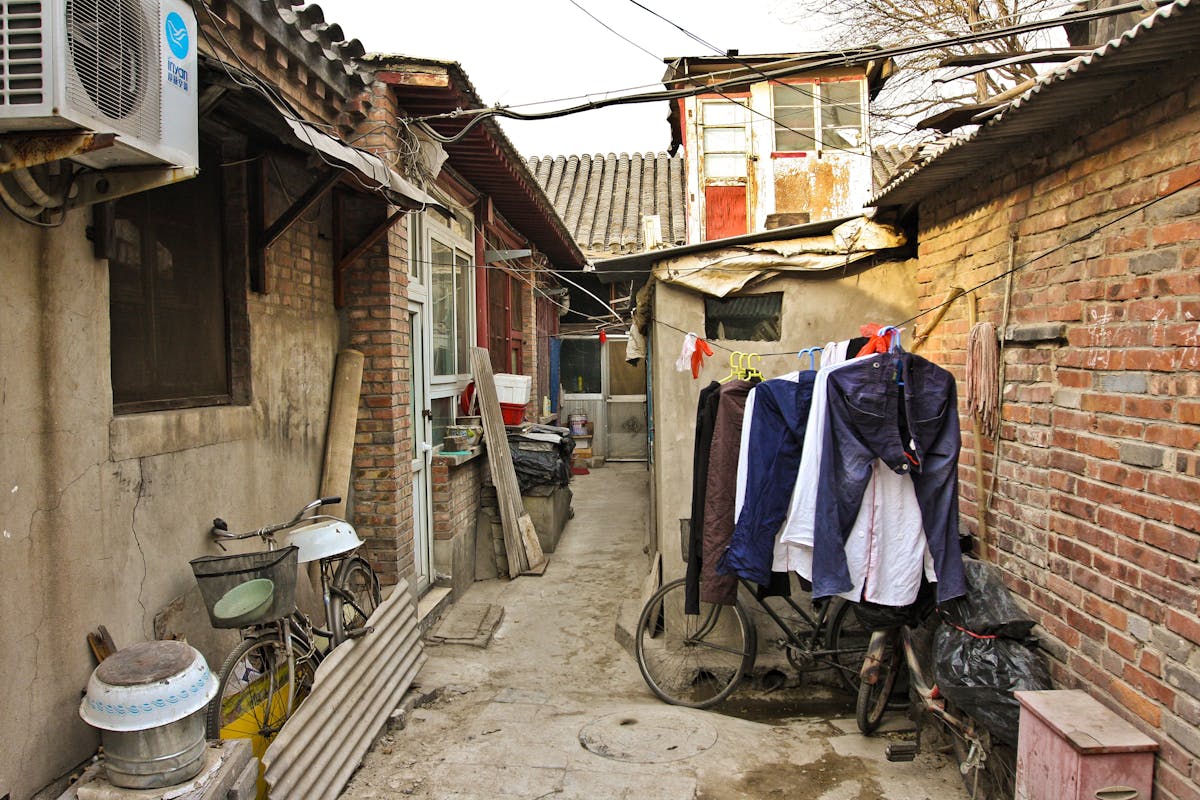
Grey brick, red doors, bicycles, tangled overhead cables and the occasional persimmon tree. Beijing’s alleys are the most photographed thing in the city after the palace, and most visitors photograph the wrong ones.
Nanluoguxiang is now essentially a retail street. Walk it once for the roofline above the shopfronts, then turn off. The lanes running east and west — Mao’er Hutong, Banchang Hutong — are residential, quiet and about ninety seconds away.
Better still, go to the Dongsi hutongs, a grid of numbered alleys east of the Forbidden City that remain genuinely lived in and see very few visitors. Or Shichahai, where Yandai Xiejie runs down to the Yinding Bridge and the lakes open out on both sides — the classic Beijing frame of a stone bridge, willows and a boat.
Two points of etiquette. These are people’s homes: courtyard gates are private, and pushing a lens through one is not acceptable. And the residents are largely elderly and have been photographed a great deal; ask, and accept a refusal without argument. Detail shots — a door knocker, a pair of stone drums, a bicycle against grey brick, a caged bird hanging from a beam — often say more than another wide shot of an alley anyway. The courtyard house guide explains what you are looking at.

Modern Beijing
The city’s contemporary architecture is more interesting than its reputation suggests, and it is nearly all free to photograph from public space.
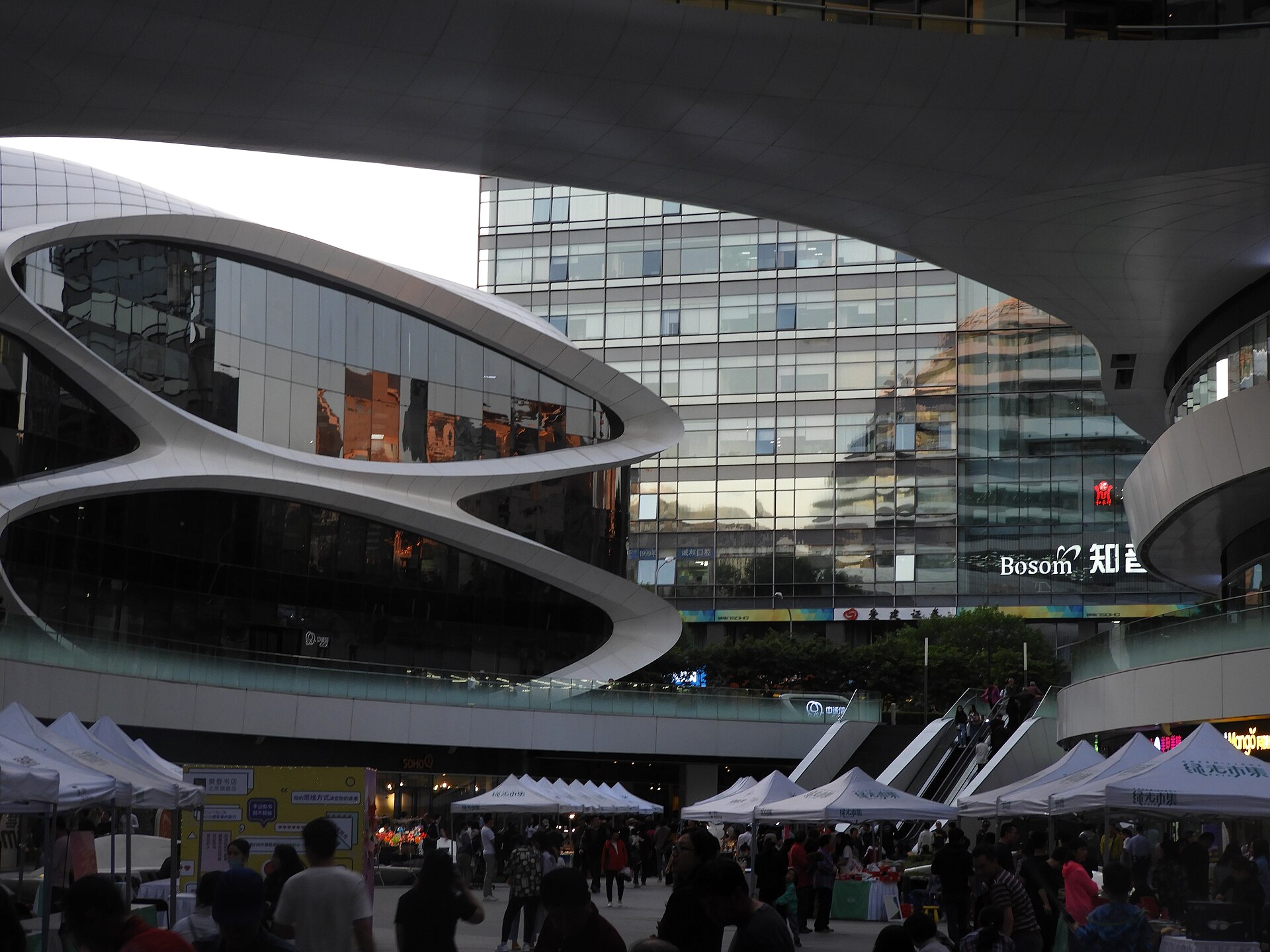
Galaxy SOHO
Zaha Hadid’s four white rounded volumes near Chaoyangmen, connected by curved bridges around a set of stacked atriums. From outside it reads as smooth shells; from inside, looking up through the voids, it becomes something much stranger. Free, open to the public, subway Line 2 or 6 to Chaoyangmen. Best on an overcast day, when the white surfaces hold detail instead of blowing out.
The CBD
The CITIC Tower — China Zun, the tallest building in Beijing — anchors a skyline that is genuinely dramatic on a clear day, with the Western Hills behind it. Rooftop bars in Sanlitun and the CBD give you the elevation; expect ¥80–130 a drink and go about forty minutes before sunset for the transition through blue hour. Nearby, the CCTV Headquarters — the looped tower most people call the Big Pants — is best from street level directly beneath, looking up through the cantilever.
798
798 Art Zone occupies a decommissioned East German-designed electronics factory: vaulted concrete sawtooth halls with north-facing clerestory windows and Cultural Revolution slogans still painted across the roof beams. The industrial fabric is more photogenic than most of the art in it. Weekdays; Sunday afternoons fill with commercial shoots.
Daxing Airport
If you are flying through Daxing, allow an extra hour. The terminal’s radiating roof and the light wells above the central concourse are the most photographed piece of new architecture in China, and you are going to be there anyway.
Temples, markets and the quieter frames
Three places rarely on a photographer’s list that reward one more than most of the headline sights.
Yonghegong, the Lama Temple is the most atmospheric interior in Beijing and the hardest to photograph well. Incense smoke hangs in the courtyards in the first hour after opening and catches the light coming over the roofs, which is the shot. Photography inside the halls is not permitted and the enormous sandalwood Maitreya is off limits, so work the courtyards, the prayer-wheel galleries and the smoke. The ginkgo avenue on the approach turns brilliant yellow in the second half of October.
The Confucius Temple and Guozijian, a few minutes’ walk west, is almost always empty by comparison — stone stelae under ancient cypresses, a courtyard of imperial examination tablets, and no crowd to work around. On a weekday morning you may have it entirely.
Panjiayuan on a Saturday at dawn is the best street photography in Beijing: several thousand stalls of jade, porcelain, Mao badges, birdcages and outright junk, traders unpacking under bare bulbs, and hard early light down the aisles. Ask before photographing traders — most will agree, some will use it to open a sale — and do not photograph money changing hands.
For anything involving people at close range, a small camera and an obvious willingness to show someone the frame afterwards does more for your access than any lens.
Light, season and air
The hours. Beijing’s sightlines are long and its subjects large, which makes the golden hour disproportionately valuable — flat midday light turns grey brick and grey sky into the same tone. Blue hour is short but excellent around the Drum and Bell Towers, at Qianmen, and along the CBD skyline.
The seasons. Late September to early November is the best window: dry, clear, and with autumn colour from mid-October, when the ginkgoes along the Lama Temple approach and the moat trees turn. April brings blossom at Yuyuantan. Winter is bare and cold, and the two or three days after a snowfall — gold roofs under white, which is the photograph everyone wants — are worth rearranging a trip around if you happen to be there.
The air. This decides whether long views work at all. Beijing’s air is now far better than its reputation — a record-low 27 µg/m³ annual PM2.5 average in 2025 — but a hazy day still flattens the CBD skyline and the view from Jingshan into a single grey mass, and no editing recovers it. Check before committing to a viewpoint; the air quality guide explains what to look at.
Where not to point a camera
This is the part worth reading properly, because the rules are stricter than most visitors expect and enforcement is real.
- Military personnel and installations. Photographing soldiers, military vehicles or military buildings is prohibited and taken seriously. This includes the honour guard around Tiananmen.
- Police and security personnel. Not formally forbidden everywhere, but you will be asked to delete the images and it is not a conversation worth having.
- Government buildings and compounds, particularly around Zhongnanhai west of the Forbidden City. Keep walking.
- Inside the Forbidden City’s halls. Flash and tripods are not permitted, and some interiors prohibit photography altogether. Signs are posted.
- Airport security and border areas. Obvious, but the terminal architecture at Daxing is genuinely tempting and the security zones are not.
- Drones, anywhere. The whole Beijing administrative area is controlled airspace requiring prior approval no visitor will obtain, drones must be registered with CAAC under your real name and activated through the UOM app, and rules from May 2026 restrict bringing one into the city at all. Penalties include confiscation and fines of ¥500–10,000. Leave it at home — the Great Wall photography guide covers the same position for the sections outside the city.
Tiananmen Square itself deserves a separate note. Entry requires advance booking, a passport and a security check, bags are scanned, and while ordinary photography of the square and the Gate is normal and widely done, tripods and anything resembling professional equipment attract attention. Keep it to a handheld camera or a phone, do not photograph security personnel, and do not linger near barriers.
Practicalities
Tripods. Fine in parks and on the street, not permitted inside most museum and palace interiors, and restricted at Tiananmen. A compact travel tripod attracts far less attention than a full-size one.
Getting around. The subway reaches nearly everything here and costs ¥3–8 a journey, but it does not run early enough for a dawn shoot at the moat — that is a taxi or a DiDi. Bag scanners at every station will scan a camera bag without comment.
Bookings. The Forbidden City, Tiananmen and most state museums operate real-name reservation: a passport number per person, booked in advance, and popular dates sell out. Carry the physical passport, since gate scanners read the document.
Hanfu shoots. Renting Ming or Tang costume with hair and makeup and having a photographer shoot you at Jingshan or the Temple of Heaven is enormously popular and costs ¥200–600. If that is not your plan, be aware that these shoots occupy the best positions at the best times, particularly at weekends. The hanfu guide covers the studios.
Payment. Every park ticket office, and every rooftop bar, expects Alipay or WeChat Pay. Set both up before you fly. And if you want the history behind the frames rather than just the angles, the imperial landmarks guide covers what you are photographing.
What is overrated
- The Olympic Park at night. The Bird’s Nest lit up is one photograph and about twenty minutes. It is a long way out for that.
- Wangfujing’s snack street. The scorpions on sticks are a prop, priced for tourists, and the photograph is a cliché without being interesting.
- The Forbidden City’s central axis at midday. Crowded, flat and shot to death. The eastern courtyards are where the pictures are.
- Nanluoguxiang. A shopping street with good rooflines. Ninety seconds’ walk gets you somewhere better.
- Sunrise at the Summer Palace. It does not open early enough for the light, and the gate queue is real. Beihai in the afternoon does the same job.
- Paying for a “photography tour” of the hutongs. You can walk them yourself for nothing. A guide is worth it for access and language, not for locations.
A one-day photo route
- 06:30 — Donghuamen and the north-east corner tower, reflected in the moat. Free, empty, best light of the day.
- 07:30 — Temple of Heaven for the dancers and calligraphers, or the Dongsi hutongs as the city wakes.
- 10:00 — 798, or Galaxy SOHO if the sky is flat and you want interiors.
- 13:00 — Lunch, and the middle of the day off. The light is not worth fighting.
- 15:30 — Beihai’s eastern shore for the White Dagoba, or a boat on the lake.
- 17:00 — Jingshan, up the eastern path, in position by 17:30.
- 19:00 — Blue hour at the Drum and Bell Towers, then dinner in the alleys behind them.
Frequently asked questions
What is the best photo spot in Beijing?
Jingshan Park at sunset, looking south over the Forbidden City. Entry is ¥2, the climb takes ten minutes, and no other viewpoint in the city gives you the whole palace roofline with the Western Hills behind it. Arrive ninety minutes before sunset and use the eastern path.
Where can I photograph the Forbidden City without a ticket?
From outside the walls. The Jiaolou corner towers reflected in the moat — the north-east one at Donghuamen especially — are free to shoot and best at dawn when the water is still. Jingshan, to the north, gives the elevated view for two yuan.
Can I fly a drone in Beijing?
No. The whole Beijing administrative area is controlled airspace requiring prior approval that a visitor will not get, every drone must be registered with CAAC under the operator’s real name and activated in the UOM app, and rules introduced in May 2026 restrict bringing one into the city. Penalties include confiscation and fines up to ¥10,000.
Are there places where photography is banned?
Yes. Military personnel, vehicles and installations; government compounds, particularly around Zhongnanhai; the interiors of some halls in the Forbidden City; and airport security zones. Photographing police is unwise even where not formally prohibited. Signs are posted where interiors are restricted.
Is Tiananmen Square difficult to photograph?
Ordinary handheld photography of the square and the Gate is normal. But entry requires advance booking, a passport and a security check, tripods and professional-looking rigs attract attention, and photographing security personnel or lingering at barriers will get you moved on. Keep it simple.
Can I use a tripod?
In parks and on the street, yes. Inside museums and palace halls, generally no. At Tiananmen, expect problems. A compact travel tripod passes unremarked where a full-size one does not.
What is the best time of year?
Late September to early November: dry, clear air and autumn colour from mid-October. April brings blossom. The two or three days after a winter snowfall give you gold roofs under white, which is the best Beijing photograph there is, but snow is uncommon and short-lived.
Which hutongs should I photograph?
Not Nanluoguxiang, which is now a shopping street. The lanes running off it — Mao’er, Banchang — are residential and ninety seconds away. The Dongsi hutongs are better still and much quieter. Ask before photographing residents, and treat courtyard gates as private.
Is there a good rooftop view of the skyline?
The rooftop bars in Sanlitun and the CBD, where a drink at ¥80–130 buys the elevation. Arrive about forty minutes before sunset to get both the daylight skyline and blue hour. Check the air quality first; haze flattens the view entirely.
Do I need a proper camera?
No. Beijing’s subjects are large, well lit and mostly at a distance, which suits a phone well, and a phone attracts less official attention than a large body and lens. The one thing a phone struggles with is the compressed telephoto view from Jingshan, where a 70–200mm makes a real difference.