Beijing Imperial Landmarks & Historical Sites
Summer Palace Complete Tour Guide & Highlights
Plan your Summer Palace visit. Walking routes, boat rides on Kunming Lake, and the most beautiful spots in this imperial garden.

The Summer Palace (Yiheyuan) is one of China’s largest imperial gardens and exceptionally well preserved, and it makes a gentler, greener day after the intensity of the great palace at the city’s centre. Three-quarters of its 290 hectares are water — the vast Kunming Lake — with the rest rising up the wooded slopes of Longevity Hill, crowned by the golden Tower of Buddhist Incense. This was the Qing court’s summer retreat, lavishly rebuilt by the Empress Dowager Cixi, and it remains a masterpiece of Chinese landscape design. As of 2026, the entry ticket is ¥30 in peak season (Apr–Oct) and ¥20 off-season, while the through ticket covering the inner attractions is ¥60 peak / ¥50 off-season. Bring your passport — tickets are real-name and released 7 days ahead.
You can march through the headline sights in two hours or drift around the lake all afternoon, and both work. This guide covers tickets and which one to buy, the best walking route along the famous Long Corridor and up Longevity Hill, the boat rides on Kunming Lake, the quieter back-lake and Suzhou Street, how to get there, and the questions visitors ask most. Whether you want history or just a beautiful place to breathe, here’s how to do it well.
Summer Palace at a glance
- Entry ticket
- ¥30 peak (Apr 1–Oct 31), ¥20 off-season (Nov 1–Mar 31).
- Through ticket
- ¥60 peak / ¥50 off-season — adds the Tower of Buddhist Incense, Garden of Virtue and Harmony, Suzhou Street and Wenchang Gallery.
- Add-ons à la carte
- Tower of Buddhist Incense ¥10, Suzhou Street ¥10, Garden of Virtue and Harmony ¥5, Summer Palace Museum ¥20.
- Hours
- park 6:00am–8:00pm April–October (last entry 7:00pm), 6:30am–7:00pm November–March (last entry 6:00pm); inner sites 8:00am–6:00pm (last entry 5:30pm) in peak season, 8:30am–5:00pm (last entry 4:30pm) off-season. The four paid inner sites close on Mondays except major holidays.
- Boats
- rental from ¥200/hour (¥600 deposit); ticket sales 8:30am–4:30pm.
- Booking
- real-name, passport required, released 7 days ahead.
- Nearest metro
- Beigongmen (Line 4) for the North Palace Gate.
- Time needed
- 2 hours for highlights; half a day to savour it.
Tickets: entry versus the through ticket
The basic ¥30 entry ticket gives you the run of the grounds — the lake, the Long Corridor, Longevity Hill’s exterior, the bridges and gardens. That’s already a lot, and for many visitors it’s enough. The through ticket at ¥60 bundles in the four paid interior sites: the Tower of Buddhist Incense (the big climb for the best view), the Garden of Virtue and Harmony with its imperial theatre, Suzhou Street, and the Wenchang Gallery.
My honest take: if you want to climb the Tower of Buddhist Incense for the panorama over Kunming Lake — and you should — the through ticket is worth it, because the tower alone plus a couple of the others adds up to more than the bundle. If you’re short on time or just want to wander the lakeside, the basic entry ticket is fine. Either way, tickets are real-name and tied to your passport, released seven days in advance, so carry your passport and book ahead in peak season.
A brief history
The garden’s origins go back to the 12th century, but the Summer Palace as we know it took shape under the Qianlong Emperor in the 1750s, who enlarged Kunming Lake and modelled scenes on the famous landscapes of southern China. It was twice devastated — burned by British troops in 1860 and damaged again in 1900 — and twice rebuilt. The driving force behind the reconstruction was the formidable Empress Dowager Cixi, who famously diverted funds intended for the imperial navy to restore her summer retreat, even building a marble boat on the lakeshore as a pointed monument. She spent her summers here directing the affairs of a crumbling dynasty from its most beautiful setting. It became a UNESCO World Heritage Site in 1998. For the bigger story, see our rundown of Beijing’s imperial sites.
The highlights, in walking order
The Long Corridor
Running 728 metres along the north shore of the lake, the Long Corridor is the spine of the garden, and in 1992 it earned a place in Guinness World Records. Every beam and crossbeam is painted — more than 14,000 individual scenes of landscapes, flowers, birds and stories from Chinese literature. It’s a covered, shaded stroll the whole length of the lakefront, which makes it a blessing in summer heat or light rain. Take your time and look up.
The Tower of Buddhist Incense and Longevity Hill
Halfway along the corridor, a steep climb leads up Longevity Hill through the Hall of Dispelling Clouds to the Tower of Buddhist Incense, the octagonal landmark you see from across the lake. The climb is the only real exertion of the visit, but the reward is a sweeping view over the garden: Kunming Lake spread out below, the Seventeen-Arch Bridge in the distance, and on a clear day the Western Hills beyond. This is the photo you came for.

Kunming Lake and the Seventeen-Arch Bridge
The lake makes up three-quarters of the park, and getting out onto it — or walking its causeways — is half the pleasure. The Seventeen-Arch Bridge sweeps gracefully out to South Lake Island and is one of the most photographed spots in the garden, especially at sunset when light pours through all seventeen arches. The western West Causeway, modelled on Hangzhou’s West Lake, is gloriously quiet and lined with willows and six elegant bridges — skip it if you’re rushed, savour it if you’re not.
The Marble Boat and the back lake
At the northwest corner sits Cixi’s notorious Marble Boat, a lakeside folly of carved stone. From here you can cross to the tranquil back lake and Suzhou Street, a recreated canal-side shopping street where eunuchs and palace staff once played-acted at commerce for the imperial family’s amusement. The back of the hill is far quieter than the lakefront and worth the detour if you have time.
Boat rides on Kunming Lake
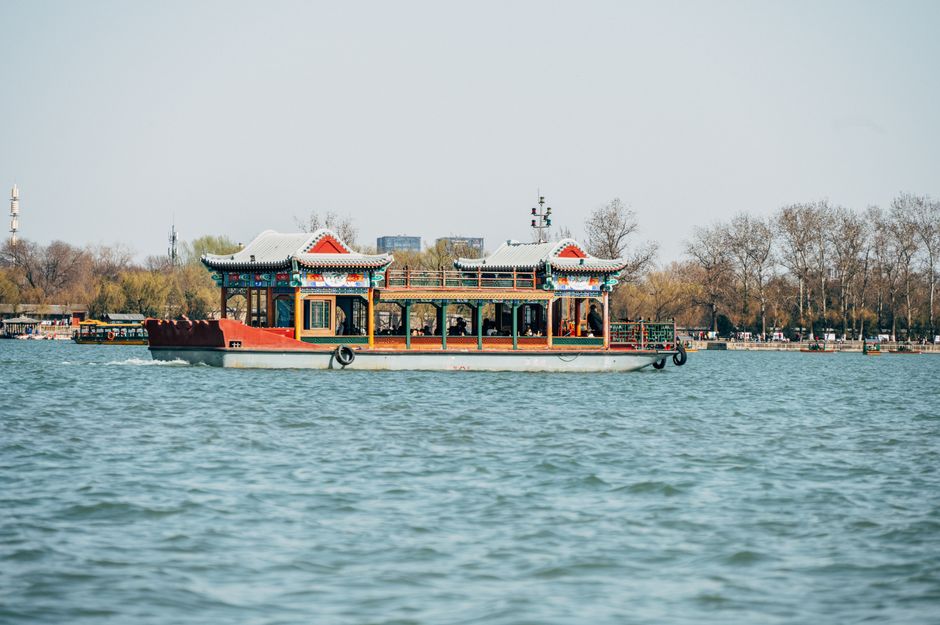
You can experience the lake two ways. Six-seat self-drive electric boats rent for ¥200 per hour with a ¥600 refundable deposit, picked up at the Yulantang, Wenchang Pavilion and Bafang Pavilion docks — a lovely, low-effort way to see the garden from the water. Or take the larger dragon-boat ferries that cross between the north shore and South Lake Island near the Seventeen-Arch Bridge, which double as a handy shortcut if your legs are tired. Boat ticket sales run 8:30am–4:30pm. On a warm afternoon, an hour on the water is the highlight of many visitors’ day.
Getting there and the best route
The simplest approach is the North Palace Gate, served by Beigongmen station (Line 4). Entering here you come over the back of Longevity Hill, can take in Suzhou Street and the back lake first, then crest the hill at the Tower of Buddhist Incense and descend to the lakefront — a satisfying route that saves the big view and the lake for the second half. Alternatively, the East Palace Gate (a short walk or bus from Xiyuan station) is the grand traditional entrance and puts you straight at the Hall of Benevolence and Longevity and the head of the Long Corridor. The full network is laid out in our guide to getting around underground.
The Summer Palace sits in the city’s northwest, near the university district and not far from the Old Summer Palace ruins (Yuanmingyuan), which you can combine if you have a full day. It also pairs naturally with a relaxed afternoon — many people do the Summer Palace in the morning and a central imperial garden like Beihai, beside the Forbidden City, later, or vice versa.
Visitor tips
- Go early or late. Midday weekends are very busy; early morning and the last two hours before closing are calm and beautifully lit.
- Wear comfortable shoes — distances here are real, and Longevity Hill is a genuine climb.
- Buy the through ticket if you want to climb the Tower of Buddhist Incense (you do).
- Combine walking and a boat: walk the Long Corridor and hill, then ferry back across the lake to rest your legs.
- Autumn and late spring are sublime — see our calendar of Beijing’s best months.
- Bring water and a hat in summer; much of the lakefront is exposed.
The Summer Palace through the seasons
Few places in Beijing change so dramatically with the calendar. Spring brings blossom — peach and cherry along the lake, willows greening the causeways — and is arguably the prettiest time of all. Summer fills the lake with boats and the back-lake inlets with lotus, though it’s also the hottest and busiest; come at opening. Autumn brings crisp air and golden foliage on Longevity Hill below the Tower of Buddhist Incense, and it is a fine season, too, for the rooftop view from the hill just north of the Forbidden City. Winter empties the place out and, when Kunming Lake freezes solid, locals come to skate and slide on the ice beneath the snow-dusted pavilions — a magical, uncrowded scene, though the boats stop running. Off-season tickets are cheaper too. For the bigger picture, see the best time to visit Beijing.
Combining with the Old Summer Palace
Just a kilometre east lies the Old Summer Palace (Yuanmingyuan), a separate site with a very different mood. Once an even grander imperial garden-palace, it was looted by Anglo-French forces in 1860 and then burned by British troops, and its evocative marble ruins — particularly the European-style fountains designed by Jesuit architects — have been left as a national memorial to that humiliation. It’s a poignant, beautiful, far quieter complement to the restored splendour of the Summer Palace, and the two pair naturally into a full day in the northwest. If you have the time and any interest in modern Chinese history, do both.
Dining and practicalities
There’s a famous historic restaurant, the Tingliguan (Listening to Orioles Pavilion), inside the grounds, serving imperial-style cuisine in an atmospheric lakeside setting — pricey but a memorable lunch. Otherwise food inside is limited to snack kiosks, so eat before or after; the university district nearby (Haidian) has endless casual options, and our survey of Beijing’s restaurants and street food points the way. Practical notes: the park is genuinely large and involves real walking plus the hill climb, so wear good shoes and pace yourself; combining a walk one way with a ferry back across the lake saves your legs. Toilets are dotted throughout but cluster near the main gates and the Tower of Buddhist Incense. And as everywhere in Beijing’s imperial sights, carry your passport for ticketing. Planning a day further afield? The thirteen Ming imperial tombs, in Changping about 42 km north-northwest of the city centre, combine well with the Great Wall at Badaling and offer a quieter taste of imperial history outside the city centre.
The Seventeen-Arch Bridge and South Lake Island
If you have time for one detour beyond the main sights, make it the Seventeen-Arch Bridge at the southeastern end of Kunming Lake. Built in the 18th century and stretching 150 metres to South Lake Island, it’s carved with more than 500 stone lions along its balustrades — no two quite alike — and its long, graceful curve is one of the most photographed sights in the whole garden. There’s a famous phenomenon here too: around the winter solstice, the setting sun aligns so that golden light pours through all seventeen arches at once, an effect photographers travel specially to capture. South Lake Island itself holds the Dragon King Temple, where emperors once prayed for rain. Reaching the bridge involves a longer walk along the eastern shore or a quick hop on a cross-lake ferry, and far fewer visitors make it this far, so you’ll often have the views largely to yourself. Our roundup of the city’s best photo spots covers where else an alignment like that is worth chasing.
For a deeper appreciation of the garden’s design, look for the way it borrows scenery from beyond its walls — the distant Western Hills and the Jade Spring Hill pagoda are deliberately framed by the layout, a classic technique of Chinese landscape gardening called “borrowed views.” The West Causeway, modelled on Hangzhou’s famous West Lake, was Qianlong’s homage to the celebrated southern landscapes he admired on his tours. Once you start noticing these intentions, the Summer Palace reveals itself not as a random collection of pretty pavilions but as a carefully composed three-dimensional painting meant to be walked through.
One practical note for planning: the Summer Palace is genuinely enormous, and trying to see every corner in a single visit leads to exhaustion rather than enjoyment. If you have only a couple of hours, focus on the eastern half — the historic halls, the Long Corridor, the climb to the Tower of Buddhist Incense, and the Marble Boat — and save the western causeways and South Lake Island for a return trip or a more leisurely day. Pace yourself, use the ferries to cut out backtracking, and build in a tea break at one of the lakeside pavilions. The garden was designed for unhurried imperial leisure, and it rewards visitors who slow down to match.
On a short trip this is an afternoon rather than a morning, and it is best entered from Beigongmen so the climb over Longevity Hill comes before the Long Corridor rather than after it. A three-day plan for the city sets out where that afternoon fits and what it costs alongside everything else.
Two stops down Line 4 is the garden that was the emperors’ real home before 1860. Yuanmingyuan was burned in October 1860 and, unlike the Summer Palace, never rebuilt as a complete palace, though some of its temples have been restored; the Old Summer Palace guide covers its Western Mansions ruins, the ¥25 through ticket, and how to fit both gardens into one long day.
There is also an older way to arrive. The Royal River boat runs from the dock at Beijing Zoo up the Changhe, the waterway the Empress Dowager Cixi used every summer, to the South Ruyi Gate in about an hour; the Beijing Zoo guide covers pairing the pandas at opening with a late-morning sailing here.
Summer Palace FAQ
How long do I need at the Summer Palace?
Two hours covers the Long Corridor, Longevity Hill and the lakefront at a brisk pace. To enjoy a boat ride, the back lake and the quieter causeways, give it half a day.
Is the through ticket worth it?
Yes if you want to climb the Tower of Buddhist Incense for the panorama, which is the garden’s signature view. If you only plan to stroll the lakeside, the basic ¥30 entry ticket is enough.
Which gate should I use?
The North Palace Gate (Beigongmen, Line 4) is the easiest by metro and gives a great over-the-hill route. The East Palace Gate is the grand traditional entrance near the historic halls. Either works well.
Can I rent a boat on Kunming Lake?
Yes — self-drive electric boats seating six cost ¥200 an hour plus a ¥600 deposit, and larger ferries cross the lake. Boat sales run 8:30am to 4:30pm.
Is the Summer Palace good in winter?
It’s beautiful and uncrowded, and the frozen lake is a sight in itself, but the boats don’t run and the climb can be icy. Dress very warmly. Off-season tickets are cheaper too.
Is it suitable for older visitors or those with limited mobility?
The lakefront and Long Corridor are flat and easy, and the ferry can replace a lot of walking. The climb up Longevity Hill is the only strenuous part and can be skipped while still enjoying most of the garden.
The bottom line on the Summer Palace
The Summer Palace is the most relaxing of Beijing’s great imperial sights and a perfect antidote to a heavy day of palaces and crowds. Carry your passport, buy the through ticket if you want the tower view, walk the painted Long Corridor and climb Longevity Hill for the panorama, then drift back across Kunming Lake by boat. Come early or late to dodge the crowds, and don’t rush — this is a place built for lingering.
Pair it with the central Beihai Park for a day of imperial gardens, or the circular halls of the Temple of Heaven for the architectural counterpoint. For the full picture, see our guide to Beijing’s historical attractions, and to map out your days, our start-to-finish guide to the city.