Beijing Imperial Landmarks & Historical Sites
Temple of Heaven: Architecture, History & Visitor Guide
Discover the Temple of Heaven's stunning architecture and fascinating history. Tickets, best times, and what not to miss.
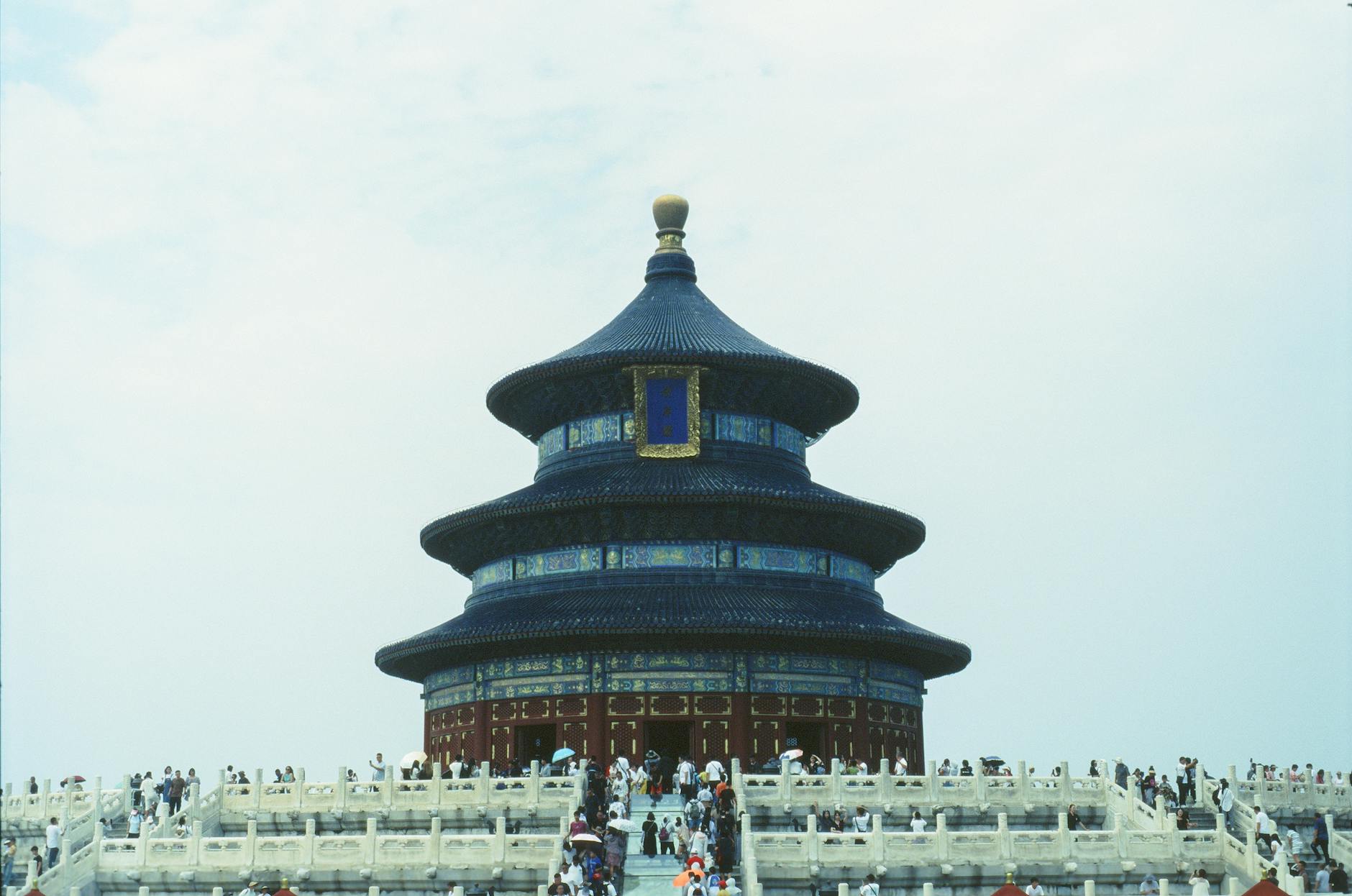
The Temple of Heaven (Tiantan) is the most perfect piece of architecture in Beijing, and one of the most relaxing places to spend a morning in the whole city. For nearly five centuries, Ming and Qing emperors came here to offer sacrifices to Heaven and pray for good harvests, with the winter-solstice rite among the great ceremonies of the imperial year. The result is a sublime complex of round halls and marble altars set in a vast park where, today, thousands of locals come to dance, sing, play cards and practise tai chi. As of 2026, park entry is just ¥15 in peak season and less off-season, while the through ticket that includes the three historic halls is ¥34 in peak season (Apr–Oct) and ¥28 off-season. Foreign visitors book with a passport, online or at the ticket office, so bring it along.
Come here after the Forbidden City and the contrast is wonderful: where the palace is overwhelming, the Temple of Heaven is serene and human. This guide covers tickets and the all-important through ticket, opening hours, the architecture and acoustics that make the place special, the best walking route, the famous early-morning park life, and the questions visitors ask most. Come early, take your time, and you’ll understand why this is many people’s favourite sight in the city.
Temple of Heaven at a glance
- Park entry
- ¥15 in peak season, less off-season — lets you into the grounds but not the historic halls.
- Through ticket
- ¥34 peak (Apr 1–Oct 31), ¥28 off-season (Nov 1–Mar 31) — covers the park plus the Hall of Prayer for Good Harvests, the Imperial Vault of Heaven and the Circular Mound Altar. Get this one.
- Opening hours
- the park and the historic halls keep separate hours that vary with the season, so check the current times on the Beijing government’s Temple of Heaven visitor page. The historic scenic areas close on Mondays except statutory holidays; the park itself stays open.
- Booking
- digital ticketing, passport required for foreign visitors.
- Best entrance
- East Gate (Tiantandongmen, Line 5, Exit A) for the historic buildings.
- Time needed
- 2–3 hours including a relaxed walk through the park.
- Best for
- architecture lovers, photographers, early risers who want to see real Beijing park life.
Tickets: always buy the through ticket
This is the single most common mistake here. The ¥15 park ticket gets you through the gate and into the lovely grounds — but it does not let you into the three iconic structures everyone comes to see. For an extra ¥19 in peak season the through ticket (联票) covers the Hall of Prayer for Good Harvests, the Imperial Vault of Heaven with its Echo Wall, and the Circular Mound Altar. Buy the through ticket. There is no reason not to, and you’ll kick yourself if you arrive at the famous blue-roofed hall holding only a park ticket.
Tickets are sold online and at the ticket offices, and foreign visitors book online with a passport. You can book through the official WeChat mini-program or buy on arrival at the East Gate machines and windows using your passport. Unlike the Forbidden City, the Temple of Heaven rarely sells out, so advance booking isn’t critical — but having your passport on you is.
A sacred geometry: history and meaning
The Temple of Heaven was built in 1420, the same year the Forbidden City was completed, under the same Yongle Emperor. Its purpose was immense: this was where the Son of Heaven communicated with Heaven itself. Each winter solstice the emperor would travel here in a silent procession, fast, and perform elaborate rituals on the Circular Mound Altar to secure the favour of Heaven for the coming year, and he returned to pray for good harvests. A failed harvest could be read as a sign Heaven had withdrawn its mandate, so the stakes were nothing less than the legitimacy of the dynasty.
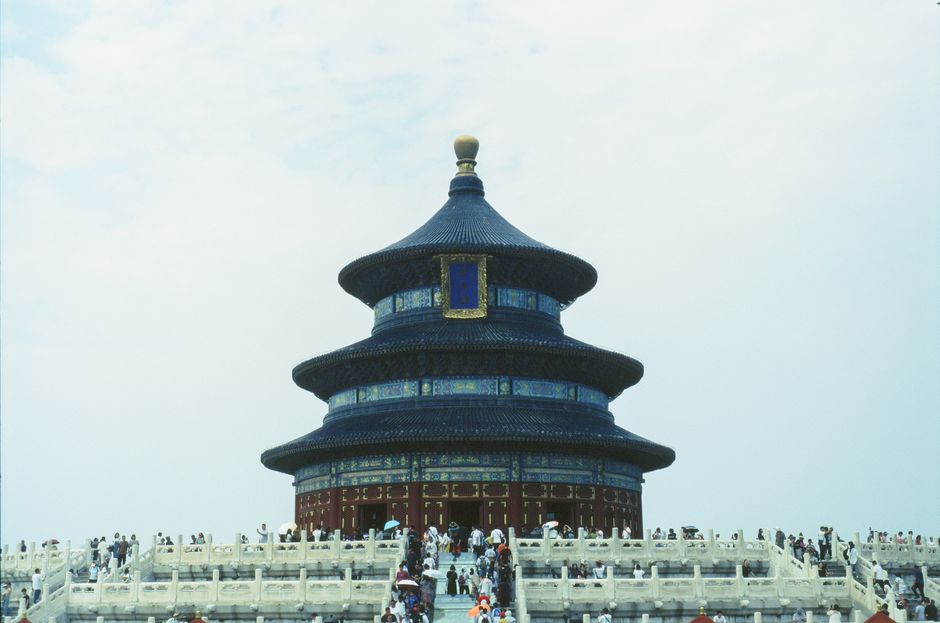
The whole complex is a model of the Chinese cosmos. The round halls and altars represent Heaven; the square enclosing walls represent Earth — and notice how the northern walls are rounded while the southern ones are squared, mirroring the ancient belief that “heaven is round and earth is square.” Numbers carry meaning everywhere, especially the number nine and its multiples, the most yang and imperial of figures. It became a UNESCO World Heritage Site in 1998. To set it among the city’s other great monuments, see our walk through Beijing’s dynastic landmarks.
The three things you must see
The Hall of Prayer for Good Harvests
This is the building on every Beijing postcard: a 38-metre, triple-eaved circular hall with deep-blue glazed tiles, raised on a three-tiered marble terrace. What astonishes most is that it was built entirely of wood, without a single nail, and held up by an ingenious system of interlocking timbers. Inside, four central pillars represent the seasons, and two rings of twelve pillars represent the months and the traditional two-hour periods of the day. It burned down after a lightning strike in 1889 and was faithfully rebuilt. Stand back on the axis to take it in whole — it’s even more striking in person than in photographs.

The Imperial Vault of Heaven and the Echo Wall
A smaller single-roofed version of the great hall, the Imperial Vault of Heaven stored the sacred tablets used in the ceremonies. It’s encircled by the famous Echo Wall, a smooth circular wall with acoustics so precise that, in theory, a whisper spoken against it travels clear around to the other side. In practice the crowds usually drown the effect, but it’s a charming experiment if you catch a quiet moment. Look too for the Triple-Sound Stones on the path, where a clap echoes once, twice, then three times.
The Circular Mound Altar
The southernmost and most sacred structure is an open, three-tiered marble altar where the solstice ritual actually took place — there was no roof, because here the emperor stood directly beneath Heaven. At its centre is the Heart of Heaven Stone; stand on it and speak, and your voice resonates back at you, amplified by the surrounding balustrades. The entire altar is built around multiples of nine: nine rings of stones, the innermost of nine slabs, expanding outward to eighty-one in the outer ring.
The park: tai chi, dancing and real Beijing life
The temples are only half the reason to come. The other half is the park itself, especially in the early morning, when Beijing’s retirees come out to exercise. Under the ancient cypresses you’ll find groups doing tai chi and qigong, ballroom dancers gliding across the pavements, choirs belting out revolutionary songs, people playing jianzi (a feathered shuttlecock kicked between players), calligraphers writing water-characters on the stone, and fiercely competitive card and chess games. It’s warm, communal, completely unselfconscious, and it’s the best window into everyday Beijing life you’ll find anywhere in the city. Wander the corridors west of the main axis, especially the Long Corridor, to see it at its liveliest.
Suggested route and getting there
Enter at the East Gate (Tiantandongmen station, Line 5, Exit A), which drops you closest to the historic buildings. From there a clean route runs: through the Long Corridor (catch the morning park life) → the Hall of Prayer for Good Harvests → south along the central axis to the Imperial Vault and Echo Wall → finishing at the Circular Mound Altar. Exit at the South Gate, or loop back through the western park if you want more of the dancing and singing. The whole walk is flat and easy. The full network is in our explainer on the metro system.
Timing-wise, the temples open at 8:00am while the park opens at dawn — so the ideal plan is to enter the park around 7:30–8:00am, soak up the morning activity, then move to the halls right as they open and beat the tour groups. For seasonal advice across the city, see our look at how the seasons play out here.
Visitor tips
- Buy the through ticket, not the ¥15 park-only ticket — covered above, but it’s the mistake everyone makes.
- Come for opening to catch the park life and avoid the midday halls crowds.
- Bring your passport for the digital ticketing system.
- Allow 2–3 hours; the park is large and the axis from north to south is a real walk.
- The halls and the park keep separate hours, and both shift with the season, so check closing times before planning a late visit; the grounds are lovely for a quiet stroll even without hall access.
- Pair it with a nearby meal; the Hongqiao Pearl Market is a short walk from the East Gate if you want to combine it with shopping.
More to explore beyond the main axis
Most visitors march the central axis and leave, but the park hides several worthwhile corners. To the west of the Hall of Prayer stands the Fasting Palace (Zhai Gong), the moated compound where the emperor purified himself with three days of fasting before the solstice ceremony — a quiet, often-empty complex that rewards the detour. Look too for the ancient cypress grove, some trees over 500 years old, including the famous gnarled “Nine-Dragon Juniper”, about 600 years old, outside the northwest corner of the Echo Wall, its trunk twisting like coiled dragons. The Long Corridor on the eastern side, originally used to carry sacrificial offerings to the altar, is now the social heart of the morning park, lined with locals playing cards, singing and practising erhu. Allowing time for these turns a 90-minute tick-box visit into a genuinely rich morning.
Photography and the best light
The Hall of Prayer for Good Harvests faces south, so morning and midday light hits its facade beautifully — but the cleanest shots, without crowds spilling into frame, come right at opening. For a classic composition, stand on the central axis south of the hall and shoot straight up the marble staircase to centre the building’s perfect symmetry. The deep-blue roof tiles photograph best against a clear sky, so save the temple for one of Beijing’s bright, wind-scrubbed days; check air quality the night before. Inside the round halls, the painted ceilings and the dragon-and-phoenix caisson reward a look straight up. The Echo Wall and the resonating stones are more about experience than photos, but the curved wall itself makes a pleasing frame. It is one of the ten frames worth planning a morning around in our Beijing photo guide.
Where to eat and what to combine
The Temple of Heaven sits in the southern part of the old city, and the area around the East Gate has plenty of casual restaurants and the Hongqiao (Pearl) Market for a browse afterwards. For something more memorable, the temple is within striking distance of the Qianmen and Dashilan district to the northwest, home to historic shops and old Beijing snacks — pair the two for a half-day. Many visitors do the temple in the morning and roast duck for lunch; our roundup of the city’s duck houses and other classics covers where to find the best. Because the park is flat, central and not too large, it also slots neatly into an itinerary alongside Tiananmen and its surrounding monuments and the emperors’ walled city to the north.
What the solstice ceremony involved
To really understand the Temple of Heaven, it helps to picture what happened here on the longest night of the year. In the days before the winter solstice, the emperor would withdraw to the Fasting Palace to purify himself — no meat, no wine, no music, no contact with the business of state. Before dawn on the solstice, he processed in near-total silence to the Circular Mound Altar, dressed in ceremonial robes of a kind still preserved among the Forbidden City’s imperial treasures, to make offerings of animals, jade and silk and to read prayers to Heaven by torchlight. Every gesture was prescribed, every number significant, and the entire court held its breath: a flawless ceremony reaffirmed the emperor’s role as the link between Heaven and the human world, while any error was an ill omen. The ritual was performed for the last time in the early 20th century, but standing on the Heart of Heaven Stone today — where the emperor once knelt — you’re occupying the exact spot where imperial China believed earth touched the sky. It’s a quietly powerful thing to know as you walk the axis, and it transforms three handsome old buildings into something far more profound.
The entire park, too, was designed as an instrument for the imperial rites, from the winter-solstice sacrifice to the prayers for good harvests. The long raised causeway (the Danbi Bridge) that connects the Circular Mound Altar to the Hall of Prayer was built so the emperor could process northward, symbolically ascending toward Heaven; it slopes gently upward as you walk it. The separation of the round, southern altar (for the solstice sky rituals) from the northern hall (for spring harvest prayers) reflects the two distinct ceremonies the complex hosted. Knowing the logic behind the layout turns a pleasant stroll into a reading of the imperial Chinese cosmos, written in marble and blue tile.
Fitting this into a short trip is mostly a question of which morning you give it, since the park before nine and the park at eleven are barely the same place. It sits on the third morning of our three-day Beijing route, paired with the Summer Palace in the afternoon.
The Temple of Heaven is not the only Beijing park with a morning scene. Our overview of Beijing’s parks covers where to find park life across the city, which parks are free, and how to book the imperial ones online.
Temple of Heaven FAQ
What’s the difference between the park ticket and the through ticket?
The ¥15 park ticket only lets you into the grounds. The through ticket (¥34 peak / ¥28 off-season) adds the three historic structures — the Hall of Prayer for Good Harvests, the Imperial Vault of Heaven and the Circular Mound Altar. Always buy the through ticket.
Do I need to book in advance?
Not usually — unlike the Forbidden City, the Temple of Heaven rarely sells out, so you can buy on arrival. But the system is digital and foreign visitors need a passport to register, so always carry yours.
How long should I spend here?
Two to three hours is ideal: enough for the three main structures plus a relaxed walk through the park to enjoy the morning activity. History buffs and photographers could easily spend longer.
When is the park life at its best?
Early morning is the time to look for the dancing, singing and tai chi groups. By mid-morning the locals disperse and the tour groups arrive.
Is the Temple of Heaven good for kids?
Yes — the open park, the Echo Wall acoustics and the resonating stones are genuinely fun for children, and there’s room to run around. See our advice on what works for younger travellers for more family-friendly planning.
Can I visit on the same day as the Forbidden City?
It’s possible but a lot for one day — both are large. Giving each its own morning is the easier plan. If you must combine, do the Forbidden City first thing, then the Temple of Heaven park in the afternoon, after checking its closing time. Planning a day outside the city? The Ming dynasty’s mountain tomb valley, where 13 emperors are buried in Changping, about 42 km north-northwest of the city centre, pairs perfectly with the Great Wall at Badaling for a memorable full-day trip.
The bottom line on the Temple of Heaven
The Temple of Heaven is the architectural high point of Beijing and its most peaceful great sight. Come for opening, buy the through ticket, catch the dancers and tai chi practitioners in the park, then walk the sacred axis from the blue-roofed Hall of Prayer for Good Harvests down to the open marble altar where emperors once stood beneath Heaven itself. Budget two to three unhurried hours and you’ll leave calmer than you arrived — which is exactly what the place was designed for.
Pair it with the nearby Forbidden City and the Qing court’s garden retreat in the northwest for the classic trio of imperial Beijing. For the full overview, see our guide to Beijing’s historical attractions, and if you’re still shaping your itinerary, start with our guide to putting a Beijing trip together.