Beijing Parks & Gardens
The Old Summer Palace (Yuanmingyuan): Ruins, History and Visiting Guide
The imperial garden British and French troops burned in 1860: what is left to see, which of the four tickets to buy, how to book, and why the ruins mean so much to Chinese visitors.
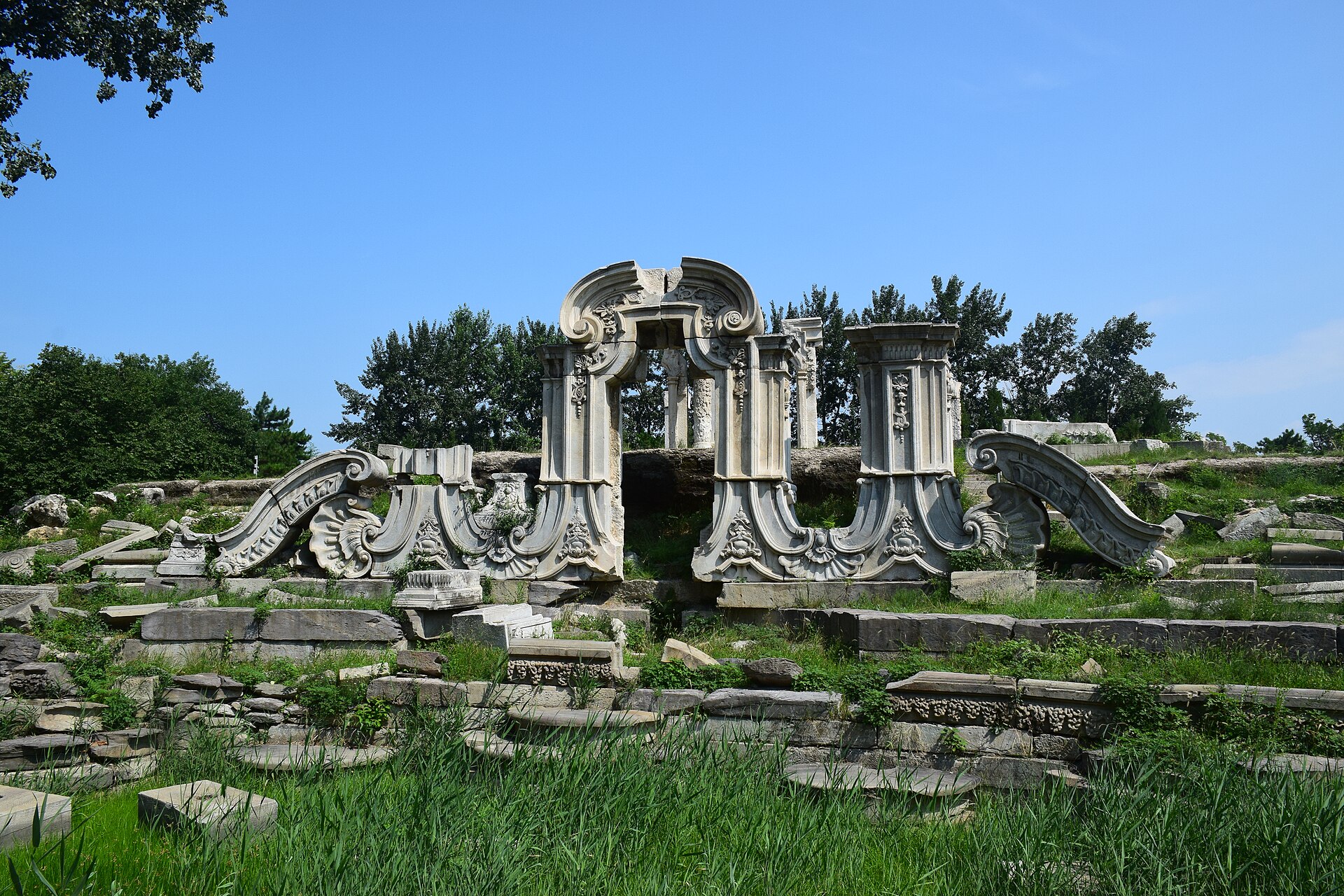
The most photographed thing at Yuanmingyuan is a doorway that no longer leads anywhere. It stands at the Great Fountain: a scrolled marble frame carved with shells and acanthus leaves, the vocabulary of a Roman villa, cracked down the middle and still upright, with broken columns and tumbled blocks lying in the grass around it. The Old Summer Palace was, for well over a century, where the Qing emperors actually lived and ruled, a garden of lakes, islands and hundreds of halls about five times the size of the Forbidden City. In October 1860 British and French troops looted it and then burned it. It has never been rebuilt, and that is the point of the place.
This guide covers what happened here and why it still matters so much to the Chinese visitors who make up nearly all of the crowd; what you can actually see, from the Western Mansions ruins to the lakes and the one temple that came through; which of the four tickets to buy and how to book it; how to pair the visit with the Summer Palace, two stops up Line 4; and an honest view of who should make the trip. Prices and opening hours were checked in September and October 2026; treat them as the right order of magnitude, and check the park’s own channels before a public holiday or one of its free days.
The Old Summer Palace at a glance
| What | Detail |
|---|---|
| Through ticket (all areas) | ¥25 — the one to buy |
| General admission | ¥10, grounds only; excludes the Western Mansions ruins and the model exhibition |
| Western Mansions ruins | ¥15 on its own; included in the through ticket |
| Panoramic model exhibition | ¥10 on its own; included in the through ticket |
| Concessions | Half price for full-time undergraduates; current city listings make under-18s and over-60s free. Show a passport and let the gate decide |
| Free days | 18 October, the second Saturday in June, the third Saturday in September |
| Hours | Ticketed entry from 07:00; last entry 19:00 (April–October) and 17:30 (November–March) |
| Time needed | 1½–2 hours for the ruins alone; 3–4 hours with the lakes |
| Subway | Line 4, Yuanmingyuan Park station, Exit B, for the South Gate |
| Booking | Official WeChat mini-program or website, any date within the month; rarely sells out outside holidays and free days |
The board at the gate lists four prices, and the cheapest is the one to avoid. The ¥10 general ticket gets you into the grounds but not into the Western Mansions, which is what almost everybody has come to see, and the difference is fifteen yuan. Unless all you want is a walk by the lakes, buy the through ticket (通票, tōngpiào).
What happened here
A garden the emperors preferred to the Forbidden City
The Kangxi emperor gave the land to his fourth son, Yinzhen, in 1707, along with the name Yuanmingyuan, usually translated as the Garden of Perfect Brightness. When Yinzhen came to the throne as the Yongzheng emperor, he did something his father had not: he built audience halls and government offices into the garden and moved the business of ruling there. From the 1720s until 1860 the Qing court spent most of the year in these north-western suburbs, among lakes and hills, and went back to the Forbidden City mainly for the great ceremonies. The palace that visitors now queue for in the centre of Beijing was the formal address. This was home.
The Qianlong emperor, who reigned for six decades from 1736, made the garden a lifelong project. He enlarged the original estate, added the Garden of Eternal Spring (Changchunyuan) to the east, and later folded a third garden, Qichunyuan, into the whole to the south-east, which is why “Yuanmingyuan” now means all three. He had scenery he admired on his tours of the Yangtze delta recreated in miniature, and a shopping street built where eunuchs played the shopkeepers so that the court could go to market without leaving home. In 1744 court painters recorded forty of the garden’s scenes in an album of silk paintings, each paired with a poem by the emperor. That album left China in 1860 and is now in the Bibliothèque nationale de France in Paris, which is a fair summary of where much of the garden ended up.
The European palaces
The corner of the garden that draws visitors today was a curiosity even when it was new. In the 1740s, the story goes, Qianlong saw a picture of a European fountain and wanted one of his own. The Italian Jesuit Giuseppe Castiglione, a court painter known in Chinese as Lang Shining, designed a group of European-style buildings for him, and the French Jesuit Michel Benoist engineered the waterworks. Through the 1750s Chinese craftsmen raised palaces of marble and brick with Baroque facades, curving double staircases and fountain basins, often finished with glazed Chinese roof tiles, so that the result is neither quite European nor quite Chinese. The group became known as the Xiyanglou, the Western Mansions. It sat in a narrow strip along the northern edge of the Garden of Eternal Spring and took up only a small fraction of the estate.
It was a showpiece rather than a place anyone lived, and not an entirely practical one. One account has it that after Benoist died in 1774 nobody at court could keep his pumping machinery working, and that on the rare days the emperor wanted to see the fountains play, servants filled the reservoir by hand.
October 1860
The Second Opium War brought a British and French army to the outskirts of Beijing in the autumn of 1860, after a dispute over the treaty the Qing court had signed two years earlier. The Xianfeng emperor fled north to his summer retreat at Chengde Mountain Resort, and on 6 October French troops reached Yuanmingyuan, with the British close behind. The looting went on for days, by officers and men alike. Silks, porcelain, jade, clocks and books were carried off by the cartload, and what could not be carried was smashed. A Pekingese dog found in the palace was shipped to England and presented to Queen Victoria, who named it Looty.
What turned looting into destruction was the fate of a negotiating party. In September, Qing forces had seized a group of British and French envoys and their escort, and when the survivors were released it emerged that around twenty had died in captivity, some after torture, among them a correspondent for The Times, Thomas Bowlby. Lord Elgin, the British envoy, chose to burn the emperor’s favourite residence as a reprisal aimed at the throne rather than the city. On 18 and 19 October British troops set the garden alight, and smoke drifted over Beijing for days. Charles Gordon, then a young officer, wrote home that it made his heart sore to burn such places. The French had led the looting but declined to take part in the burning, and the following year Victor Hugo wrote that two bandits had entered the palace, one to plunder and one to set fire.
Even that was not the end. Some buildings in the outlying parts of the garden survived the fire, and the Summer Palace next door, burned at the same time, was rebuilt in the 1880s. Yuanmingyuan never was. When foreign armies returned to Beijing in 1900, during the Boxer crisis, the garden was plundered again, and in the decades that followed soldiers, warlords and local people stripped whatever remained, selling the timber and carting off the stone to build elsewhere. Pieces turned up all over the city: a stele pavilion from the garden now stands in Zhongshan Park beside Tiananmen, and carved marble columns from its ancestral temple stand on the Peking University campus next door. By the middle of the twentieth century much of the site was farmland and villages.
The ruins were cleared, sorted and planted from the 1970s, and the site opened as the Yuanmingyuan Ruins Park in 1988. A handful of gates and pavilions in the southern garden have since been rebuilt and the old landscape of hills and waterways replanted, but the question of reconstructing the palaces themselves, which comes up every few years, keeps getting the same answer. The Western Mansions stay as they fell.
Why it matters so much to Chinese visitors
Spend an hour at the Great Fountain and you will notice two different visits going on. The few foreign visitors tend to treat the place as a romantic ruin, and it does that very well: European columns among the reeds, a Baroque doorway against a Beijing sky. Chinese visitors, who make up nearly all of the crowd, are usually here for something closer to a memorial. Yuanmingyuan is a designated patriotic education base. School groups arrive by the coachload, and the story told over their guides’ loudspeakers is the opening chapter of what Chinese schoolbooks call the century of humiliation, the hundred years of foreign invasion and unequal treaties that began with the Opium Wars. The phrase you will hear again and again is 勿忘国耻, wù wàng guó chǐ: never forget national humiliation.
Knowing this changes what you are looking at. The broken marble is not lying in the grass through neglect; it is kept as it fell, on purpose, as evidence. The campaign to bring home the looted bronze zodiac heads, which is described below, has been front-page news in China for a quarter of a century, and an auction of two of them in Paris in 2009 turned into a diplomatic row. On 18 October, the anniversary of the burning, entry is free and the park fills with people who come specifically to mark the day.
None of this makes Yuanmingyuan an uncomfortable place for a foreign visitor, British and French passports included. Nobody will hold 1860 against you, and people are more likely to be curious than anything else. But it is worth behaving as you would at any memorial. The ruins are not a climbing frame, and a grinning selfie on the rubble lands differently here than it would in the Roman Forum.
The Western Mansions: what is actually left
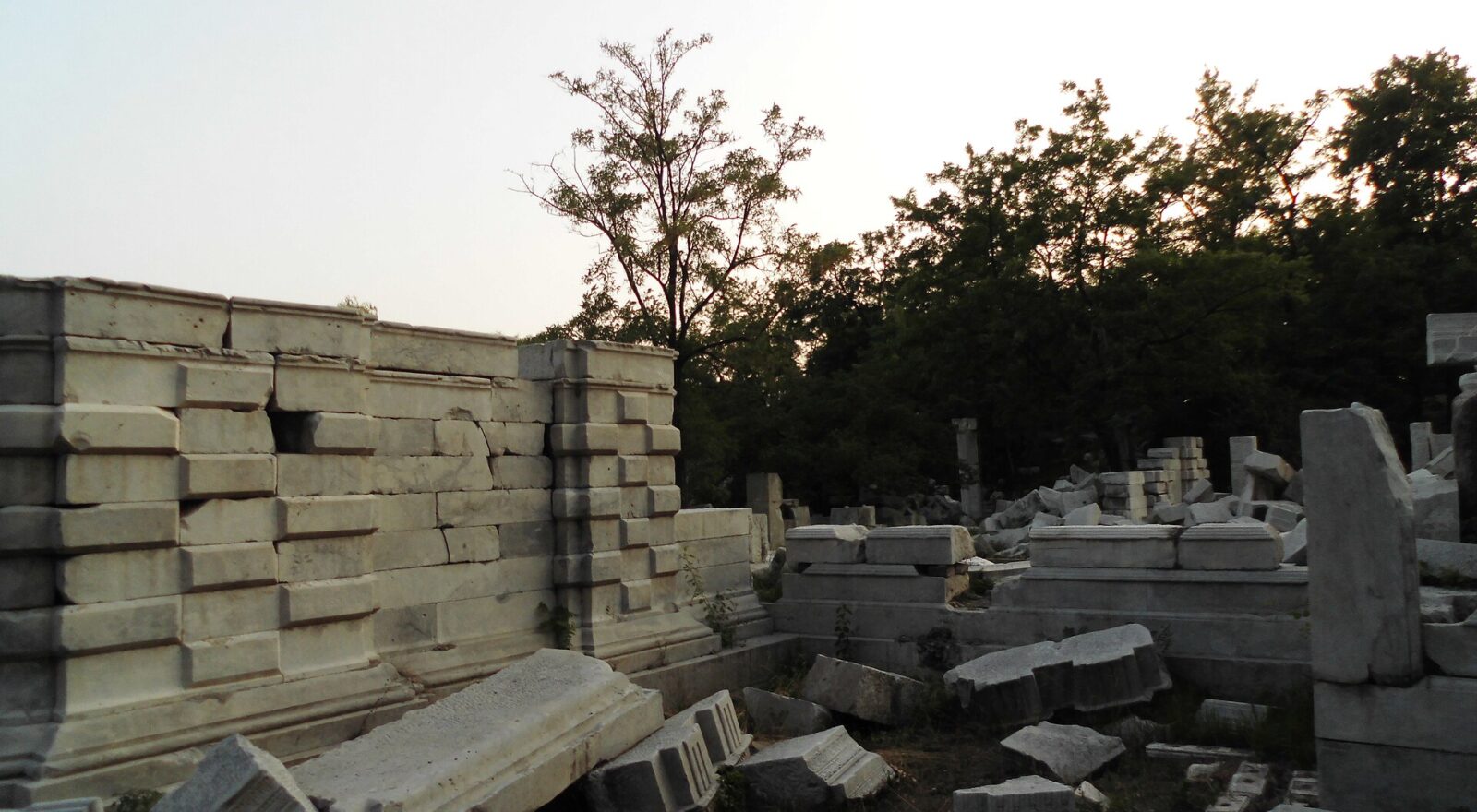
The Western Mansions ruins are fenced off from the rest of the park and need either the ¥15 ruins ticket or the through ticket. The area is a strip less than a kilometre long, running west to east, and you could walk it end to end in twenty minutes, although most people take an hour or more. Going from west to east, these are the things to look for.
Xieqiqu, the first of them
Xieqiqu (谐奇趣), roughly “harmonious and unusual delight”, was the first of the European buildings, finished around 1751: a three-storey hall with curving wings that ended in octagonal pavilions where court musicians played, above a fountain pool. Today it is a scatter of carved fragments, but the plan is easy enough to read from the base, and the carving on the surviving blocks, all scrolls and shells, is a good introduction to what the rest of the strip once looked like.
The maze
Just to the north is the one thing in the Western Mansions you can still use as it was intended. Wanhuazhen (万花阵), the Labyrinth of Ten Thousand Flowers, also called the Yellow Flower Maze, is a maze of low carved-brick walls around a white marble pavilion on a raised base, rebuilt on its original plan. On Mid-Autumn nights, the story goes, palace maids carrying yellow silk lanterns raced through it towards the emperor, who sat in the pavilion and rewarded whoever reached him first. The walls are about chest height, so getting properly lost takes some effort, but children love it, and most adults who say they will wait outside end up going in.
Haiyantang and the zodiac fountain
Haiyantang (海晏堂), the Hall of the Calm Sea, was the largest of the European buildings and the setting for the garden’s most famous object. Below its western facade, a fountain pool was lined with twelve figures, the animals of the Chinese zodiac, each with a bronze head on a robed stone body. Each spouted water in turn for the two hours of the day that belonged to its sign, and at noon all twelve spouted together: a water clock dressed up as a fountain. Castiglione is credited with the design, and court craftsmen cast the heads. Today you see the empty basin behind a railing, with a great stone scallop shell at its centre and the ledges where the figures sat.
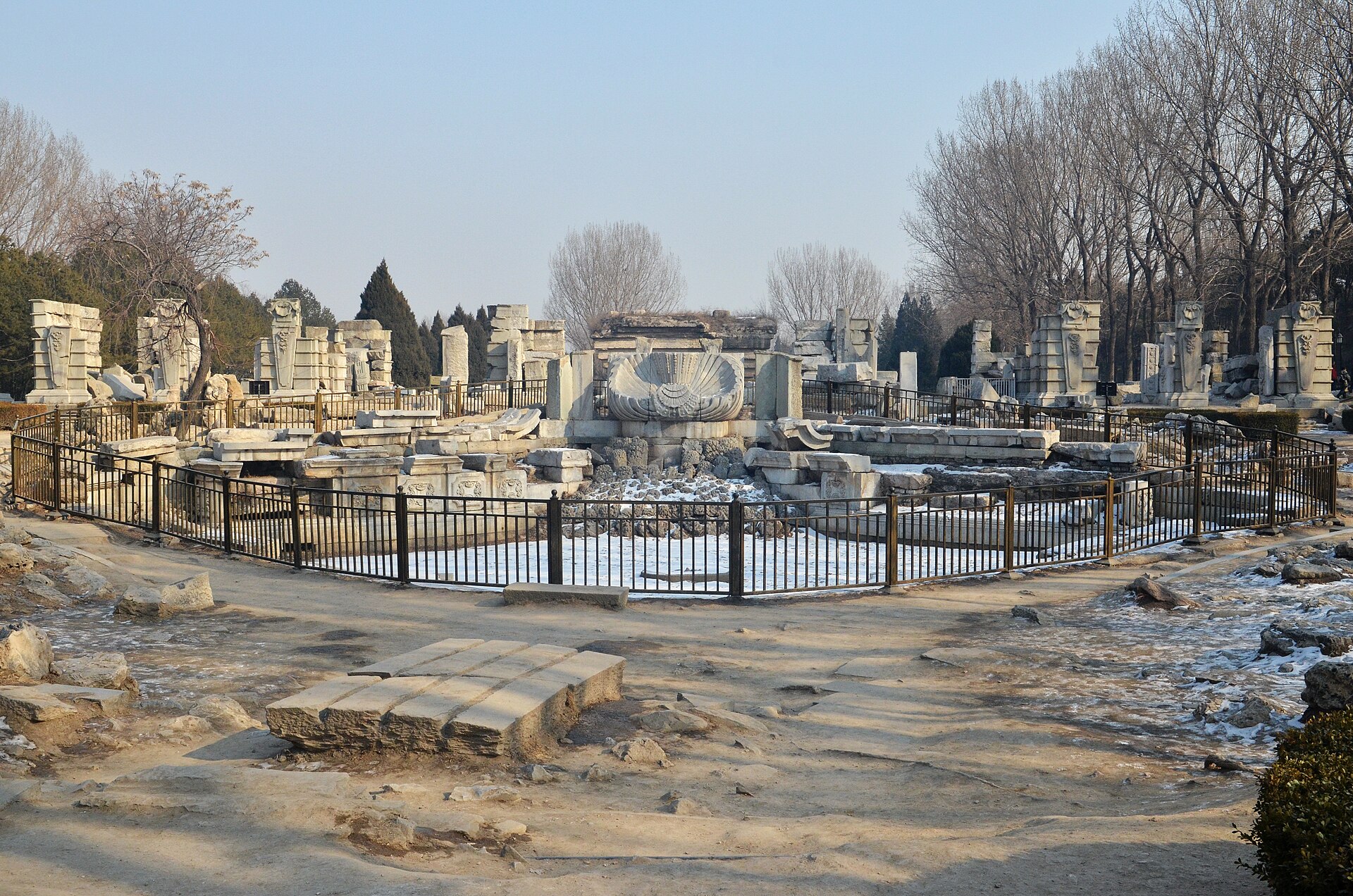
Where the heads went is a story that runs well into this century. Seven of the twelve are back in China. The ox, tiger and monkey were bought at auction in Hong Kong in 2000 by the Poly Group and are held by its Poly Art Museum in Beijing. The pig was bought by the Macau casino magnate Stanley Ho in 2003 and given to the same museum. The rat and rabbit, whose sale at Christie’s in Paris in 2009 caused the row mentioned above, were donated by the Pinault family in 2013 and are held by the National Museum of China. The horse, which Stanley Ho also bought, came back to Yuanmingyuan itself on 1 December 2020, the first object looted from the garden to return to its original home; it is displayed in Zhengjue Temple, in the southern part of the park. The dragon, snake, goat, rooster and dog have never resurfaced.
The Great Fountain and the Hall of Distant Seas
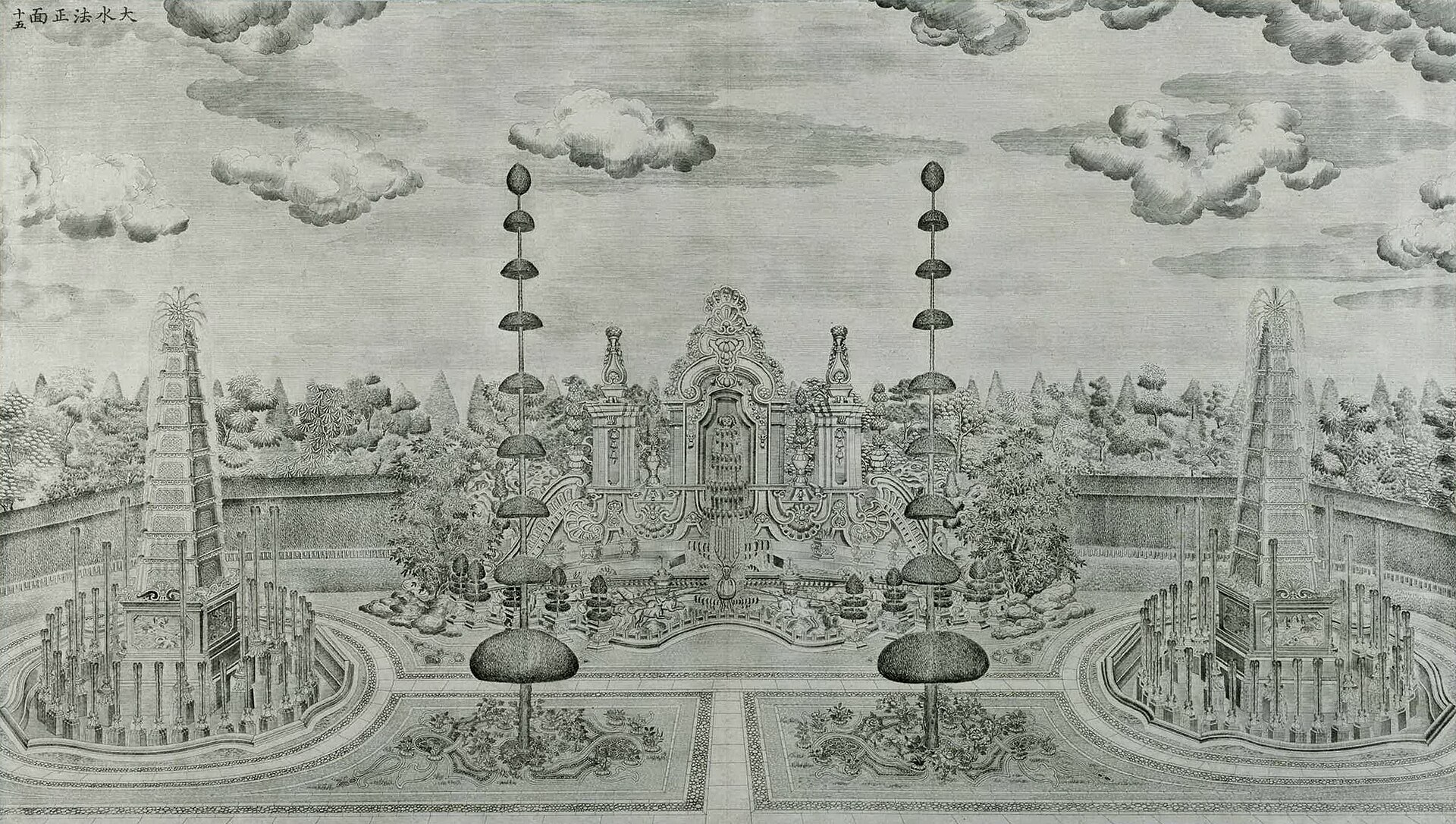
Further east is the scene on every postcard. Dashuifa (大水法), the Great Fountain, was a cascade set against a stone niche shaped like a monumental gateway and flanked by tiered fountain towers. The niche still stands, split at the top but upright, with the remains of the basins in front of it. Facing it from the south is Guanshuifa (观水法), the Fountain-Viewing Seat, where the emperor sat on a throne in front of a carved stone screen decorated with European armour, swords and drums; the screen panels spent decades on a nearby university campus before they were brought back. Behind the fountain, on higher ground, rise the columns of Yuanyingguan (远瀛观), the Hall of Distant Seas. Together they are the most complete group on the site, and the best light on them comes in the last hour before closing, when the marble turns gold.
The eastern end
The strip finishes with Xianfashan (线法山), a small hill once ringed by a spiral path, and beyond it the site of the Perspective Walls (线法墙), where painted panels stood in receding rows to give the illusion of a street disappearing into the distance, a theatre set for an emperor who would never see the places it showed. There is little left now but the mound and some footings, and most visitors turn round at the Great Fountain. If you have the legs for it, the walk to the end is quiet and brings you close to the East Gate.
The model exhibition
The panoramic model, included in the through ticket, is a large sand-table reconstruction of the whole garden at its height, showing the halls, bridges and islands as they stood before 1860. Fifteen minutes with it does more than any amount of reading to explain the empty fields and lakes outside, and it is better seen before you set off across the park than after.
Beyond the ruins: lakes, islands and one surviving temple
The Western Mansions occupy a small corner of a park of around 350 hectares, and the rest of it is the reason to give Yuanmingyuan more than an hour. Much of the old garden was water, with lakes, canals and ponds linking more than a hundred separate scenic compounds, and the water is still there, edged with willows and reed beds, with footpaths where the halls once stood. On a weekday it is one of the quietest places in Beijing that still has a subway station at the gate.
Fuhai and the islands of the immortals
Fuhai (福海), the Sea of Blessing, is the largest lake, roughly square, with a cluster of small islands in the middle called Penglai Yaotai (蓬岛瑶台), after the mythical islands where the immortals lived. A path runs all the way round, the views across the water to the Western Hills are good on a clear day, and in the warmer months boats go out on the lake. In a cold winter the lakes freeze and the park usually opens an area for skating and ice-bikes, much as Beihai Park does in the city centre. If you need to sit down somewhere with a view, this is the place.
Jiuzhou, where the emperors lived
West of Fuhai, nine islands set around the Back Lake formed the residential heart of the original garden. They were called Jiuzhou (九州), after the nine provinces of ancient China, so that the emperor living at its centre lived, symbolically, at the centre of the realm. The buildings are gone, but the landscape of artificial hills, islands and channels has been restored, with some foundations exposed. Few tour groups come this far, which is the appeal; it is the best place in the park to get a sense of the scale of the thing that was lost.
Zhengjue Temple and the horse head
Zhengjue Temple (正觉寺), a Tibetan Buddhist temple in the southern garden, is the only building complex of any size to have come through 1860 and everything after it. It has been restored, and since December 2020 its halls have displayed the bronze horse head, with an exhibition on its return. Allow half an hour, and check at the gate that the exhibition is open on the day, since temporary shows come and go. Standing in front of the one head that made it home, a few hundred metres from where it was cast to spout water, is a stranger experience than you might expect.
Lotus season
From July into August the ponds and lakes fill with lotus, and Yuanmingyuan has long run one of the city’s summer lotus festivals. It is the park’s most beautiful season and also its most uncomfortable: by mid-morning in July the heat is serious, and shade is thin near the water. Go early, and bring insect repellent if you are staying into the evening.
Tickets and booking
Which ticket
The through ticket, at ¥25, covers everything: the grounds, the Western Mansions ruins and the panoramic model. The ¥10 general ticket is fine for a lakeside walk and nothing else, and the separate ¥15 ruins ticket only makes sense if you already hold the general ticket and change your mind. Full-time undergraduates pay half price. Current city listings also give free entry to under-18s and over-60s; older listings show a reduced children’s price instead, and whether a foreign passport or student card qualifies is decided at the gate. Bring the passport, ask, and do not lose sleep over it. At these prices the worst case is a few yuan.
How to book
Tickets are sold through the park’s official WeChat mini-program and its website. Unlike the Forbidden City, which releases tickets a week ahead and can sell out within minutes (the Forbidden City guide has the detail), Yuanmingyuan lets you book any date within the current month, and outside public holidays and its free days it rarely sells out. Search for 圆明园 in WeChat, choose the through ticket, pick a date and pay with WeChat Pay. If a Chinese-language mini-program is more than you want to deal with, Trip.com resells tickets in English; check that the price is close to the ¥25 face value. Carry your passport whichever way you book, since real-name rules apply at many Beijing sites and staff may ask to see it.
The free days
Entry is free three days a year: 18 October, the anniversary of the burning; the second Saturday in June, China’s Cultural and Natural Heritage Day; and the third Saturday in September, National Defence Education Day. All three are crowded, and 18 October in particular is a day of commemoration rather than a quiet stroll. If ¥25 is no obstacle, come on another day. Or come on the 18th precisely because of what it means, and expect company.
Getting there and getting around
Take Line 4 to Yuanmingyuan Park station and use Exit B, which brings you out by the South Gate. From Xidan the ride is about half an hour; from Tiananmen allow 40–45 minutes including the change from Line 1. The Beijing subway guide covers paying at the gates with a foreign contactless card, which works on every line.
The catch is that the South Gate is the furthest gate from the Western Mansions, about 2 kilometres away on foot, or half an hour without stopping. If the ruins are all you want, take a taxi or DiDi to the East Gate (东门, Dōngmén), across the road from Tsinghua University’s west gate, which puts you a few minutes’ walk from the Western Mansions; from Wudaokou on Line 13 the ride takes about ten minutes. Inside the park, electric carts run along the main routes for a small fare. They are not essential, but after three hours on foot the cart back to the gate is very welcome.
Peking University and Tsinghua sit on either side of the park and look, on the map, like an obvious add-on. Both restrict visitors and require advance reservation, so do not plan on wandering across from the ruins.
A route that sees everything
- Enter at the South Gate from Line 4, Exit B.
- Look in at Zhengjue Temple for the horse head, if the exhibition is open.
- Walk north through Qichunyuan to Fuhai and follow its shore round to the east.
- Cross into Changchunyuan and see the panoramic model.
- Walk the Western Mansions from west to east: Xieqiqu, the maze, Haiyantang, then the Great Fountain in the late light.
- Leave by the East Gate and take a DiDi to Wudaokou for dinner among the student restaurants.
That is roughly 5 kilometres on flat paths and three to four hours at an easy pace. To cut it to two hours, do it backwards: go straight to the East Gate, walk the Western Mansions, see the model, and leave the lakes for another time.
When to go
| Season | What you get | Watch out for |
|---|---|---|
| Spring (April–May) | Blossom along the lakes, willows in new leaf, mild walking weather | Spring winds, the odd dusty day, and the Labour Day holiday (1–5 May) |
| Summer (June–August) | Lotus on the ponds in July and August, long light evenings | Heat with little shade at the ruins; mosquitoes by the water at dusk |
| Autumn (September–early November) | The best walking weather of the year, golden willows, clear light on the marble | Golden Week (1–7 October) and the free day on 18 October |
| Winter (November–March) | Snow on the ruins, frozen lakes, hardly anyone about | A bitter wind across open ground, and last entry at 17:30 |
Autumn is the best all-round season, and late October, when the willows turn and the air is often clear, is as good as Yuanmingyuan gets; the autumn leaves guide covers where else the colour is good that month. Winter is underrated. The ruins under snow are the most striking version of the place, there is almost no one else there, and the cold is manageable if you dress for it and keep moving.
Whatever the season, the time of day matters more. The Western Mansions are at their busiest from mid-morning to early afternoon, when the tour groups and school parties come through, and weekends are much busier than weekdays. Arrive at opening for quiet, or come in the last two hours before closing for the best light. The lakes and the western garden are quiet at any hour.
Old Summer Palace or Summer Palace? Doing both
Visitors mix the two up constantly, and Beijing taxi drivers are used to it. The Summer Palace (颐和园, Yíhéyuán) is the one with Kunming Lake, Longevity Hill and the Long Corridor. The Old Summer Palace (圆明园, Yuánmíngyuán) is the ruins. Both were burned in 1860. The Summer Palace was rebuilt in the 1880s for the Empress Dowager Cixi, reputedly with money meant for the navy; Yuanmingyuan was not. Seen on the same day they make a single argument: one is what a burned imperial garden looks like when it is restored, and the other is what it looks like when it is left as evidence.
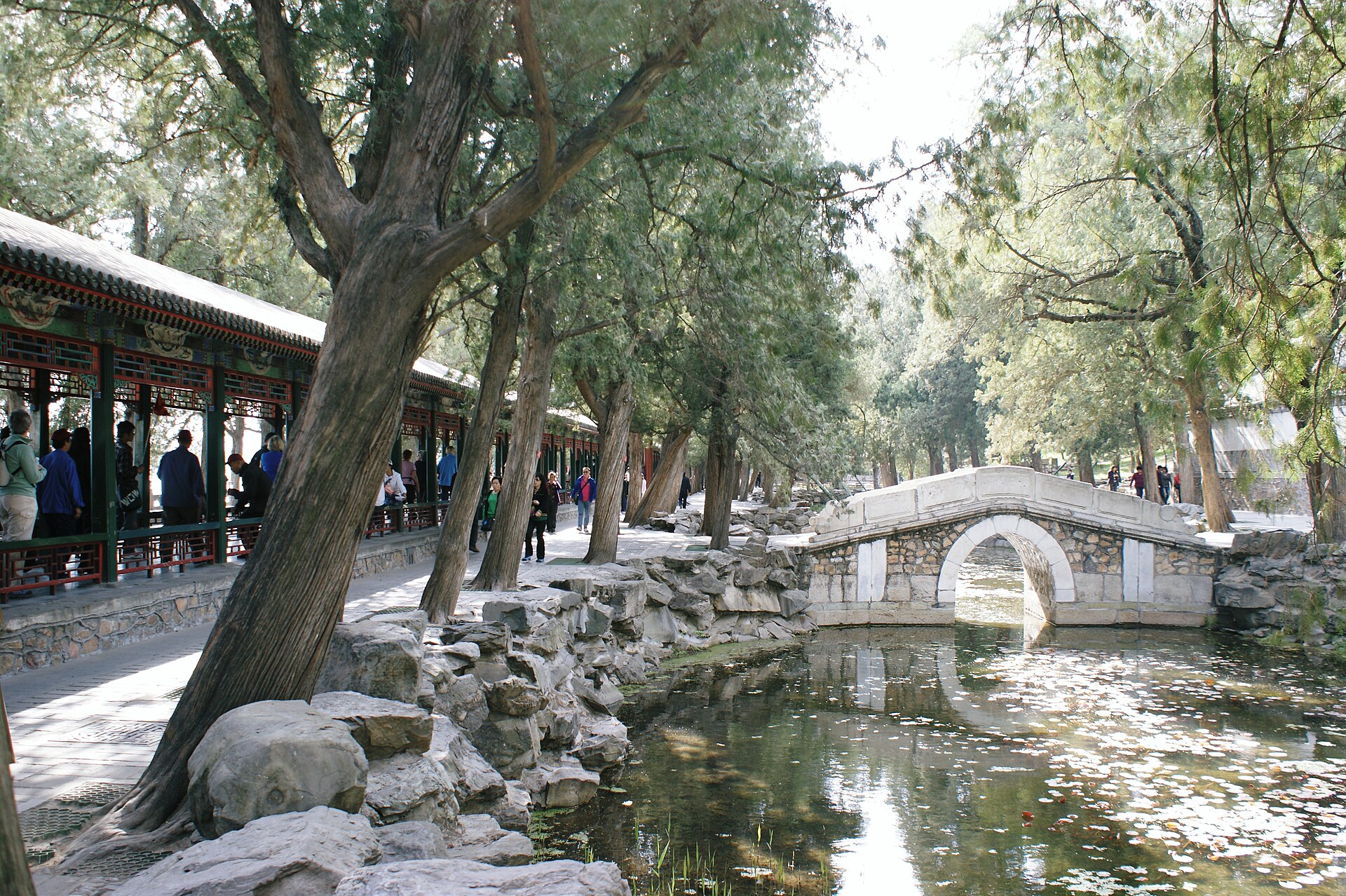
They are two stops apart on Line 4: Beigongmen for the Summer Palace’s north gate, then Xiyuan, then Yuanmingyuan Park. The best order is the Summer Palace first, from opening, when it is at its quietest; lunch; and Yuanmingyuan for the afternoon, ending at the Great Fountain in the late light. It is a long day on foot and one of the best in Beijing. The guide to Beijing’s parks and gardens has more ideas for building days around the city’s green spaces, including the Fragrant Hills further west if you have a second day out this way.
Is the Old Summer Palace worth it? The honest verdict
Yes, with conditions. On a first trip of two or three days, when the Forbidden City, the Temple of Heaven, the Great Wall and the Summer Palace are already competing for every hour, Yuanmingyuan is a reasonable thing to cut. The Summer Palace gives you the imperial garden at full strength, and you will not miss the experience of a garden so much as the story of one.
Given four days or more, or on a second visit, it earns its place, especially if the history of 1860 interests you or you simply want a long walk somewhere green and quiet. It suits photographers, people who like ruins, and families with children who need to run; the maze alone is worth the trip for anyone under ten. The second-visit itinerary builds it into a slower trip.
What disappoints people is arriving with the wrong picture. Apart from Zhengjue Temple and a few rebuilt gates and pavilions, nothing stands. The Western Mansions area is small, fenced and, at weekends, crowded with groups, and if you see only that and leave, you will wonder what the fuss was about. What surprises people is the rest: the sheer size of the park, the quiet of the western lakes on a weekday morning, and how much a field of broken stone can say once you know what it was.
Practical tips
- Buy the through ticket. The ¥10 general ticket does not include the Western Mansions.
- Wear proper shoes. A full visit is 5 kilometres or more, mostly on flat paths with some gravel and uneven stone around the ruins.
- Bring water and a snack. Kiosks cluster near the gates and are thin on the ground in between.
- Plan for the sun. Shade around the ruins is patchy; a hat and sunscreen matter from May to September.
- Toilets are plentiful along the main paths and generally clean.
- Leave the drone at home. The whole of Beijing is controlled airspace, and parks are no exception.
- Access: the main paths are flat and paved, and manageable with a wheelchair or pushchair; the Western Mansions have uneven stone underfoot, and the maze is narrow. The accessibility guide covers the city more widely.
- With children: the maze, the boats on Fuhai and the space to run make this one of the better historic sites for families. The Beijing with kids guide has more.
- Eat before or after. Wudaokou, a short ride from the East Gate, is a student district packed with cheap, good restaurants.
Line 4 also makes Yuanmingyuan easy to combine with Beijing Zoo, seven stops south, where the pandas moved into a new house in 2026. The guide to Beijing Zoo’s pandas explains why the zoo belongs at the start of the day rather than the end, and how to travel on from it by boat along the old imperial waterway.
Frequently asked questions
What is the difference between the Old Summer Palace and the Summer Palace?
They are separate parks about two kilometres apart. The Summer Palace (Yiheyuan) is the intact garden with Kunming Lake, Longevity Hill and the Long Corridor, rebuilt in the 1880s after it was burned in 1860. The Old Summer Palace (Yuanmingyuan) was the larger and more important garden, burned in the same week and left in ruins.
How much does it cost to visit the Old Summer Palace?
The through ticket is ¥25 and covers the grounds, the Western Mansions ruins and the panoramic model exhibition. A ¥10 general ticket covers the grounds only. Full-time undergraduates pay half price, and current listings give free entry to under-18s and over-60s, subject to the gate accepting your documents.
Do I need to book Yuanmingyuan tickets in advance?
Booking through the park’s WeChat mini-program or website is the standard route, and you can book any date within the current month. It rarely sells out except on public holidays and free days, so booking the day before or the morning of your visit is usually fine. Bring your passport.
How long should I spend at the Old Summer Palace?
An hour and a half to two hours for the Western Mansions and the model exhibition, entering by the East Gate. Three to four hours to see the lakes and Zhengjue Temple as well, and a full afternoon if you are combining it with the Summer Palace.
Who burned the Old Summer Palace?
British troops, on the orders of Lord Elgin, on 18 and 19 October 1860, at the end of the Second Opium War, in reprisal for the torture and deaths of captured envoys. British and French troops had looted it in the days before; the French declined to join the burning. The garden was plundered again in 1900 and stripped over the following decades.
Where are the bronze zodiac heads from Yuanmingyuan now?
Seven of the twelve are back in China. The horse is displayed in Zhengjue Temple at Yuanmingyuan; the ox, tiger, monkey and pig are held by the Poly Art Museum; and the rat and rabbit by the National Museum of China. The dragon, snake, goat, rooster and dog are still missing.
When is entry to the Old Summer Palace free?
On 18 October, the anniversary of the burning; on the second Saturday in June, Cultural and Natural Heritage Day; and on the third Saturday in September, National Defence Education Day. Expect crowds on all three.
How do I get to the Old Summer Palace by subway?
Line 4 to Yuanmingyuan Park station, Exit B, which comes out by the South Gate. The Western Mansions are about 2 kilometres from there, so if they are your only goal, a short taxi or DiDi ride to the East Gate saves half an hour of walking.
Is the Old Summer Palace worth it if I have already seen the Summer Palace?
Yes, if you have the time. The two are very different experiences: the Summer Palace shows you an imperial garden, and Yuanmingyuan tells you what happened to one. Seen together, on one long day linked by Line 4, they make more sense than either does alone.