Beijing Museums & Galleries
Capital Museum: Beijing’s Own Story, Told Well
The best single museum for understanding Beijing itself: how to get in with a passport, the history, folk customs, porcelain and bronze galleries worth your time, and how long to allow.
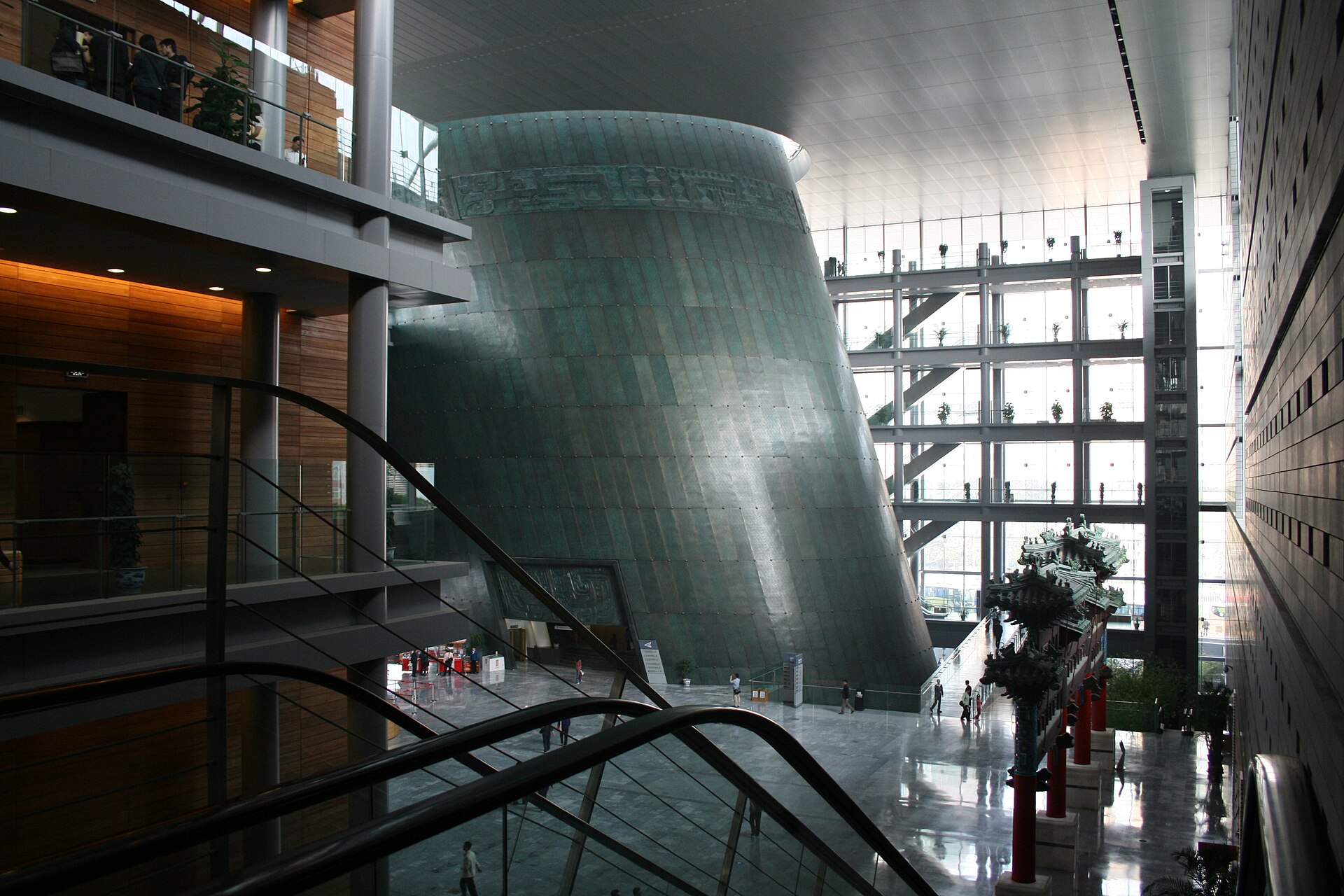
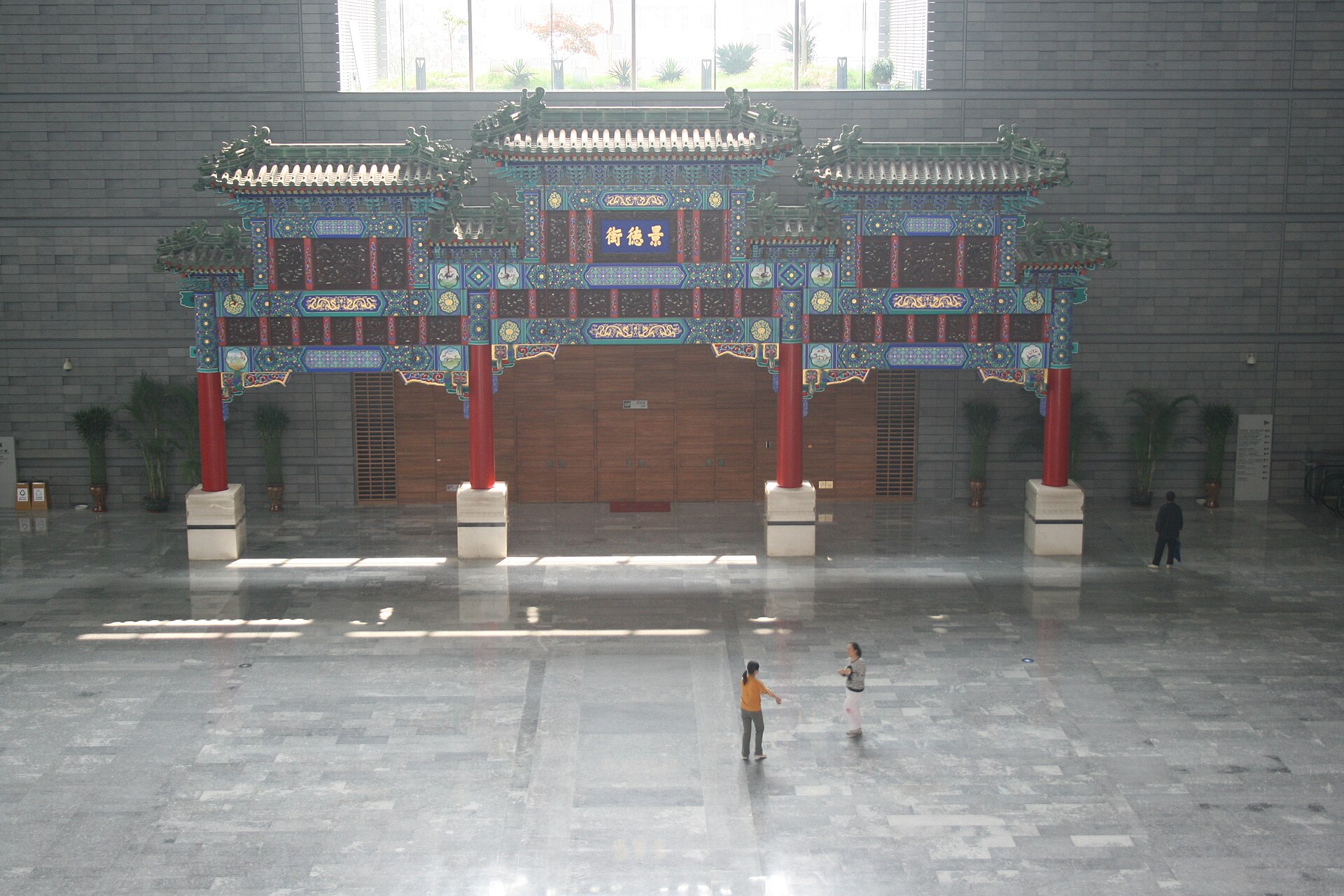
The first thing you see inside is a piece of street. A painted memorial archway, all green tiles, red columns and gilded beams, that once stood over a Beijing road now stands in the atrium of the Capital Museum Beijing opened on Chang’an Avenue in 2006, beneath a glass roof and beside a great bronze-clad drum that leans out through the building’s facade as if it were being dug out of the ground. It is a good introduction to the place. Most of China’s big museums tell the story of the nation; this one tells the story of the city, from the bronze-casting state that ruled here three thousand years ago to the shopkeepers and wedding processions of the old hutongs.
This guide covers how to get in with a passport, the galleries worth your time (the Beijing history galleries, the folk customs, the porcelain and the bronzes), how long to allow, how the museum compares with the National Museum across town, the newer eastern branch on the Grand Canal, and what to pair it with nearby. The museum moves its closing day around big exhibitions, so check the dates for the week you travel.
The Capital Museum at a glance
| What | Detail |
|---|---|
| Cost | Free; some special exhibitions may charge |
| Entry | Free, no reservation needed; register at the north entrance with your passport |
| Hours (2026) | 09:00–20:00, last entry 19:00; after 17:00 only the ground floor and the basement stay open |
| Closed | Normally Mondays; in 2026, Tuesdays from 18 May to 18 October during a major exhibition |
| Address | 16 Fuxingmenwai Street, Xicheng District, on West Chang’an Avenue |
| Subway | Line 1, Muxidi station; the Military Museum is one stop further west |
| Allow | 2 hours for the highlights; 3–4 hours to do it properly |
| English | Bilingual labels in the permanent galleries; English website at en.capitalmuseum.org.cn |
| Second site | The Beijing Grand Canal Museum, in Tongzhou |
Why this museum, and why now
Beijing is full of places that only make sense if you know the city’s history, and very few of them explain it. The Forbidden City tells you about the Ming and Qing courts, the hutongs show you how ordinary Beijingers lived, the Drum and Bell Towers and the old city gates hint at the shape of a walled city that has mostly disappeared. The Capital Museum is where those pieces fit together. In a morning here you learn that Beijing has been a city for some three thousand years, that it was a frontier town for most of them, that the Mongols built the capital of a unified China on this site and the Ming rebuilt it, and that the grid of lanes you have been walking through is a direct descendant of Kublai Khan’s.
It is also simply a pleasant museum to visit. It is far less crowded than the National Museum, easier to get into, and small enough to see properly in a morning, with a collection that in places is as good as anything in the country. For a first visit to Beijing that already includes the Forbidden City and the National Museum, it is the museum most likely to be skipped and most likely to be missed. For a second visit, it is close to essential.
Booking and getting in
Entry is free, as at most of China’s state museums, and no advance reservation is needed: since 20 December 2025 visitors can register on arrival at the north entrance with a valid identity document. Bring your passport for that.
Bring your passport and allow for a security check at the entrance. Large bags may need to go into the cloakroom. The museum is normally closed on Mondays, but closing days move around big exhibitions, and in 2026 it closed on Tuesdays instead from 18 May to 18 October while a major exhibition on the ancient Maya and Andean civilisations was on. Check the week you travel. The guide to Beijing’s museums explains how the real-name booking system works across the city.
The evening option
In 2026 the museum stayed open until 20:00, with last entry at 19:00, though after 17:00 only the ground floor and the basement remained open. That makes it one of the few major museums in Beijing you can visit after a day elsewhere, and on a summer evening, when the outdoor sights are still too hot and the tour groups have gone, it is a calm place to spend an hour. Check that the late opening is still running before you rely on it.
The building
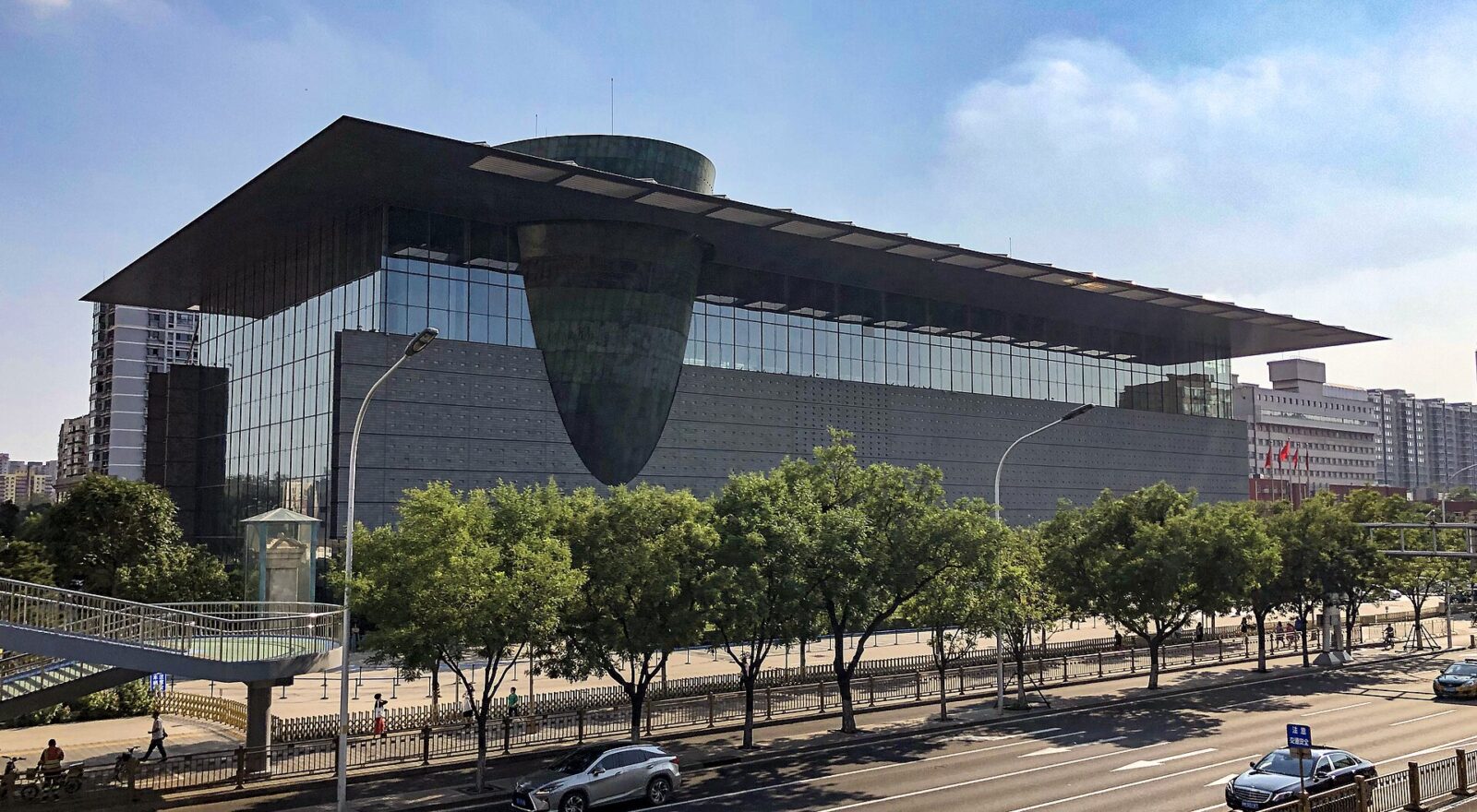
The museum building, designed by a French and Chinese team and opened in 2006, is worth a look in itself. Under a huge overhanging roof that nods to the eaves of traditional Chinese halls are three separate structures: a rectangular hall that holds the permanent galleries, a long office block, and the bronze-clad drum, an oval hall for special exhibitions that tilts out through the glass wall onto Chang’an Avenue. The drum is meant to evoke an ancient bronze vessel emerging from the earth, and from inside the atrium, where you can walk right around its base, it is properly impressive.
The memorial archway in the atrium, its central panel inscribed with the name of Jingde Street, is one of the old pailou that once spanned Beijing’s main streets. Most were taken down in the twentieth century to make room for traffic; seeing one indoors, under glass, says something about how the city has changed. Before the move to this building the museum occupied the Confucius Temple, from 1981 until the new building was ready, which is why older guidebooks send you there.
The galleries worth your time
Beijing’s history
The core of the museum is the general history of Beijing, which was renewed in recent years and now fills about 4,900 square metres of the main hall with more than 1,100 objects. It runs from the earliest people in the area, with the cave site of Peking Man at Zhoukoudian, through imperial Beijing and the Republican period to the capital of modern China, and its great strength is that it tells a story you will recognise as you walk around the city afterwards.
The story starts properly around three thousand years ago at Liulihe, in what is now Fangshan District in the south-west, where the Western Zhou dynasty established the state of Yan, and where archaeologists have excavated the walls, tombs and bronzes of its capital. From there the galleries follow Beijing through its long centuries as a frontier city between the Chinese heartland and the steppe; through the Liao and Jin dynasties, both of which made it a capital; through Dadu, the great planned city that Kublai Khan built for the Yuan; and on to the Ming rebuilding that gave Beijing the walls, gates and palace whose outline you can still trace today. Maps and models make the changing outline of the city easy to follow, and you come away understanding why the old streets run the way they do.
Old Beijing folk customs
The gallery most visitors enjoy most is the one on the customs of old Beijing, the everyday life of the city between the late Qing and the middle of the twentieth century. Here are the rituals of birth, marriage and death, with a bridal sedan chair and the paraphernalia of a wedding procession; the festivals of the year; the shop signs, street cries and trades of the old commercial streets; and the furnishings of a courtyard home. It is the best preparation in the city for a walk through the hutongs, and the guide to Beijing’s courtyard houses picks up where it leaves off.
Porcelain
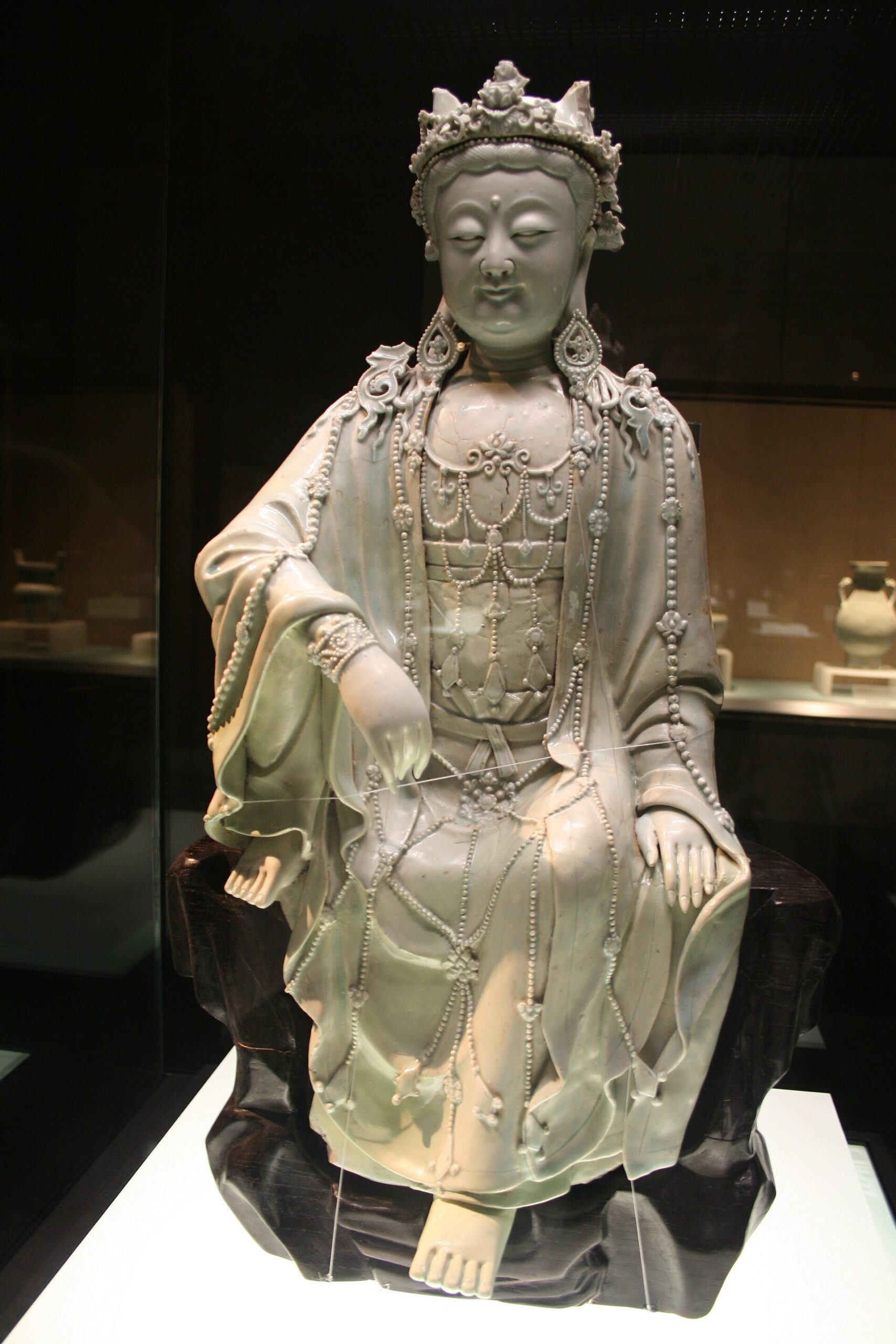
The porcelain gallery is one of the museum’s great strengths, running from early celadons through the Song wares to the Yuan blue-and-white, much of it excavated in Beijing itself, and the imperial porcelain of the Ming and Qing. Look out for the Yuan dynasty qingbai Guanyin, a seated figure of the bodhisattva in pale blue-white porcelain, hung with strings of beads and modelled with a delicacy that is hard to believe of fired clay.
Bronze Art of the Yan Region
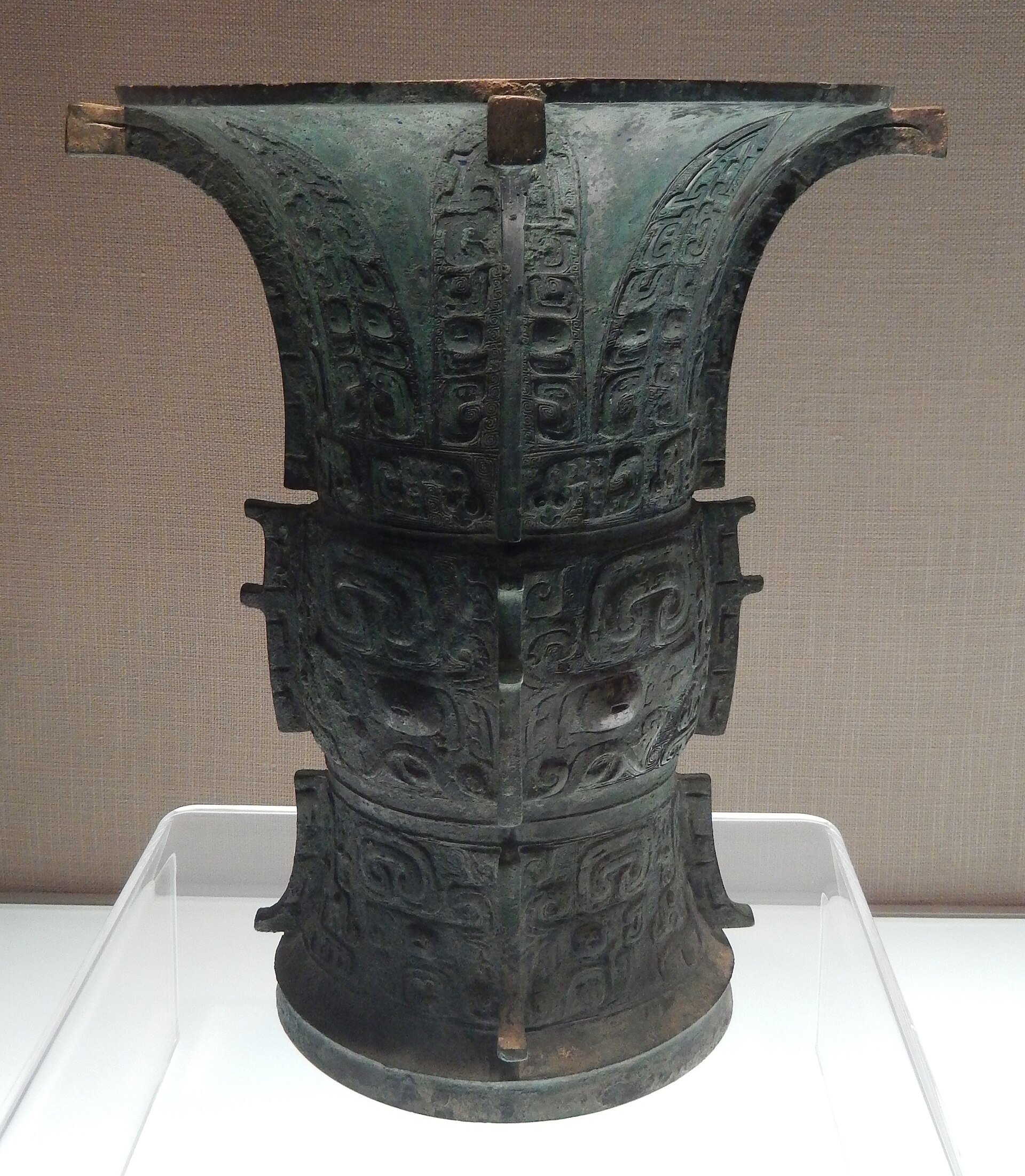
The bronze gallery concentrates on the Western Zhou bronzes of the Yan state, many of them from the excavations at Liulihe: ritual cooking vessels, wine containers and weapons, some inscribed with records of the Yan rulers and their dealings with the Zhou king. If you have seen the bronzes at the National Museum, these will look familiar in style, but there is a particular satisfaction in seeing objects made in Beijing three thousand years ago, about an hour’s drive from where they were found.
Jade, Buddhist art, calligraphy and painting
The remaining galleries are smaller and more specialised. The jade gallery runs from Neolithic ritual discs to the elaborate carvings of the Qing court. The Buddhist art gallery gathers gilt-bronze and stone figures, many from Beijing’s own temples, including Tibetan Buddhist works that make a good companion to a visit to the Lama Temple. The calligraphy and painting galleries rotate their displays, since works on paper and silk cannot be shown for long. Pick the ones that interest you rather than trying to do them all.
Special exhibitions
The oval hall inside the bronze drum hosts the museum’s big temporary exhibitions, which are often international loans and can be excellent. In 2026 the museum showed a major exhibition on the ancient civilisations of the Maya and the Andes, and earlier shows have brought in collections from across China and abroad. Check the website before your visit to see what is on; a strong special exhibition is a reason to choose a date, and sometimes a reason to plan the visit around it.
How long to spend, and a route through it
Two hours will get you the highlights; three or four let you see the museum properly. A good order is to start with the Beijing history galleries, which give you the framework, then the folk customs, then two or three of the art galleries according to your interests, and finally the special exhibition in the drum if there is one. On a short visit, the essentials are the history galleries, the folk customs and the porcelain.
The museum is spread over several floors, with lifts, escalators and benches throughout, and it is one of the more comfortable museums in Beijing for anyone who finds long days on foot hard going. Toilets are clean and easy to find, and there is a café for a break between galleries.
English, audio guides and photography
The permanent galleries are labelled in Chinese and English, and the English is generally clear, if sometimes brief. The museum’s English-language website covers visiting information and some of the collection, and is worth a look before you go. Ask at the service desk about audio guides, which have been available in English. Photography without flash is allowed in the permanent galleries; special exhibitions sometimes restrict it, so watch for the signs.
Capital Museum or National Museum?
They are often compared, and they do different jobs.
| Capital Museum | National Museum of China | |
|---|---|---|
| Story told | Beijing, from the Yan state to the Qing | China, from the Neolithic to the present |
| Best objects | Porcelain, Yan bronzes, folk customs | The Ancient China galleries’ bronzes, jades and ceramics |
| Crowds | Moderate | Heavy, especially at weekends |
| Booking | None needed | Competitive; tickets released 7 days ahead at 17:00 |
| Size | A morning | A day, if you let it |
| Location | Muxidi, Line 1 | Tiananmen Square, Line 1 |
If you can only do one and you are interested in Chinese art and history in general, the National Museum has the greater collection. If you want to understand Beijing, or you cannot get a National Museum ticket, or you simply prefer a museum you can see in a morning without crowds, choose the Capital Museum. They are on the same subway line, about a quarter of an hour apart, and on a longer trip there is no reason not to see both.
The eastern branch: the Beijing Grand Canal Museum
Since December 2023 the Capital Museum has had a second home, the Beijing Grand Canal Museum, in the north-west corner of the City Green Heart Forest Park in Tongzhou, the new administrative sub-centre on the eastern edge of Beijing. It is a large, modern museum about the Grand Canal, the waterway that carried grain from the south to feed the capital for some six centuries and ended at Tongzhou. Its permanent exhibition, in eight parts, has more than a thousand objects, with a huge sand-table model, films and interactive displays, and among its treasures is a Qianlong-era Jingdezhen porcelain vase that was once in the collection of the Old Summer Palace.
Tickets are booked through the Capital Museum’s or the Grand Canal Museum’s WeChat accounts and mini-programs. In 2026 it opened 10:00–20:00, with last entry at 19:00, and from September it returned to closing on Mondays. It is a long way from the centre, so plan on a half-day including the journey and check the route in a map app before you go. It is worth the trip for anyone interested in the canal, in China’s engineering history, or in seeing the new eastern city that Beijing is building; for a short first visit, the main museum is the better use of your time.
Making a day of it nearby
The Capital Museum sits on West Chang’an Avenue, a stretch of Beijing that most visitors only pass through on the way to somewhere else, but there is enough nearby to fill a day:
- The Military Museum, one stop west on Line 1, with its halls of tanks, aircraft and missiles. Free, with a real-name booking.
- The White Cloud Temple, the headquarters of the Quanzhen school of Taoism, a short taxi ride to the south. The White Cloud Temple guide covers what to look for.
- Yuyuantan Park, to the north-west, best known for its spring cherry blossom; the cherry blossom guide explains when to go.
- The National Museum, east on Line 1 to Tiananmen East (allow extra time for the walk and security), if you want to compare the two in one long day.
A good full day in this part of the city is the Capital Museum in the morning, lunch, and the White Cloud Temple in the afternoon, ending with a walk in Yuyuantan in spring or a ride back east along Chang’an Avenue past the Forbidden City at dusk.
Reading the city after your visit
The best thing about the Capital Museum is how it changes the rest of your trip, and it is worth knowing what to look for once you are back on the street. The Line 2 subway loop traces the course of the Ming inner city wall, since demolished, while the Second Ring Road mostly follows the moat that once surrounded it, so every time you ride Line 2 you are circling the old city. A few fragments survive: the great gate of Zhengyangmen at the south end of Tiananmen Square, the arrow tower at Deshengmen in the north, and the south-east corner tower at Dongbianmen, with a stretch of wall beside it preserved as the Ming City Wall Relics Park.
Further north, the Drum and Bell Towers stand near what was the centre of Kublai Khan’s Dadu, and the lanes around them, running east to west off the old north–south roads, still follow the pattern laid out for the Yuan capital. Walk the hutongs between the towers and Nanluoguxiang with the museum’s maps in mind and the neighbourhood reads like a page of the history galleries: a planned imperial city, overlaid by six centuries of courtyard houses, shops and temples.
The honest verdict
The Capital Museum is one of the best museums in Beijing and one of the least visited by foreigners, which is a shame. It is not as grand as the National Museum, and its collection cannot match the Palace Museum’s, but it does something neither of them does: it explains the city. If you have walked the hutongs, climbed Jingshan and stood in the Forbidden City and wondered how it all fits together, this is where you find out.
It is less essential if your interest is Chinese art in general rather than Beijing in particular, in which case the National Museum’s Ancient China galleries are the better choice, and it is not one for children, who will find the history galleries slow going outside the folk customs. For everyone else, it repays a morning very well.
Practical tips
- Bring your passport. Entry is free, and you register with it at the north entrance.
- Check the closing day the week you travel; it moves around big exhibitions.
- Go early or late. Mornings are quiet, and in 2026 the museum was open until 20:00, with only the ground floor and basement open after 17:00.
- Start with the history galleries for context, then the folk customs and the porcelain.
- Use the cloakroom for large bags; the security check at the entrance is thorough.
- Getting there: Line 1 to Muxidi. The Beijing subway guide covers tapping in with a foreign contactless card.
- Combine it with the Military Museum one stop west, or the White Cloud Temple to the south.
If you are planning several museums in one trip, the release times are the thing to get right. Our guide to Beijing museum booking sets out when each of the big museums opens its tickets, how to fill in the forms with a passport, and what to try when a date is fully booked.
Frequently asked questions
Is the Capital Museum in Beijing free?
Yes. Entry to the Capital Museum is free, though some special exhibitions may charge. No advance reservation is needed: visitors register at the north entrance with a valid identity document, and foreign visitors use their passport.
Do I need to book the Capital Museum with a passport?
No. Take your passport to the north entrance, register there and go through the security check. Entry is free, and you do not need to choose a date in advance.
What are the Capital Museum’s opening hours?
In 2026 it opened 09:00–20:00, with last entry at 19:00 and only the ground floor and the basement open after 17:00. It normally closes on Mondays, but in 2026 it closed on Tuesdays from 18 May to 18 October during a major exhibition, so check before you go.
How long should I spend at the Capital Museum?
Two hours for the highlights, three or four to see it properly. The essentials are the Beijing history galleries, the old Beijing folk customs and the porcelain.
How do I get to the Capital Museum by subway?
Take Line 1 to Muxidi station. The museum is at 16 Fuxingmenwai Street on West Chang’an Avenue, a short walk away. The National Museum is a quarter of an hour east on the same line.
Is the Capital Museum better than the National Museum?
It is different. The National Museum has the greater collection and tells China’s story; the Capital Museum tells Beijing’s, and is calmer and easier to get into. If you want to understand the city, choose the Capital Museum; for Chinese art and history in general, the National Museum.
What is the Beijing Grand Canal Museum?
It is the Capital Museum’s eastern branch, opened in December 2023 in Tongzhou, devoted to the Grand Canal and its role in feeding the capital. It is a fine modern museum but a long trip from the centre, best for visitors with a particular interest in the canal.