Beijing Temples & Spiritual Sites
Tanzhe Temple: Ancient Mountain Temple Day Trip
Guide to Tanzhe Temple, the oldest temple near Beijing: the Emperor Tree ginkgo, pagoda forest, mountain setting, how to get there and tips.

There’s an old Beijing saying: “First there was Tanzhe Temple, then there was Beijing.” Tanzhe Temple (Tanzhesi), cradled in a forested fold of the Western Hills some 40 km from the city centre, is reckoned to be the oldest Buddhist temple in the Beijing area — founded around 1,700 years ago, well before the imperial capital itself took shape. Set against a mountainside, terraced up the slope through grand halls, pagoda groves and ancient trees, it makes one of the most rewarding and atmospheric temple day trips from Beijing. Its glories include a pair of 1,000-plus-year-old ginkgo trees — one honoured by an emperor as the “Emperor Tree” — that turn a breathtaking gold each November, a serene mountain setting that has drawn pilgrims and emperors for centuries, and a sense of deep history you simply can’t find at the city’s busier temples. This guide covers the temple’s story, what to see, the famous trees, the best time to visit, opening hours, tickets, how to get there, and how to combine it with nearby Jietai Temple for a perfect day. It is a day-four destination in our itinerary for a second visit, once the central sights are done.
Tanzhe Temple is the day trip I recommend to anyone who wants to swap the city’s crowds for ancient trees, mountain air and 1,700 years of history. It’s beautiful, peaceful and steeped in legend. This guide covers the temple, the trees, and how to plan a smooth visit. Let’s head for the hills.
Tanzhe Temple at a glance
- What
- the oldest Buddhist temple near Beijing (~1,700 years old), set on a forested mountainside in Mentougou District, ~40 km west of the centre.
- Highlights
- the 1,300-year-old “Emperor Tree” ginkgo and its companion; the terraced halls; the pagoda forest; ancient cypresses and a famous magnolia.
- Hours
- 8:30–16:30 (last entry before close).
- Ticket
- around ¥55.
- Getting there
- subway Line 1 to Pingguoyuan, then bus 931 to the Tanzhesi terminus; or drive/taxi (~1–1.5 hours).
- Best time
- early November for the golden ginkgo; spring for blossom; any clear day for the mountain setting.
- Best for
- a half- or full-day escape; lovers of history, nature and quiet temples.
Older than Beijing itself
Tanzhe Temple’s claim to fame is its sheer antiquity. It was founded during the Western Jin dynasty, around 307 AD — making it roughly 1,700 years old and, by tradition, the earliest Buddhist temple in the Beijing region, predating the city’s rise as a capital by centuries. Hence the saying that Tanzhe came first and Beijing followed — a claim to seniority that even Fayuan, the oldest temple within the city walls proper, doesn’t contest. Originally called Jiafu Temple and later Longquan Temple, it acquired its popular name from its setting: Tan for the Dragon Pool (Tanzhe) on the mountain above, and zhe for the zhe (cudrania) trees that once grew here. Over the following dynasties it was repeatedly expanded and favoured by emperors — particularly during the Ming and Qing, when it became a major imperial temple. The Qing emperors Kanglxi and Qianlong both visited and lavished patronage on it, building lodges within the grounds for their stays. That long imperial connection, layered over its ancient Buddhist roots, gives Tanzhe a grandeur and a depth of history matched by few sites near the capital — you are walking through seventeen centuries of continuous worship.
The temple on the mountainside
Part of what makes Tanzhe so memorable is its setting and layout. Backed by the Baozhu (Precious Pearl) Peak and embraced by nine smaller hills — a configuration traditionally considered supremely auspicious feng shui — the temple climbs the slope on a series of terraces, so that you ascend through its courtyards and halls, gaining views over the rooftops and forest as you go. The central axis leads up through the Mountain Gate, the Hall of the Heavenly Kings, the imposing Mahavira Hall (Daxiongbaodian) — the main hall, with its great Buddha images — and on to the Vairocana Pavilion near the top, from which the views are finest. To either side spread subsidiary courtyards, monks’ quarters, the former imperial lodges, and shrines. The whole complex is shaded by ancient trees and dotted with steles, ornamental rocks and quiet corners. Wandering up through the terraces, with the mountain rising behind and the forest all around, is a wonderfully peaceful experience — a world away from the flat, walled enclosures of the city temples.
The ancient trees: the Emperor Tree
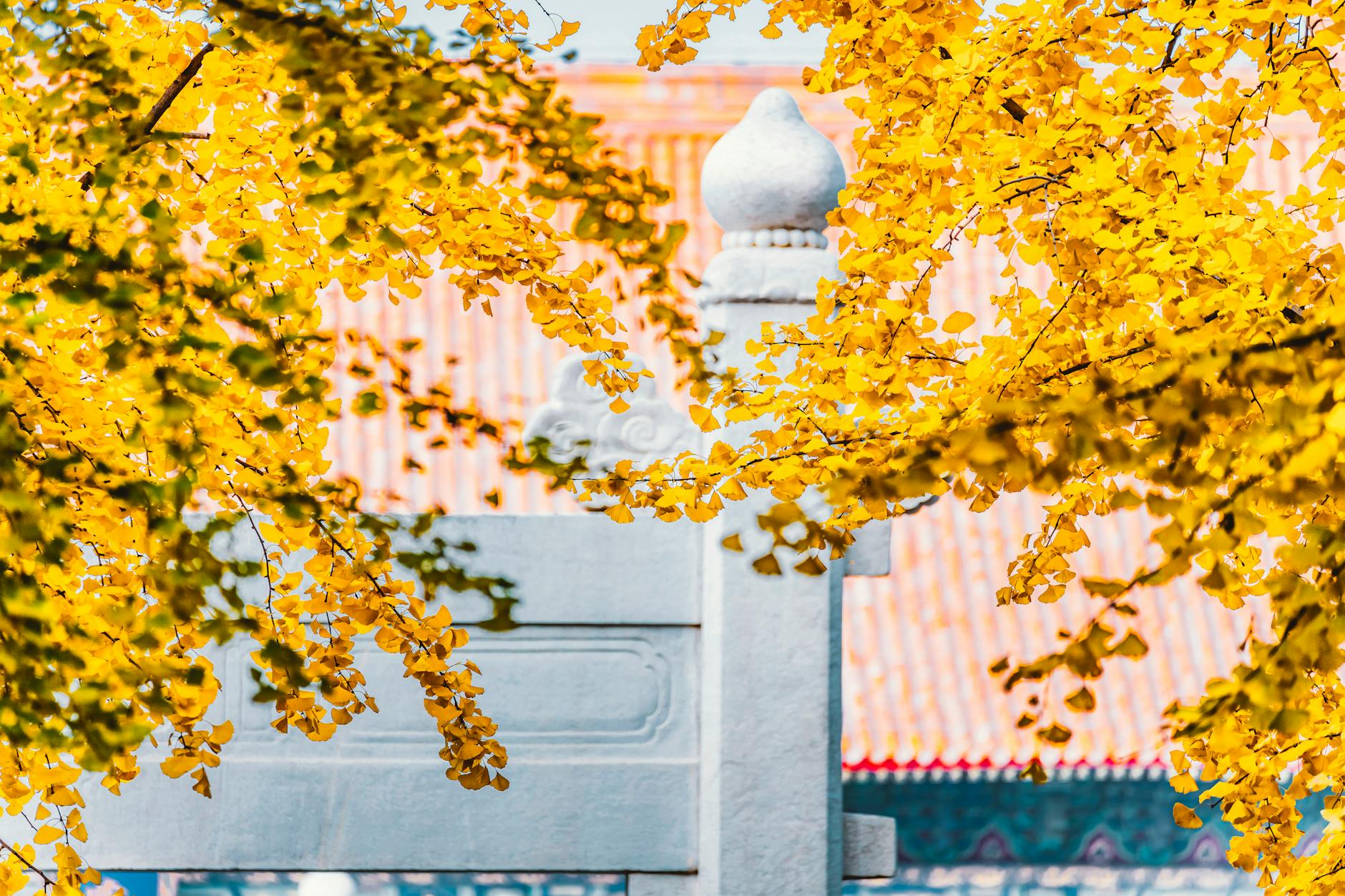
Tanzhe is famous above all for its ancient trees, and the stars of the show are two venerable ginkgos standing in the courtyard before the Vairocana Pavilion. The larger, planted in the Tang dynasty over 1,300 years ago, is so magnificent that the Qianlong Emperor personally conferred on it the title “Emperor Tree” (Dishu) — the highest honour ever bestowed on a tree in China. Its trunk is so vast that several people linking arms can barely encircle it, and its golden crown soars high above the halls. Beside it stands a slightly younger companion ginkgo, planted later and nicknamed the “Matching King Tree.” In early November, when the ginkgos turn a brilliant, glowing gold and shed a carpet of leaves against the temple’s red walls and grey tiles, the courtyard becomes one of the most photographed and beloved autumn scenes near Beijing — locals flock here for it. But the trees are remarkable in any season, and Tanzhe holds other arboreal treasures too: ancient cypresses, a celebrated “Emperor’s Bodhi” magnolia said to be 400 years old that blooms gloriously in spring, and the unusual zhe trees that gave the temple its name. For tree-lovers, Tanzhe is a living museum.
The pagoda forest
Just outside the main temple, set among the trees, lies one of Tanzhe’s most evocative features: its pagoda forest (talin), a collection of more than 70 brick and stone stupas built over the centuries as the tombs of the temple’s eminent abbots and monks. Ranging in date across the Jin, Yuan, Ming and Qing dynasties and varying in size and style, these moss-touched memorial pagodas stand in quiet clusters beneath the canopy, a serene and slightly melancholy spot that vividly conveys the temple’s great age and the generations of monks who lived and died here. It’s one of the largest and oldest such pagoda groves in the Beijing area, and well worth the short detour from the main halls. Wandering among the silent stupas, dappled in forest light, is a highlight many visitors remember as much as the temple itself.
Best time to visit
Tanzhe is a year-round destination, but timing transforms the experience. Early November is the headline window, when the ancient ginkgos blaze gold — it’s spectacular, but also the busiest time, so go on a weekday and arrive early. Spring (April–May) is glorious too, when the 400-year-old magnolia and other blossoms flower against the halls and the hills turn green. Summer is lush and noticeably cooler than the city thanks to the elevation and forest, making it a fine heat-escape, though it can be hazy or wet. Winter is quiet and starkly beautiful, especially under snow, with the fewest visitors. For the best balance of good weather and manageable crowds, aim for late spring or early autumn; for the famous ginkgo gold, accept the November crowds and plan around them. Whenever you go, a clear day rewards you with the mountain views that are central to Tanzhe’s appeal. See our guide to which months actually suit a visit for the wider seasonal picture.
Legends and imperial connections
A temple this old naturally accumulates legends, and Tanzhe has more than its share. The most famous concerns a Yuan-dynasty princess, Miaoyan, said to be a daughter of Kublai Khan, who became a nun here to atone for the bloodshed of the Mongol conquests; she is reputed to have prayed so devoutly, kneeling and bowing, that she wore two footprint-shaped hollows into a stone slab, which is still preserved in the temple and known as the “Praying Stone.” Another tale attaches to a great cooking cauldron in the temple kitchens, said to be so vast it could cook rice for a thousand monks and to have a special pit at the bottom where sand from the rice would collect. The temple’s strong imperial links are real history: Ming and Qing emperors visited and endowed it, and Qianlong built a travelling palace within the grounds and famously honoured the great ginkgo. These layers of legend and royal patronage give Tanzhe a storytelling richness that brings the halls and trees to life — keep an eye out for the Praying Stone and the old cauldrons as you explore, and the centuries seem to fold in on themselves.
Tips for your visit
To make the day go smoothly, set out early — the journey takes an hour or more each way, and you’ll want unhurried time at the temple, especially if combining it with Jietai. Wear sturdy, comfortable shoes, as the temple is built up a slope on terraces and involves a fair bit of stepped climbing, and bring water and a warm layer, since the hills run cooler and breezier than the city. If autumn ginkgo is your goal, check recent photos or the local foliage reports before you go, as the peak gold lasts only a week or two and shifts with the weather. Set up a mobile-payment app for the bus, tickets and snacks, and download an offline map, as mountain phone signal can be patchy. There are simple eateries near the temple, but it’s wise to carry a few snacks. Finally, consider hiring a car or taxi for the day if you’re visiting both Tanzhe and Jietai — it removes the awkward bus transfers and lets you enjoy two temples at a relaxed pace. Treat the halls with the usual quiet respect, and Tanzhe rewards you with one of the loveliest days out from Beijing.
Hours, tickets and how to get there
Tanzhe Temple is open daily, roughly 8:30 to 16:30 (with last entry shortly before closing), and admission is about ¥55. It lies in Mentougou District, around 40 km west of central Beijing. The classic public-transport route is to take subway Line 1 to its western terminus, Pingguoyuan, then transfer to bus 931 from the bus stand on the west side and ride it to the Tanzhesi (Tanzhe Temple) terminus — the bus winds up into the hills and takes around an hour, so allow plenty of time. Alternatively, a taxi or DiDi from the city takes around 1 to 1.5 hours depending on traffic and is far more flexible, especially if you’re combining Tanzhe with Jietai Temple. Allow 2–3 hours at the temple itself, more if you linger in the pagoda forest or hike a little on the surrounding paths. Bring water, comfortable shoes for the terraced climb, and layers, as the hills are cooler than the city. For the full range of escapes, see our guide to getting out of the city for the day.
Combining with Jietai Temple
Tanzhe’s perfect partner is Jietai Temple, another ancient and beautiful mountain temple that lies just a few kilometres away on the same side of the city — the two are very commonly visited together on a single day trip, and a taxi between them takes only 10–15 minutes. Jietai is famous for housing the largest ordination terrace in China and for its extraordinary collection of ancient, twisted pine trees, making it a wonderful complement to Tanzhe’s ginkgos and grandeur. Doing both gives you a deeply satisfying day among the temples and forests of the Western Hills, with two of the oldest and most atmospheric Buddhist sites near Beijing. With an early start, some visitors push on further into the hills to the preserved Ming and Qing courtyard houses of Cuandixia village, making a long but rewarding day of it. See our Jietai Temple guide to plan the pairing, and our Fragrant Hills guide for another nearby Western Hills escape. A little temple etiquette goes a long way at both.
Who Tanzhe Temple is for
Tanzhe suits travellers who want more than a tick-box temple. It’s ideal for history lovers drawn to its 1,700-year story and imperial connections; for nature and tree enthusiasts who’ll marvel at the Emperor Tree and the pagoda forest; for photographers, especially in the golden ginkgo season; and for anyone craving a peaceful, scenic escape from the intensity of central Beijing. Families enjoy the space to roam and the legends, and walkers appreciate the mountain setting and gentle trails nearby. It’s less suited to those on a very tight schedule, since the round trip eats up much of a day, or to visitors who want their sights packed close together in the city — for them, the centrally located lamasery at Yonghegong or Confucius Temple deliver comparable history without the journey. But if you have a spare day and a taste for ancient places, mountain air and quiet beauty, Tanzhe — ideally paired with Jietai — is one of the most rewarding ways to spend it near Beijing, and a welcome contrast to the palaces and the Great Wall days — even quieter Wall sections like the lakeside stretch at Huanghuacheng — that fill most itineraries. The hills around it carry real trails, covered in our guide to hiking near Beijing.
Getting out here takes most of a day, which is why it tends to appear only on longer trips — and why it stays as quiet as it does. It is the recommended final day in our week-long Beijing plan, paired with Jietai half an hour away.
Tanzhe Temple FAQ
Why is Tanzhe Temple famous?
It’s reckoned to be the oldest Buddhist temple near Beijing — around 1,700 years old — hence the saying “first there was Tanzhe Temple, then there was Beijing.” It’s celebrated for its mountain setting, terraced halls, pagoda forest, and ancient trees, especially the 1,300-year-old “Emperor Tree” ginkgo.
When is the best time to see the golden ginkgo?
Early November is the peak window, when the ancient ginkgos turn brilliant gold and carpet the courtyard with leaves against the red walls. It’s spectacular but busy, so visit on a weekday and arrive early. Spring blossom and clear-day mountain views are lovely too.
How do I get to Tanzhe Temple from Beijing?
Take subway Line 1 to Pingguoyuan, then bus 931 to the Tanzhesi terminus (about an hour up into the hills). Alternatively, a taxi or DiDi takes around 1–1.5 hours and is more flexible, especially if combining with Jietai Temple. The temple is about 40 km west of the centre.
How much does it cost and how long should I allow?
Admission is around ¥55, and the temple is open roughly 8:30–16:30. Allow 2–3 hours for the terraced halls, the ancient trees and the pagoda forest, plus travel time of an hour or more each way — so it’s a half- to full-day trip.
Can I combine Tanzhe with Jietai Temple?
Yes — they’re only a few kilometres apart on the same side of the city and are very commonly visited together. A taxi between them takes 10–15 minutes. Together they make an ideal full-day temple excursion into the Western Hills.
Is Tanzhe Temple worth the trip?
Very much so, if you enjoy history and nature. Its great age, beautiful mountain setting, ancient trees and pagoda forest make it one of the most rewarding temple day trips near Beijing — peaceful, atmospheric and a real change from the city’s busier sights.
The bottom line on Tanzhe Temple
Tanzhe Temple is the perfect antidote to Beijing’s busy city-centre sights — a 1,700-year-old mountain monastery, older than the capital itself, where terraced halls climb a forested slope, a moss-touched pagoda forest slumbers among the trees, and a 1,300-year-old “Emperor Tree” ginkgo blazes gold each November. Come in autumn for the famous leaves or in spring for the blossom, allow a relaxed half to full day, and pair it with nearby Jietai Temple for one of the best temple excursions near Beijing. It’s history, nature and tranquillity in one rewarding trip.
Plan the pairing with our Jietai Temple guide, find more escapes in our day trips from Beijing guide, and see the full picture of Beijing’s temples. First time in the city? Start with our guide to planning time in the capital.