Beijing Money & Internet
Buying a SIM Card in Beijing: Airport Counters and City Shops
Who actually needs a Chinese SIM, where to buy one at Capital, Daxing and in the city, what registration involves, 2026 package prices, and how to run it alongside your home number.

Stand in the queue at a China Mobile counter for long enough and you will see the same small scene play out: a visitor hands over a passport, looks into a camera for a face scan, picks a phone number from a list on a tablet, and walks away ten minutes later with a Chinese number that makes a surprising number of small problems disappear. A China SIM card for tourists is not the right answer for everyone, and for most short trips it is not the first thing to buy. But it does one thing that nothing else can, which is give you a +86 number, and in Beijing that number opens doors that a foreign one does not.
This guide covers who actually needs a local SIM, where to buy one at Capital, at Daxing and in the city, what the registration involves, what the packages cost, how to run it alongside your home number or an eSIM, and what happens to the number when you leave. Prices and rules were checked in September 2026; package prices change often and differ between counters, so treat them as the right order of magnitude and ask at the desk.
The short version
| Question | Answer |
|---|---|
| Can tourists buy one? | Yes, with a passport |
| Where? | Airport counters at Capital and Daxing, or any carrier business hall |
| What does registration involve? | Your original passport and a face scan. About 10–15 minutes |
| What does it cost? | Roughly ¥80–200 for a tourist package of 10–30GB, valid 7–30 days |
| Processing fee? | None. You pay the package price |
| How many per passport? | Up to five, each with a different number |
| Does it reach Google and WhatsApp? | No. A local SIM is inside the firewall |
| What it gives you that an eSIM can’t | A Chinese number, for public WiFi codes, app sign-ups, deliveries and calls |
| Hours | Business halls typically 08:30–20:00, seven days a week |
Do you actually need one?
For most visitors on a trip of a week or two, the honest answer is no. A roaming eSIM installed before you fly gives you data from the moment you land and generally reaches your usual apps without a VPN, and your home number keeps receiving your bank’s security texts. Our China eSIM guide explains how that works. A local SIM becomes worth the queue when one of these applies:
- You want to use public WiFi. Most public networks in Beijing, in cafés, malls, stations and many public spaces, send a login code by text to a Chinese mobile number. A foreign number often never receives it.
- An app or mini-program insists on a +86 number. Food delivery, some restaurant booking and queueing systems, a few ticketing mini-programs and a number of Chinese apps want a local number at sign-up.
- People need to call you. Delivery riders, drivers, guides, landlords and hotel staff will phone rather than message, and calling a foreign number is expensive for them and often simply not done.
- You are staying for a month or more. Over a long stay, a local package is cheaper per gigabyte than roaming, and the number becomes part of how you live day to day.
- Your phone cannot take an eSIM. A phone bought in mainland China, or one without eSIM hardware, needs a physical SIM for local data.
If none of those applies, skip it, and spend the ten minutes at the airport getting cash and finding the train instead.
What a local SIM will not do
Be clear about this before you buy, because it is the most common misunderstanding. A Chinese SIM puts your phone on the domestic Chinese internet. Google in all its forms, WhatsApp, Instagram, Facebook, YouTube and much else are blocked on it, exactly as they are for residents. A local SIM gives you a Chinese number and cheap Chinese data; it does not give you the open internet.
That is why many long-stay visitors run two lines: the local SIM for the number and for Chinese apps, and a roaming eSIM for anything behind the firewall. On a dual-SIM phone this works well, as long as you set each line to do the right job.
Where to buy one
At the airports
Both of Beijing’s airports have counters where foreign visitors can buy a SIM on arrival, run by the carriers themselves and at the city’s “Beijing Service” desks for international travellers. At Capital, China Unicom’s counter is on the international arrivals level of Terminal 3. At Daxing, the Beijing Service counter in the terminal handles SIM sales and collection, with staff used to foreign passports. The Capital Airport guide and the Daxing guide cover the layout of each terminal.
Two cautions. First, counters keep business hours, and a late-night arrival may find them closed; if you land after mid-evening, plan to buy in the city the next day, and have an eSIM or your home roaming to get you through the first night. Second, airport counters sometimes steer visitors towards their larger packages. Ask what the smaller ones are before you agree.
Order online, collect at the airport
The carriers also let you apply online before you travel and collect the SIM when you land. According to Beijing’s official guidance for visitors, China Unicom’s pre-orders are collected at Daxing and China Mobile’s at Capital, so pick the carrier that matches your arrival airport. You still show your passport and complete the face scan in person at collection.
In the city
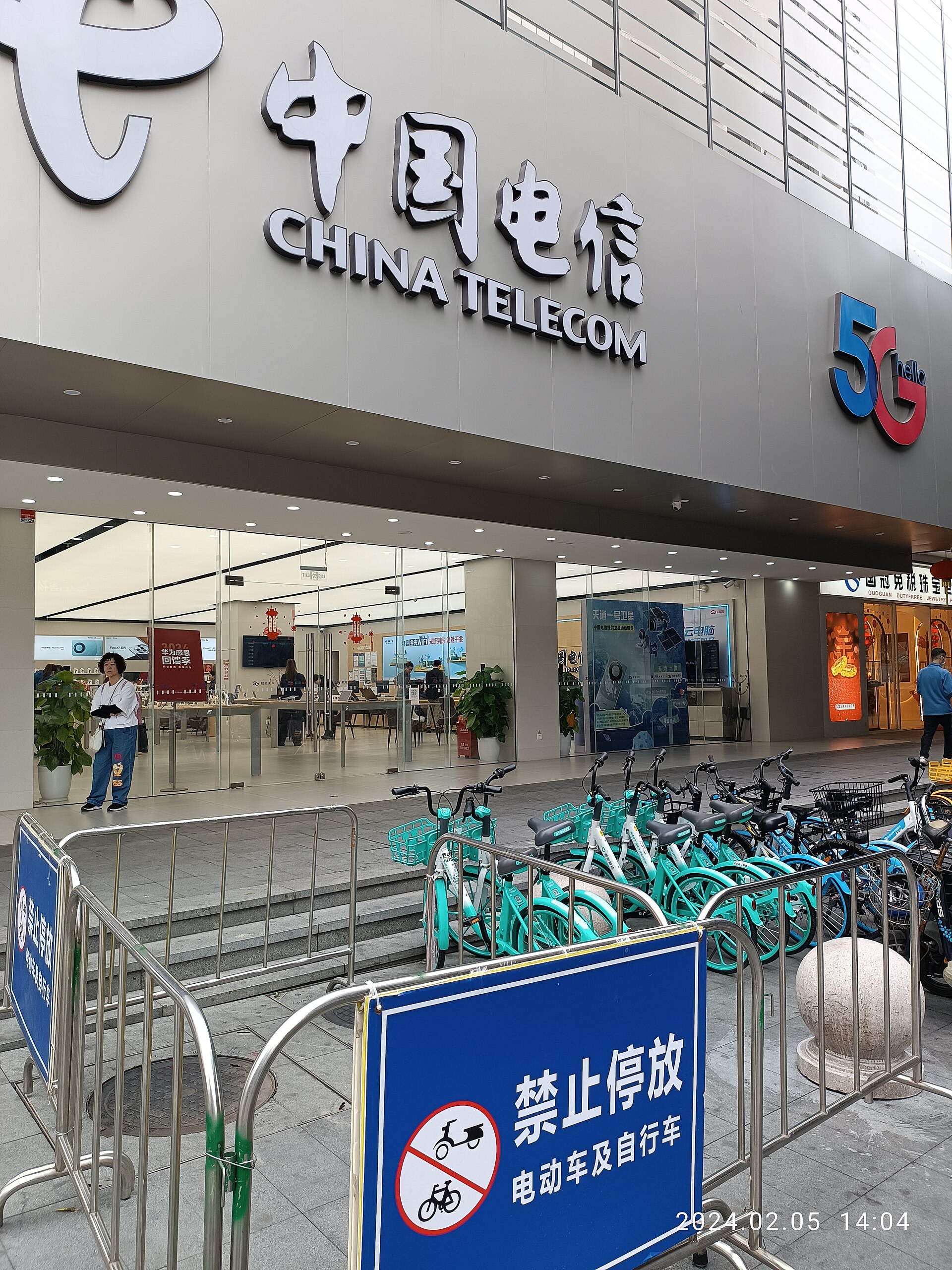
Every neighbourhood has carrier business halls, called yíngyètīng (营业厅). They sell SIMs to foreigners with a passport, charge no processing fee, and issue the card on the spot; opening hours are typically 08:30 to 20:00, seven days a week. Larger branches in the main shopping districts see more foreign customers than small neighbourhood ones and are more likely to have someone who can help in English.
Buy only from the carriers’ own halls or official airport counters. Street sellers and small phone shops offering ready-registered SIMs are selling numbers registered to someone else, which is both against the rules and a good way to have the number cut off halfway through your trip.
The three carriers
| Carrier | Chinese | Pinyin | Hotline | Worth knowing |
|---|---|---|---|---|
| China Mobile | 中国移动 | Zhōngguó Yídòng | 10086 | The largest network, with the widest rural and mountain coverage |
| China Unicom | 中国联通 | Zhōngguó Liántōng | 10010 | Sells packages aimed specifically at foreign tourists |
| China Telecom | 中国电信 | Zhōngguó Diànxìn | 10000 | Strong in cities; less often chosen by visitors |
In central Beijing, all three networks are fast and reliable, including underground on the subway. The difference shows up out of town. If your trip includes wild sections of the Great Wall, village stays in the mountains or long rural drives, China Mobile’s coverage is the safest bet. For a city-focused trip, China Unicom’s tourist packages are usually the simplest to buy.
Buying it, step by step
- Bring your original passport. Copies and photos are not accepted, and the number is registered to it under China’s real-name rules.
- Choose a package. Ask for the tourist packages first; the counter will list the data allowance, validity and any included call minutes.
- Pick a number, usually from a list on a tablet. Numbers full of 8s cost extra, because 8 is a lucky number; numbers with a lot of 4s tend to be cheaper, because 4 sounds like the word for death. You do not need a lucky number.
- Complete the face scan and the registration. Staff do most of it; you look into the camera and sign.
- Pay, by Alipay, WeChat Pay or cash; some counters also take a foreign card, so ask if that is your plan.
- Let staff insert the SIM and test it before you leave the counter. Make sure data works and that a text arrives.
The whole process usually takes ten to fifteen minutes when there is no queue.
Useful words at the counter
| You want to say | Chinese | Pinyin |
|---|---|---|
| I’d like a SIM card | 我想办一张电话卡 | Wǒ xiǎng bàn yì zhāng diànhuà kǎ |
| How much data? | 多少流量? | Duōshao liúliàng? |
| For one month | 一个月 | Yí gè yuè |
| Top up | 充值 | Chōngzhí |
| Cancel the number | 销号 | Xiāohào |
What it costs
There is no processing fee; you pay the carrier’s price for the package. Prices vary between counters and change often, but as a guide to what visitors were offered in 2026:
| Package | Typical price |
|---|---|
| China Unicom tourist package, 10–20GB, 7–30 days | About ¥80–150 |
| China Unicom 30 days, 20GB plus 30 minutes of calls | About ¥200 |
| China Unicom 30 days, 100GB plus 50 minutes of calls | About ¥300 |
| China Mobile tourist package, 15–30GB, 15–30 days | About ¥100–180 |
Against a roaming eSIM, which runs to roughly US$12–18 for 10GB over 30 days at the cheaper brands, a local SIM is similar in price for a short trip and cheaper per gigabyte for a long one. The real comparison is not price. It is whether you need the number, and whether you need the open internet, which only the eSIM gives you. The budget guide puts both in the context of a full trip.

Which setup suits your trip
| Traveller | Best setup | Why |
|---|---|---|
| First visit, 3–5 days in the city | Roaming eSIM only | Data from landing, your usual apps work, nothing to queue for |
| A week or two with Great Wall hikes and day trips | Roaming eSIM; a China Mobile SIM if you are going well off the beaten track | Coverage in the mountains varies by network |
| Business trip with local contacts | Local SIM plus roaming eSIM | Colleagues, drivers and hotels will want to phone a local number |
| A month or more, including a 30-day visa-free stay | Local SIM plus roaming eSIM | Cheaper data over time, public WiFi, deliveries and a number people can call |
| Family with teenagers | An eSIM on each phone; one local SIM for a parent | Everyone stays connected if the group splits up; one +86 number handles deliveries and bookings |
| Phone bought in mainland China, or without eSIM | Local SIM | It is the only way to get local data into that phone |
The pattern is simple. The eSIM is about the open internet and the local SIM is about the number. Decide which of the two your trip actually needs, and only buy both if it needs both.
Running it alongside your home number
This is the part that needs a moment’s thought, because your home number still matters. Your bank sends security codes to it, and a card payment in China can trigger exactly that kind of check. The setups that work:
- Phone with a physical slot and eSIM, home number on eSIM: put the Chinese SIM in the slot. You keep both numbers.
- Phone with a physical slot and eSIM, home number on the physical SIM: ask your home network whether it can convert your number to an eSIM before you travel. If it can, you keep both. If not, you will be swapping SIMs, and you risk missing bank codes.
- Phone with two physical slots: both SIMs go in; simple.
- Phone with one slot and no eSIM: you have to choose. If you need the Chinese number, consider a cheap second phone for it rather than giving up your home line.
Once both lines are in, choose which one handles mobile data. For Chinese apps and cheap data, the local SIM. For Google, WhatsApp and everything else behind the firewall, a roaming eSIM if you have one. Turn off data roaming on your home line so that it does not add charges of its own.

Living with a Chinese number
Public WiFi
With a +86 number, the text-message login on café, mall and station WiFi finally works. Remember that public WiFi is Chinese internet, with the same blocks as the local SIM, and that open networks are not the place for anything sensitive. The safety tips page covers the sensible precautions.
Apps and payments
You do not need a Chinese number for Alipay, WeChat or DiDi, all of which accept foreign numbers. Adding the local number to them can still help: some mini-programs and merchants inside them want one, and delivery riders and drivers can call you. The Alipay guide and the WeChat Pay guide explain the setup, which is best done with your home number before you travel.
Calls
Local calls are cheap or included in the package. Save the numbers you will need, such as your hotel, your guide and your driver, and remember that the police emergency number is 110 and ambulance 120.
Topping up
If you run out of data, top up at any business hall, through the carrier’s own app, or through the phone top-up option in Alipay or WeChat, where you enter your Chinese number and pay. Top-ups inside the payment apps are the quickest, although parts of the process may be in Chinese.
When it does not work
| Problem | Try this |
|---|---|
| No service at all | Restart the phone. If that fails, go back to the counter, since the SIM may not be activated yet |
| Signal but no data | Make sure the Chinese line is set as the mobile data line, then toggle airplane mode |
| Google and WhatsApp will not load | That is normal on a local SIM. Switch data to a roaming eSIM for those apps |
| The face scan keeps failing | Remove glasses and hat, face the light, keep still. Staff can retry |
| A verification text never arrives | Check which line the app sent it to, and that the SIM is seated properly |
| Data runs out | Top up at a business hall, in the carrier’s app, or through Alipay or WeChat |
| A message says the number is suspended | Visit a business hall with your passport; real-name checks occasionally need repeating |
The carriers’ hotlines, 10086 for China Mobile, 10010 for China Unicom and 10000 for China Telecom, are reachable from your new number. Their menus are mostly in Chinese, and a business hall with your passport in hand is usually the faster way to fix anything that the phone itself cannot.
What happens when you leave
Ask about this when you buy, because packages differ. Short tourist packages simply run out at the end of their validity. Some plans renew monthly and carry on charging until the number is cancelled or suspended for non-payment. If yours is a monthly plan, cancel it (xiāohào, 销号) at a business hall before you leave, with your passport, so that nothing is left owing against a number registered in your name.
If you want to keep the number for a future visit, ask how long it will stay active without top-ups. Numbers that lapse are eventually recycled and given to someone else, which matters if you have registered the number with any app. And never lend or give away a SIM registered to your passport; under China’s real-name rules, whatever happens on that number is attached to you.
Is a local SIM worth it?
For a week in Beijing with a working eSIM, usually not. For a stay of a month or more, for anyone who wants to use public WiFi, order delivery or be phoned by locals, or for a phone that cannot take an eSIM, yes, and it costs less than a good dinner. The best setup for a long stay is both: a local SIM for the number and a roaming eSIM for the open internet. Our overview of money and the internet in Beijing shows where each piece fits, and the 30-day visa-free guide covers the entry rules for longer stays.
Frequently asked questions
Can tourists buy a SIM card in China?
Yes. Any visitor with a valid passport can buy one at an airport counter or a carrier’s business hall, after a face scan and real-name registration. Up to five SIMs can be registered to one passport.
Where can I buy a SIM card at Beijing airport?
At the carrier and Beijing Service counters in the arrivals areas of both Capital and Daxing. At Capital, China Unicom’s counter is on the Terminal 3 international arrivals level. Counters keep business hours, so late arrivals may need to buy in the city the next day.
What do I need to buy a SIM card in Beijing?
Your original passport. Copies and photos are refused. You will also have your face scanned for the real-name registration. No Chinese ID, bank account or contract is needed for a tourist package.
How much does a China SIM card cost for tourists?
As a guide in 2026, roughly ¥80–150 for a China Unicom tourist package of 10–20GB, about ¥100–180 for a China Mobile package of 15–30GB, and around ¥200–300 for larger 30-day plans with some call minutes. There is no processing fee.
Does a Chinese SIM card work with Google and WhatsApp?
No. A local SIM uses the domestic Chinese internet, where Google, WhatsApp, Instagram and many other services are blocked. For those, use a roaming eSIM alongside the local SIM.
Do I need a Chinese phone number in Beijing?
Not for a short trip. Alipay, WeChat and DiDi all work with a foreign number. A Chinese number helps with public WiFi logins, food delivery, some mini-programs and anyone who needs to phone you.
How do I top up a Chinese SIM card?
At any carrier business hall, in the carrier’s app, or through the phone top-up function in Alipay or WeChat, where you enter the number and pay.
What happens to my Chinese number when I leave?
Short tourist packages simply expire. Monthly plans can keep charging until cancelled, so cancel them at a business hall with your passport before you go. Lapsed numbers are eventually reassigned to new customers.