Beijing Money & Internet
Using Credit and Debit Cards in Beijing: Where They Actually Work
Where a foreign Visa, Mastercard or Amex works on its own in Beijing, where it doesn't, which card to bring, PINs and pre-authorisations, and the currency-conversion trap to refuse.

Hand a Visa card across the counter of a hutong noodle shop and you will get a polite, slightly apologetic shake of the head and a finger pointed at the QR code on the wall. Hand the same card to the front desk of a hotel on Wangfujing and nobody blinks. That is the pattern for credit cards in China: they work at the top end of the market and at the gates of the Beijing subway, and almost nowhere in between, unless you put the card inside a phone app, in which case it works nearly everywhere.
This guide sets out where a foreign card works on its own in Beijing, where it does not, which card to bring, what happens at the terminal, the fees and currency tricks to avoid, and how to stop your own bank from blocking you on the first morning. It also explains why the gap exists, which makes it much easier to predict. Figures were checked in September 2026; treat them as the right order of magnitude and look again before anything expensive.
Foreign cards in Beijing at a glance
| Question | Short answer |
|---|---|
| Will my Visa or Mastercard work? | At subway gates, hotels, department stores and airports. Rarely at street level |
| American Express? | Subway gates, many hotels, and inside Alipay and WeChat Pay. Patchy elsewhere |
| The best card to have | UnionPay, if your bank issues one. Otherwise a Visa plus a Mastercard |
| Can I tap to pay? | Yes on the subway. At shop terminals, often chip and PIN instead |
| Do I need my PIN? | Yes. Know it, even for a credit card |
| Pay in yuan or my home currency? | Always yuan |
| Apple Pay or Google Pay? | Do not rely on either. Carry the physical card |
| The way to use your card everywhere | Link it to Alipay and WeChat Pay |
| Hotel deposits | Usually a pre-authorisation on your card, released after check-out |
Where a foreign card works on its own
| Where | Card directly? | Notes |
|---|---|---|
| Subway gates, every line | Yes | Tap a contactless Visa, Mastercard, JCB, American Express or UnionPay card on the reader. No ticket, no app |
| Airport Express ticket machines | Yes | Contactless card, or an Alipay or WeChat code |
| International and mid-range hotels | Yes | Including the deposit, as a pre-authorisation |
| Department stores and big malls | Usually | Look for the card stickers at the till |
| Airport shops and restaurants | Usually | Both Capital and Daxing |
| International brand shops and chains | Often | Not guaranteed; ask before you queue |
| Trains, flights and hotels booked online | Yes | Through Trip.com and similar sites |
| Taxis hailed on the street | No | Meter, then a QR code or cash |
| Restaurants below the top end | Rarely | QR code, or a table-ordering app |
| Street food, markets, small shops, hutong cafés | No | QR code or cash |
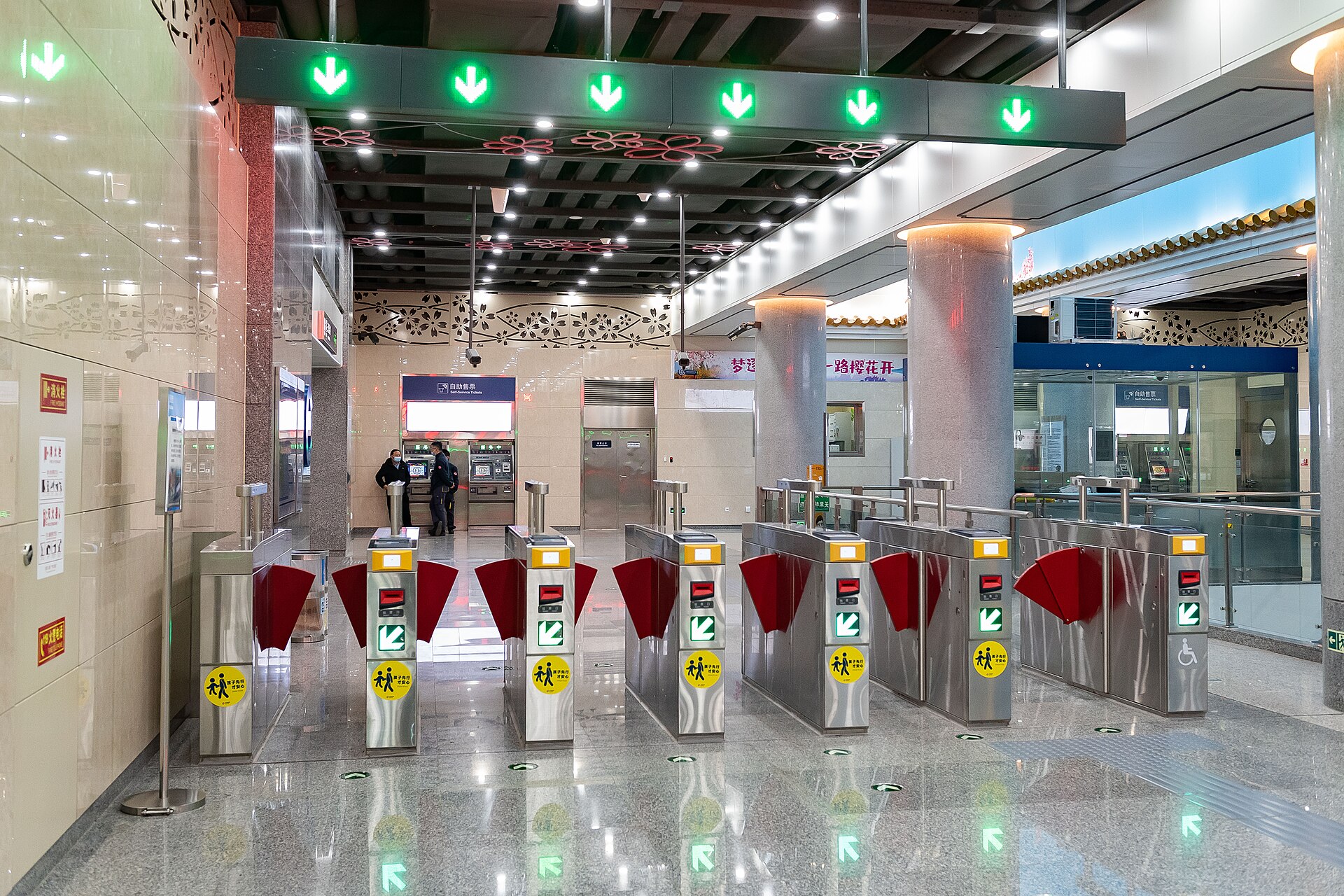
The single most useful line in that table is the first. Since the network opened its gates to foreign cards, you can ride the entire Beijing subway without buying a ticket or installing anything: hold a contactless card flat on the reader, walk through, and tap again on the way out. Our subway guide covers the lines and the stations that matter, and the airport transfer guide the trains in from both airports.
Why the gap exists
China skipped the plastic-card stage that most countries went through. When mass consumer payments took off in the 2010s, they went from cash almost straight to QR codes on phones, and card terminals never spread down to the small shops and stalls the way they did in Europe or North America. The cards that did exist were issued on UnionPay, China’s own network, so the terminals that were installed were set up for UnionPay first.
From 2023 onwards the government pushed hard to make the country easier for foreign visitors to pay in. Beijing drew up a list of around 11,000 “key merchants” across hotels, restaurants, transport, tourism, shopping, entertainment, healthcare and education, and by 2024 more than 80% of the first list accepted Visa and Mastercard. That is real progress, and it explains exactly where your card works: at the businesses on that list, chosen because visitors use them.
It is worth being clear about what the figure does not mean. Eighty per cent of 11,000 businesses selected for their foreign customers is not eighty per cent of Beijing. The city has hundreds of thousands of restaurants, shops and stalls, and the vast majority of them take QR codes and cash and nothing else. That is where the apps come in.
Your card inside an app: the real answer
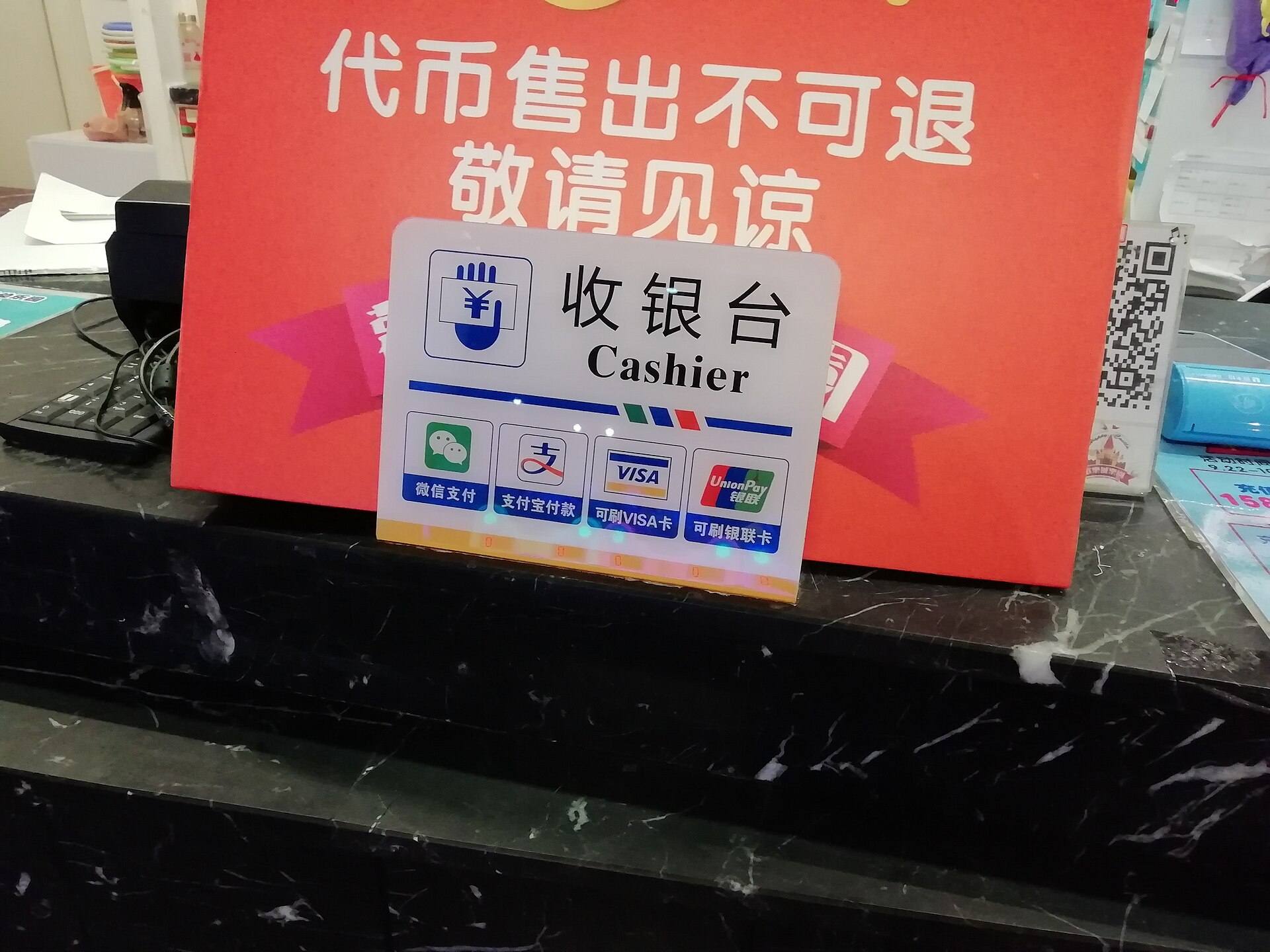
The way to make a foreign card useful everywhere is not to present it but to link it. Both Alipay and WeChat Pay accept foreign Visa, Mastercard, American Express, JCB and Discover cards after a passport check, and then every QR code in the city becomes a card terminal. The app charges your card each time you pay.
There is one catch worth knowing: both apps add a 3% fee to any single payment over ¥200 made with a foreign card, applied to the whole amount, while payments of ¥200 or less are free. UnionPay cards are exempt. So the smart pattern is to use your card directly where it is accepted for the big bills, such as hotels, department stores and online bookings, and to use the apps for everything small, which is most of a day.
A day of payments, card by card
It helps to see how this plays out over an ordinary sightseeing day. Here is a realistic one, with the payment method that actually gets used at each stop. Prices were checked in September 2026.
| Stop | Typical cost | How it gets paid |
|---|---|---|
| Subway from the hotel to Tiananmen East | ¥3–6 | Visa tapped on the gate |
| Jianbing from a cart outside the station | ¥8–15 | Alipay, scanning the vendor’s code |
| Forbidden City entry, booked a week earlier | ¥60 | WeChat Pay, inside the museum’s mini-program |
| Beef noodles at a chain shop | ¥18–25 | Alipay, showing your payment code at the till |
| DiDi across town, about 8 km | ¥35–45 | The card linked in DiDi, or Alipay |
| A ¥800 purchase in a department store | ¥800 | Visa, directly at the till, in yuan |
| Half a roast duck at Siji Minfu | about ¥159 | Alipay, under the ¥200 fee threshold |
| A beer at a hutong bar | ¥25–45 | WeChat Pay, via the code on the bar |
| Subway back to the hotel | ¥3–6 | Visa tapped on the gate |
Look at how few of those stops involve handing a card to anyone. The card does the work in every row, but it is presented directly only twice: at the subway gate and at the department store till. Everywhere else it is working behind an app. That is why the card question in Beijing is less about which card is accepted and more about which card you link, and why a fee-free card linked to both apps is the most useful thing in your wallet.
Notice too the one decision that saves real money: the department store purchase goes on the card directly, not through Alipay, which would have added ¥24 in fees. Everything under ¥200 costs nothing extra either way, so for small things use whichever method is quickest.
Which card to bring
Visa and Mastercard
The widest acceptance, both directly and inside the apps. Bring one of each if you can, from two different banks, so that one bank’s fraud department cannot stop you paying for anything.
American Express
Better than its reputation in China, though still narrower than Visa or Mastercard. It works at subway gates, in many hotels, and inside Alipay and WeChat Pay. At shop terminals it is hit and miss, so treat it as a second card, not your only one.
JCB, Discover and Diners Club
All three link to the payment apps. Discover has a long-standing network agreement with UnionPay, which means Discover and Diners cards can work on many UnionPay terminals in China, but test one early in the trip before you depend on it.
UnionPay
If your bank at home issues a UnionPay card, as many banks in Asia do, it is the best card you can bring to China. It is accepted at nearly every terminal in the country, it works at ATMs everywhere, and it is exempt from the 3% fee in Alipay and WeChat Pay. Most visitors from Europe or North America will not have one and do not need to apply for one.
Credit or debit?
Bring both if you can. A credit card is better for hotel deposits and for anything where you might need to dispute a charge. A debit card is better for ATMs, because a credit card withdrawal is treated as a cash advance with a fee and interest from the first day. And whichever cards you bring, a card with no foreign-transaction fee saves you up to 3% on everything, which adds up quickly on hotel bills.
At the terminal
Card payments in Beijing feel slightly old-fashioned to anyone used to tapping for everything at home. The terminal is usually brought to you or sits on the counter, and more often than not it wants the chip rather than a tap.
- Insert the chip unless the cashier indicates that you can tap. Contactless is standard on the subway and increasingly common in hotels and big stores, but chip and PIN is still the default at many shop terminals.
- Know your PIN. Chinese terminals commonly ask for one even on a credit card. Travellers from countries where credit cards are signed rather than PIN-verified are often caught out here. Some terminals will accept a signature instead, but not all. Chinese PINs are six digits; a four-digit foreign PIN normally works if you press confirm after the fourth digit.
- Choose yuan. If the terminal or the cashier offers to charge you in your home currency, decline. More on this below.
- Sign if asked, and keep the slip until the charge appears on your statement at the right amount.
A useful sentence if you are unsure: Kěyǐ shuā kǎ ma? (可以刷卡吗?), “can I pay by card?” If the answer is a shake of the head, the QR code on the counter is your answer.
Fees and the currency trap
Dynamic currency conversion, or DCC, is the offer to charge your card in your home currency instead of yuan. It is presented as a convenience, and sometimes as a “guaranteed” rate. It is always worse than the rate your own bank would give you, typically by several percent, and it is the single most avoidable cost of paying by card abroad. Choose yuan every time, at shop terminals, at hotel desks and at ATMs.
| Paying a ¥2,400 hotel bill | Extra cost |
|---|---|
| Card at the desk, in yuan, card with no foreign-transaction fee | ¥0 |
| Card at the desk, in yuan, card with a 3% foreign-transaction fee | About ¥72 |
| Through Alipay, card with no foreign-transaction fee | ¥72, the app’s 3% fee |
| Through Alipay, card with a 3% foreign-transaction fee | About ¥146 |
| Card at the desk, accepting conversion to your home currency | Several percent, on top of any bank fee |
The lesson of that table is simple. For large payments, a fee-free card used directly, in yuan, is the cheapest option by a distance. For small ones, the fees disappear under ¥200 and the apps are the practical choice. The Beijing budget guide shows what those large and small payments add up to over a trip.
Hotels, deposits and pre-authorisations

Hotels are the one place where a foreign card is fully at home. At check-in most will take a refundable incidentals deposit, and with a card this is a pre-authorisation: an amount, often a few hundred yuan and more at the upper end, is reserved on your card rather than charged. At check-out the hotel either completes the charge for what you owe or releases the hold.
The catch is timing. A released pre-authorisation can take several days, sometimes longer, to disappear from your statement, and in the meantime it reduces your available credit. It is not a double charge, even though it can look like one. Ask for a receipt showing the release at check-out, and if the hold is still there after a couple of weeks, send that receipt to your bank. Using a credit card rather than a debit card for the deposit keeps the held money out of your current account.
A card is also the cheapest way to pay the final bill, since it avoids the 3% app fee on a large amount. Our guide to where to stay covers the neighbourhoods, and the luxury hotels guide the top end, where card acceptance is a given.
Booking online with a foreign card
- Trains. Trip.com sells high-speed rail tickets from the same inventory as the official 12306 system and takes foreign cards, for a per-ticket service fee of roughly ¥10–25. The high-speed trains guide explains the booking and the stations.
- Hotels and flights. Trip.com and the international booking sites take foreign cards without fuss.
- Taxis. DiDi lets you add a foreign card in its own app, or you can run it through Alipay. The DiDi guide covers the setup.
- Attraction tickets. The big state-run sights book through their own websites and WeChat mini-programs, where the payment options are usually Chinese ones. This is the main reason to set up WeChat Pay even if you plan to pay for everything else by card.
Online payments with a foreign card usually trigger your bank’s security check, typically a code sent by SMS to your home number or an approval in your banking app. If you have swapped your home SIM for a data eSIM, you will not receive the text. On a dual-SIM phone, keep the home line active for messages.
Stopping your bank from blocking you
The most common reason a foreign card fails in Beijing is not a Chinese terminal refusing it. It is your own bank declining a transaction from an unfamiliar country. A few habits prevent almost all of it:
- Tell your bank you are travelling to China, with dates, if it still offers travel notices.
- Install the banking app and turn on notifications, so that a blocked payment arrives as an alert you can approve on the spot.
- Carry two cards from two banks, on two networks, kept in different places.
- Save your bank’s overseas phone number somewhere that is not only on your phone.
- Stop after two declines. Repeated attempts look more like fraud, not less, to both your bank and the payment apps.
If a card is lost or stolen, freeze it in your banking app first and then call. The rest of what to do in that situation is covered in the safety tips page, and it is also worth checking what your travel insurance says about lost cards and emergency cash.
Apple Pay, Google Pay and phone wallets
Do not plan around them. Google Wallet does not operate in mainland China, and while Apple Pay exists, a foreign card inside it has little merchant acceptance outside international hotels. A phone wallet may sometimes work at a contactless reader that takes the same card, but “sometimes” is not a payment strategy. Carry the physical cards, and use Alipay and WeChat Pay as your phone-based wallets in China.
When the card fails, what instead?
The fallbacks run in a fixed order, and it is worth having all of them ready: the same card through Alipay, then through WeChat Pay, then a second card, then cash. Cash matters more than it sounds, for the moment when a phone battery dies or a vendor’s personal QR code refuses a foreign card; our guide to cash and ATMs covers how much to carry and where to get it. For how all of these fit together, the money and internet overview is the place to start.
Frequently asked questions
Can I use my credit card in China?
Directly, at hotels, department stores, airports, international chains, online booking sites and Beijing subway gates. Not at most restaurants, street food stalls, markets, small shops or taxis. Linking the card to Alipay or WeChat Pay makes it usable almost everywhere.
Can I use Visa in Beijing?
Yes, at the places above, and Visa is one of the most widely accepted foreign networks in the city. By 2024 more than 80% of Beijing’s list of around 11,000 key merchants for foreign visitors accepted Visa and Mastercard. Street-level businesses mostly do not.
Does American Express work in China?
At Beijing subway gates, in many hotels, and inside Alipay and WeChat Pay. Acceptance at ordinary shop terminals is patchy, so bring a Visa or Mastercard as well.
Can I tap my card on the Beijing subway?
Yes. Every gate accepts contactless Visa, Mastercard, JCB, American Express and UnionPay cards. Tap in, tap out, and the fare is charged to your card. No ticket or app is needed.
Does Apple Pay work in China with a foreign card?
Do not count on it. Merchant acceptance for foreign cards in Apple Pay is minimal outside international hotels, and Google Wallet does not operate in mainland China. Carry the physical card and use Alipay or WeChat Pay on your phone.
Do I need a PIN for my credit card in China?
Usually. Chinese terminals commonly ask for a PIN even on credit cards, and not all will accept a signature instead. Check that you know your PIN before you travel, and ask your bank to set one if you do not have one.
Should I pay in yuan or in my home currency?
Always yuan. Paying in your home currency means accepting dynamic currency conversion, whose rate is several percent worse than your bank’s. This applies at shop terminals, hotel desks and ATMs.
Is UnionPay better than Visa in China?
Yes. UnionPay is China’s own network and is accepted almost everywhere, and UnionPay cards are exempt from the 3% fee that Alipay and WeChat Pay charge foreign cards on payments over ¥200. If your bank issues one, bring it.
Why was my card declined in Beijing?
Most often because your own bank blocked an unfamiliar transaction, so check your banking app for an alert. Otherwise the terminal may not take your network, or it wanted a PIN. Try once more, then switch to another card or to Alipay or WeChat Pay.