Getting Around Beijing
Beijing to Shanghai by Bullet Train: Route Guide & Tips
The complete guide to the Beijing–Shanghai bullet train: journey times, fares, classes, booking, stations and what the 4.5-hour ride is like.
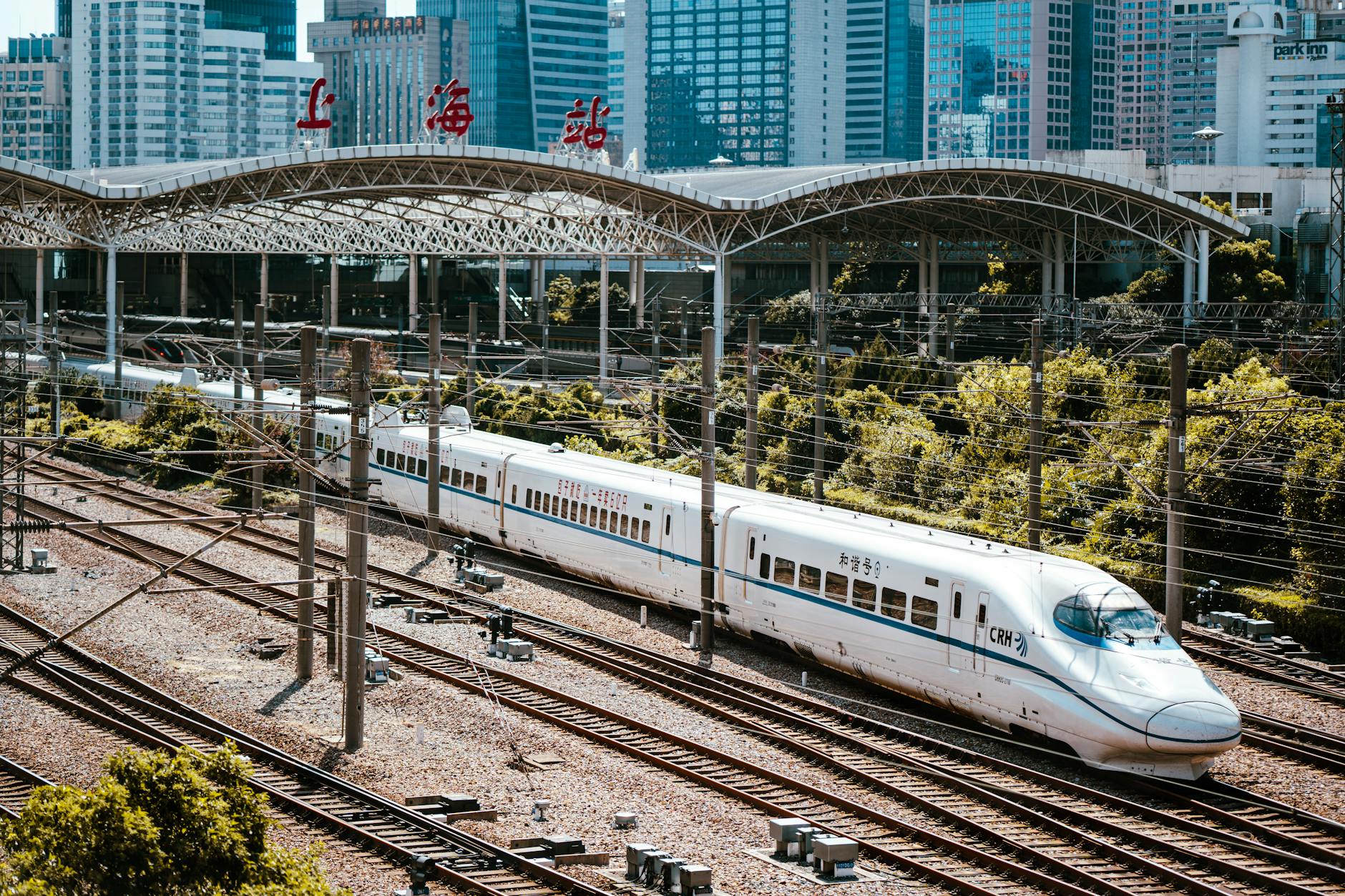
Taking the high-speed train from Beijing to Shanghai is one of the great travel experiences in China — a sleek bullet train covering the 1,318 km between the country’s two biggest cities in as little as 4.5 hours, gliding at up to 350 km/h through a constantly changing landscape of plains, rivers and rice fields. It’s faster than flying once you factor in airport hassle, far more comfortable, scenic, and remarkably affordable, with second-class fares from around ¥553. Whether you’re extending a Beijing trip with a few days in Shanghai or simply want the bucket-list experience of riding one of the world’s busiest and fastest railway lines, the journey is genuinely a highlight rather than just a transfer. This guide covers everything you need: the trains and journey times, how to book tickets, the classes and prices, the stations at each end, what the ride is like, and tips for a smooth trip. Getting to the station is its own small problem: taxis are simplest with luggage, and managing without Chinese covers the ticket hall. Flying from Daxing is the main alternative.
The Beijing–Shanghai high-speed line is the smoothest, most enjoyable way to connect China’s two great cities, and a memorable experience in its own right — one route among many in our broader Beijing high-speed trains guide. This guide covers the trains and times, booking, classes and fares, the stations, the onboard experience, and the practical tips that make it effortless. Sit back and enjoy the ride.

The Beijing–Shanghai train at a glance
- Distance
- 1,318 km between Beijing and Shanghai.
- Fastest journey
- about 4 hours 18 minutes on the quickest non-stop G-trains; most take 4.5–6 hours.
- Trains
- frequent “G” (Gaotie) high-speed services, running up to 350 km/h, from early morning to evening.
- Fares
- 2nd class from ~¥553; 1st class ~¥933; business class ~¥1,748.
- Stations
- Beijing South (Beijingnan) → Shanghai Hongqiao (most trains).
- Booking
- online via Trip.com or the official 12306 app/site, or at station counters; passport required.
- Best for
- anyone pairing Beijing with Shanghai — faster than flying door to door, and a scenic, comfortable ride.
The trains and journey times
The Beijing–Shanghai high-speed railway opened in 2011 and is one of the busiest and most profitable rail lines in the world. The trains you want are the “G” services (Gaotie, meaning high-speed), which run at up to 350 km/h and depart very frequently — roughly every 15–30 minutes through the day, from around 6am to 7pm. Journey times vary with the number of stops: the fastest non-stop trains cover the route in about 4 hours 18 minutes, while most services take between 4.5 and 6 hours depending on how many of the intermediate cities (such as Tianjin, Jinan, Nanjing and Suzhou) they call at. When booking, look for the shortest-duration G-trains if speed matters to you. There are also slower, cheaper overnight and “D” services, but for a day journey the standard G-train is the obvious choice. With so many departures, you rarely need to plan far ahead for timing — though booking the specific train and seat you want is wise in busy periods.
How to book tickets
Booking is straightforward, and you have three main options. The easiest for foreign visitors is a third-party site or app like Trip.com, which has an English interface, accepts international cards, and sends you a booking confirmation — you then collect or scan at the station. You can also book directly through the official China Railway “12306” app or website, which is cheapest (no booking fee) and now handles foreign passports, though the interface is less polished. Finally, you can buy at station ticket counters or self-service machines, but queues can be long and counters may have limited English. Whichever you choose, you’ll need your passport — Chinese rail tickets are sold against your passport number and are effectively e-tickets tied to your ID, so you simply scan your passport at the automated gates to enter the platform (no paper ticket needed). Book a few days ahead for popular departures, and well in advance around major Chinese holidays (Spring Festival, National Day, Labour Day), when trains sell out fast. Tickets go on sale up to 14 days before departure.

Classes and fares
G-trains offer three main classes, all comfortable. Second class (from around ¥553) is the workhorse and perfectly pleasant: five seats per row (3+2) in a clean, modern carriage with a fold-down tray, power socket and decent legroom — the choice most travellers make, and excellent value. First class (around ¥933) has four seats per row (2+2), noticeably wider and with more recline and space, worth the upgrade if you value comfort on the 4.5-hour ride. Business class (around ¥1,748) is genuinely luxurious — wide leather seats that recline almost flat, in a 2+1 layout at the very front, with the most space and amenities; it’s pricey but a treat. All classes are non-smoking, air-conditioned and have toilets and luggage space. For most visitors, second class is more than adequate and the smart-value pick, while first class is a comfortable indulgence on a long daytime journey. Note fares can vary slightly by specific train and demand.
The stations at each end
Most Beijing–Shanghai G-trains run between Beijing South Railway Station (Beijingnan) and Shanghai Hongqiao Railway Station. In Beijing, Beijing South is a large, modern station south of the centre, connected to the city by subway lines 4 and 14 — allow plenty of time, as it’s big and security plus passport-ticket checks take a while; aim to arrive at least 45–60 minutes before departure. At the Shanghai end, Hongqiao is a vast transport hub on the city’s western side, integrated with Hongqiao Airport and served by metro lines 2, 10 and 17, giving easy onward access into central Shanghai (around 30–40 minutes to the centre by metro). A few services use Shanghai’s other stations, so always check which station your ticket shows. At both ends, follow signs for the high-speed platforms, scan your passport at the automated gates, and note that boarding closes a few minutes before departure — Chinese high-speed trains leave exactly on time, so don’t cut it fine.
What the journey is like
The ride itself is a pleasure. Chinese high-speed trains are smooth, quiet and impressively stable — at 350 km/h you’d barely know how fast you’re going but for the speed display in the carriage and the scenery flashing past. The carriages are clean and modern, with comfortable seats, power sockets, large windows and air conditioning. The journey is genuinely scenic, rolling from the northern plains around Beijing through Shandong and across the great rivers and green, water-laced landscapes of the Yangtze Delta as you near Shanghai — a real sense of crossing the country. There’s a dining/snack car and a trolley service selling drinks, instant noodles, snacks and hot meals, though many travellers bring their own food (a station or convenience-store picnic is part of the fun). Toilets and washbasins are at the carriage ends, and there’s room for luggage on overhead racks and in end-of-carriage bays. With 4.5 hours to relax, watch the landscape, eat, read or nap, the trip flies by — most people arrive in Shanghai feeling fresh, which is rarely true of flying.
Train vs plane
People often ask whether to take the train or fly Beijing–Shanghai, and for most travellers the train wins on almost every count that matters — time, comfort, reliability and sheer enjoyment. A flight is around 2 hours 15 minutes in the air, but once you add getting to the airport (both are far from the city centres), checking in, security, boarding, frequent delays, and the trip from the destination airport into town, the real door-to-door time is often similar to or longer than the train’s — and far more stressful. The high-speed train delivers you from city centre to city centre, runs almost always on time, gives you more space and a scenic ride, and lets you keep your liquids and move around freely. Fares are broadly comparable to economy flights, sometimes cheaper. Flying only really makes sense if you find a very cheap fare or need an overnight option. For a daytime journey between the two cities, the bullet train is faster in practice, more comfortable, more reliable and more enjoyable — it’s the clear recommendation.
Tips for a smooth trip
A few pointers make the experience effortless. Book a few days ahead (and well ahead around Chinese holidays), choosing the shortest-duration G-train if speed matters. Arrive early — 45–60 minutes at Beijing South — to clear security and passport-ticket gates without stress. Carry your passport, as it’s both your ticket and your ID at the gates. Set up a mobile-payment app (Alipay or WeChat Pay) for buying food and onward transport, and download an offline map and translation app. Pack a picnic or snacks and a water bottle for the ride (there’s hot water on board for tea or instant noodles). Travel light enough to manage your bags up to the overhead racks. Keep some layers handy, as the air conditioning can be cool. And note your destination station carefully (almost always Shanghai Hongqiao) so you plan the right onward metro line. Do these and the journey is one of the easiest, most pleasant intercity trips you’ll make anywhere.
A record-breaking railway
It’s worth appreciating what you’re riding. The Beijing–Shanghai high-speed railway is one of the engineering marvels of modern China — a dedicated 1,318 km line, much of it carried on continuous elevated viaduct to keep the track dead-level and avoid the farmland and waterways below. When it opened in 2011 it slashed the journey between the two cities from over ten hours to under five, and it has since become one of the busiest passenger rail corridors on earth, carrying hundreds of millions of travellers. The line is also famous for its speed records: Chinese high-speed trains have run test and even scheduled services at the upper limits of conventional rail, and the smooth 350 km/h cruising you experience is the everyday reality. For anyone interested in trains, infrastructure, or simply the scale of modern China, the journey is a window onto a country that has built the world’s largest high-speed network — over 40,000 km of it — in barely fifteen years. That context makes the ride feel less like a commute and more like a small piece of history in motion.
Cities and scenery along the way
Depending on the train you choose, the route calls at or speeds past a string of notable cities, and knowing them adds interest to the window-watching. Soon after leaving Beijing you pass Tianjin — a great northern port city worth its own day trip if you haven’t been — then across Shandong province, with Jinan (its provincial capital) and a glimpse of the plains near Mount Tai, one of China’s sacred mountains. The line then crosses the mighty Yangtze River near Nanjing, a former imperial capital steeped in history, before entering the lush, canal-laced Yangtze Delta — the heart of classical “water town” China — passing Suzhou, famed for its gardens and silk, and Wuxi on Lake Tai, before arriving in Shanghai. Some of these make excellent stopovers in their own right if you have time: Nanjing and Suzhou in particular reward a day or two. Even if you ride straight through, the shift from dry northern plains to green, watery southern landscapes over the course of the journey is a vivid lesson in China’s geography — keep a window seat and watch the country change.
Extending your trip into Shanghai
Before you board, make sure you’ve allowed enough time in Beijing itself (see our guide to how many days to spend in Beijing) — once you head onward, its own excursions — the Qing emperors’ summer retreat up at Chengde, the valley where 13 Ming emperors are buried, the canyon boat ride in Yanqing county and Cuandixia’s ancient village — are no longer within reach. If the train is taking you on to Shanghai, you’re in for a treat — China’s dazzling, futuristic financial capital is the perfect counterpoint to Beijing’s imperial grandeur. From Hongqiao, the metro whisks you to the centre in around 30–40 minutes. Give yourself at least two or three days to take in the iconic Bund waterfront with its colonial-era architecture facing the soaring skyline of Pudong, the elegant French Concession with its plane-tree-lined streets and cafés, the classical Yu Garden, and the city’s superb food and nightlife. Pairing Beijing and Shanghai by high-speed train gives you the two essential faces of China — ancient and ultra-modern — linked by one of the world’s great rail journeys. It’s an itinerary I recommend to almost every first-time visitor with the time to do it.
Beijing to Shanghai train FAQ
How long does the train from Beijing to Shanghai take?
The fastest non-stop G-trains take about 4 hours 18 minutes; most services take between 4.5 and 6 hours depending on the number of stops. Trains cover the 1,318 km route at up to 350 km/h, running frequently from early morning to evening.
How much does a ticket cost?
Second class starts around ¥553, first class around ¥933, and business class around ¥1,748. Second class is comfortable and excellent value; first class adds more space; business class is genuinely luxurious. Fares vary slightly by train and demand.
How do I book the train?
Book online via Trip.com (easy, English, accepts foreign cards) or the official 12306 app/website (cheapest), or at station counters and machines. You’ll need your passport, which acts as your ticket — just scan it at the automated gates. Book a few days ahead, and well in advance around Chinese holidays.
Which stations do the trains use?
Most run between Beijing South (Beijingnan), on subway lines 4 and 14, and Shanghai Hongqiao, served by metro lines 2, 10 and 17. A few use other Shanghai stations, so always check your ticket. Arrive 45–60 minutes early for security and gates.
Is the train better than flying?
For most travellers, yes. Although the flight is shorter in the air, the train’s city-centre-to-city-centre convenience, reliability, comfort and scenery usually make total door-to-door time similar or better — and far less stressful. Fares are comparable. Fly only for a very cheap fare or an overnight need.
Do I need to print a ticket?
No. Chinese high-speed tickets are tied to your passport number, so you simply scan your passport at the automated gates to enter the platform — no paper ticket needed. Keep your passport handy throughout, as it’s checked at security and the gates.
The bottom line on the Beijing–Shanghai train
The high-speed train between Beijing and Shanghai is the smartest and most enjoyable way to connect China’s two great cities — a smooth, scenic 4.5-hour glide from city centre to city centre that beats flying on convenience, comfort and reliability, and costs from just ¥553 in second class. Book a fast G-train a few days ahead, bring your passport, arrive early at Beijing South, pack a picnic, and settle in to watch the country roll by. It’s not just a transfer; it’s one of the best travel experiences China has to offer.
For getting around the capital itself, we have written up every way of moving around Beijing, and how the metro lines, fares and ticketing work in more detail. If you have days to fill before your train, there are plenty of shorter escapes within a couple of hours of the city, and everything involved in planning a Beijing trip sits in one place.