Beijing Itineraries
1 Day in Beijing: An Hour-by-Hour Route Down the Axis
One day on the central axis, hour by hour, with the subway lines, the bookings to make first, a layover version, a Monday version — and what a single day cannot include.
At seven in the morning the Temple of Heaven park is full of people who are not tourists. There are perhaps two hundred ballroom dancers under the cypresses, a choir of retired railway workers, half a dozen card schools, and a man in his eighties writing enormous characters on the flagstones with a sponge brush and a bucket of water, watching them evaporate behind him. Ninety minutes later they have all gone home and the coaches have arrived. Anyone with 1 day in Beijing should understand that this is the whole game: the city gives its best hours to people who are awake for them, and a single day here succeeds or fails on the timetable rather than the ambition.
This page is one day, hour by hour, in three versions — the standard first-visit day, a tighter layover version, and a second-visit alternative — with the exact subway lines, the bookings you must make before you arrive, where to eat, and an honest account of what a single day cannot include. Prices were checked in September 2026; treat them as the right order of magnitude rather than a quotation.
The one rule
You cannot do the Great Wall and the Forbidden City in the same day. People try. The Wall is ninety minutes each way to the nearest good section, the Forbidden City needs three hours to be worth entering, and combining them produces a day of transport with two rushed hours at either end. If you have one day and the Wall matters more to you than the imperial city, go to the Wall and accept that you will not see the palace — that is a legitimate choice, and it is covered at the end of this page.
For everyone else, one day means the central axis, on foot and by subway, in a straight line from south to north. The whole route is about eight kilometres of walking and three subway journeys costing ¥3–5 each.
Book these before you arrive
None of this is optional and all of it will ruin the day if you leave it late.
- The Forbidden City. ¥60 from April to October, ¥40 from November to March. Sold online only, through the Palace Museum’s booking site or its WeChat mini-programme — there are no gate sales at all. Tickets release seven days ahead and popular dates go within minutes. Each visitor needs their own passport number on the booking, five people maximum per booking. Closed Mondays. If your one day is a Monday, use the second-visit itinerary below.
- Tiananmen Square. Requires advance booking, a passport and a security check. Allow twenty minutes for the queue.
- Payment. Set up Alipay and WeChat Pay before you fly — both accept foreign Visa and Mastercard after in-app passport verification, with no Chinese bank account needed. Do it on both phones if you are travelling as a pair.
- Dinner. The well-known Peking duck houses need a reservation, especially for two on a weekend.
Carry the physical passports rather than photographs. Gate scanners read the document, and this catches people out several times a day at the Forbidden City.
What the day costs
| Item | Cost per person | Notes |
|---|---|---|
| Temple of Heaven, through ticket | ¥34 peak / ¥28 off | Not the ¥15 park-only ticket |
| Forbidden City | ¥60 Apr–Oct / ¥40 Nov–Mar | Treasure Gallery +¥10, Clock Gallery +¥10 |
| Jingshan Park | ¥2 | ¥10 during the spring peony festival |
| Beihai Park | ¥10 peak / ¥5 off | Through ticket ¥20 |
| Subway, three journeys | ¥9–15 | Distance-based |
| Breakfast, street | ¥10–20 | Jianbing, baozi, soy milk |
| Lunch, casual | ¥30–60 | Noodles or dumplings near the palace |
| Peking duck dinner | ¥180–280 | Shared duck plus sides and a beer |
| Boat on Beihai, optional | ¥100–200 per hour | Split between the boat, not per person |
| Day total | ¥330–500 | Excluding accommodation |
The standard day, hour by hour
06:30 — Breakfast on the street
Find a jianbing cart or a steamed-bun window near your hotel. A jianbing — a thin crêpe cooked on a griddle with egg, coriander, a crisp cracker and chilli sauce — costs ¥8–12 and is the best breakfast in the city. A hotel buffet at ¥120 is a poor trade at any hour and a very poor one at this one. The breakfast guide covers what to look for.
07:00 — Temple of Heaven
Subway Line 5 to Tiantan Dongmen, the East Gate. The park opens well before the buildings do, and that hour is the point of coming this early: the morning-exercise culture in the cypress groves is one of the genuinely unrepeatable things about Beijing, and it is over by nine.
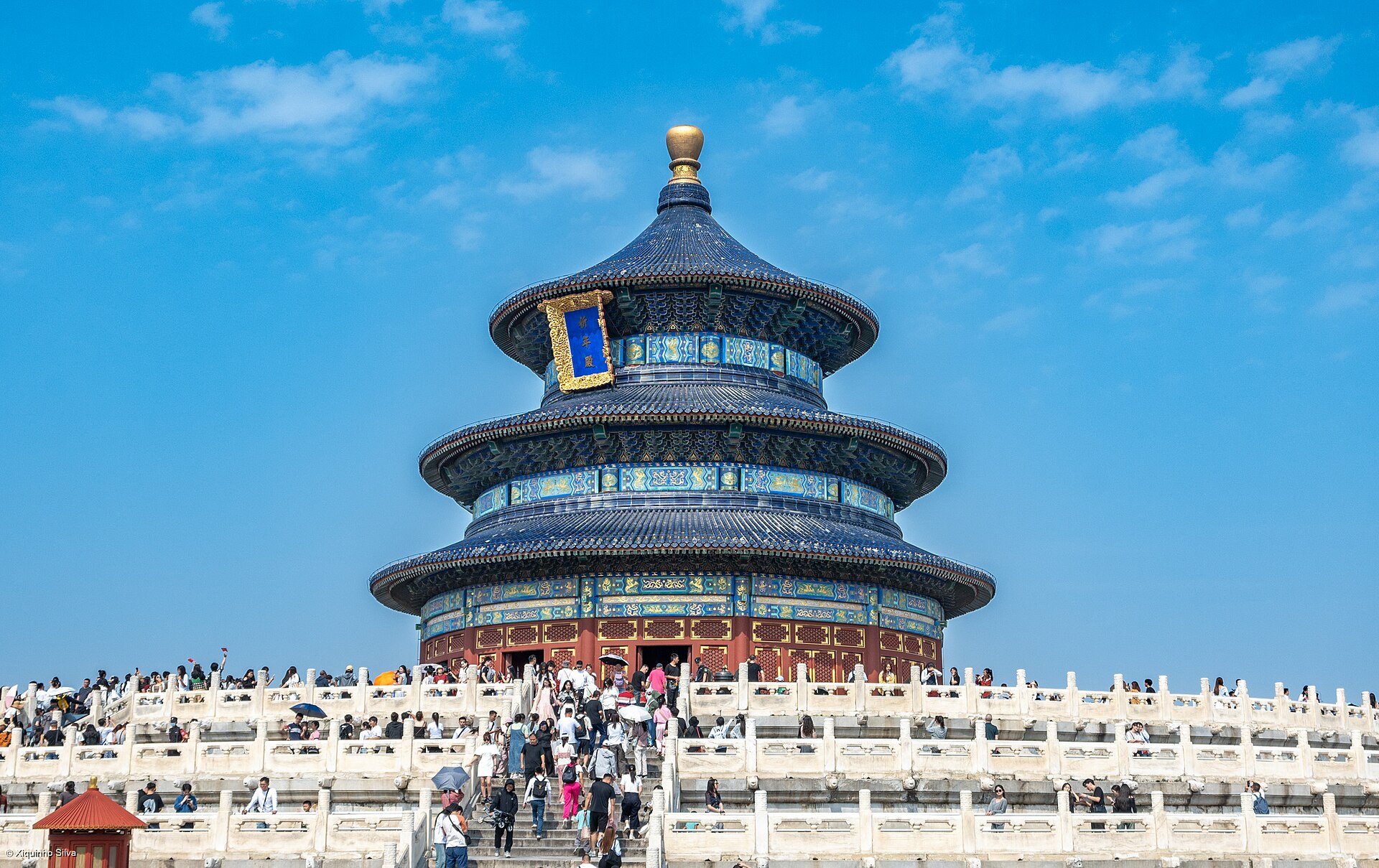
Buy the ¥34 through ticket (¥28 in the off season). The ¥15 park-only ticket does not include the Hall of Prayer for Good Harvests, which is the triple-eaved circular building you have seen in every photograph, and people discover this at the inner gate.
Walk north through the park rather than doubling back: the Circular Mound Altar first, then the Imperial Vault of Heaven and the echo wall, then the raised causeway to the Hall of Prayer. Ninety minutes is enough. The full guide explains what you are looking at.
09:15 — Across to Tiananmen
Line 5 north to Chongwenmen, change to Line 2, then Line 1 to Tiananmen East. Or walk to Qianmen on Line 2 and approach the square from the south, which is the better arrival if you have the legs — you come up under the Zhengyangmen gate tower with the whole square opening in front of you.
09:45 — Tiananmen Square
Security check, passport, pre-booked entry. The square is 800 metres long and there is no shade whatsoever; in July this is a serious consideration. Forty-five minutes covers the Monument to the People’s Heroes, the Great Hall of the People from outside and the Gate of Heavenly Peace with its portrait. Photography of the square and the buildings is normal; photographing soldiers and security personnel is not, and this is enforced.
10:30 — The Forbidden City
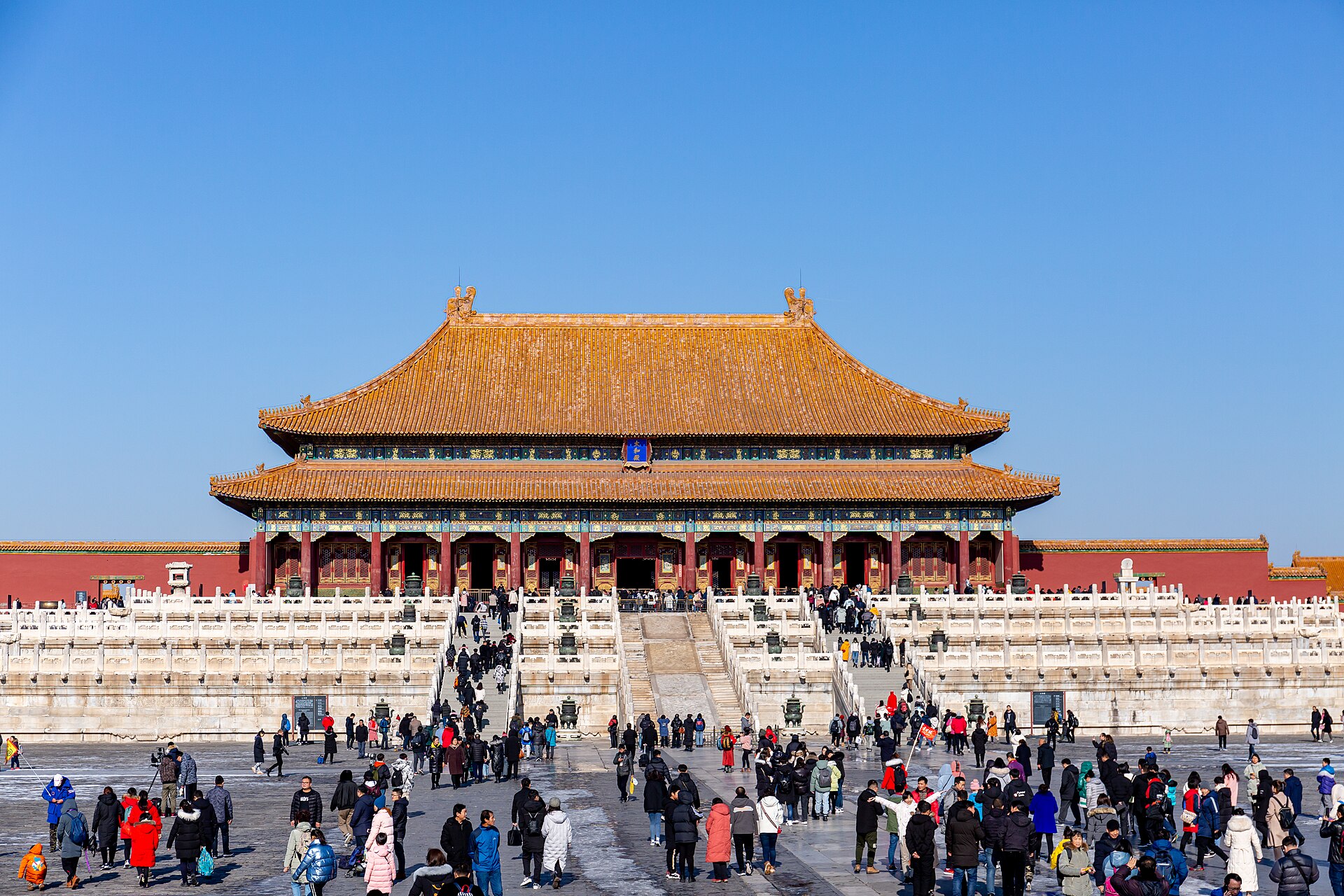
Enter at the Meridian Gate, Wumen, at the south end. Movement through the complex is strictly one-way, south to north, so there is no doubling back and no changing your mind.
Three hours. The central axis — the Hall of Supreme Harmony, the Hall of Central Harmony, the Hall of Preserving Harmony — is what everyone comes for and it moves you along in a slow river of people. Walk it, look at it, and then get off it. Peel east at the first opportunity into the Treasure Gallery courtyards (¥10 extra) and the smaller consort palaces, where the crowd drops by ninety per cent and you can actually stand still. That contrast is the single most useful piece of advice about the place.
Practical notes: no tripods, no flash in the halls, some interiors prohibit photography altogether. Toilets are frequent. There is food inside and it is mediocre. Exit at the Gate of Divine Prowess, Shenwumen, at the north end. The full palace guide covers the layout in detail, and the gallery halls are worth the extra ticket if the weather has turned.
13:30 — Lunch
Come out of Shenwumen and turn west along the moat towards Beihai, or east towards Donghuamen. There are noodle and dumpling places in the surrounding streets at ¥30–60. Do not eat on the tourist strip immediately outside the north gate; walk two streets in any direction and the price halves.
14:30 — Jingshan Park
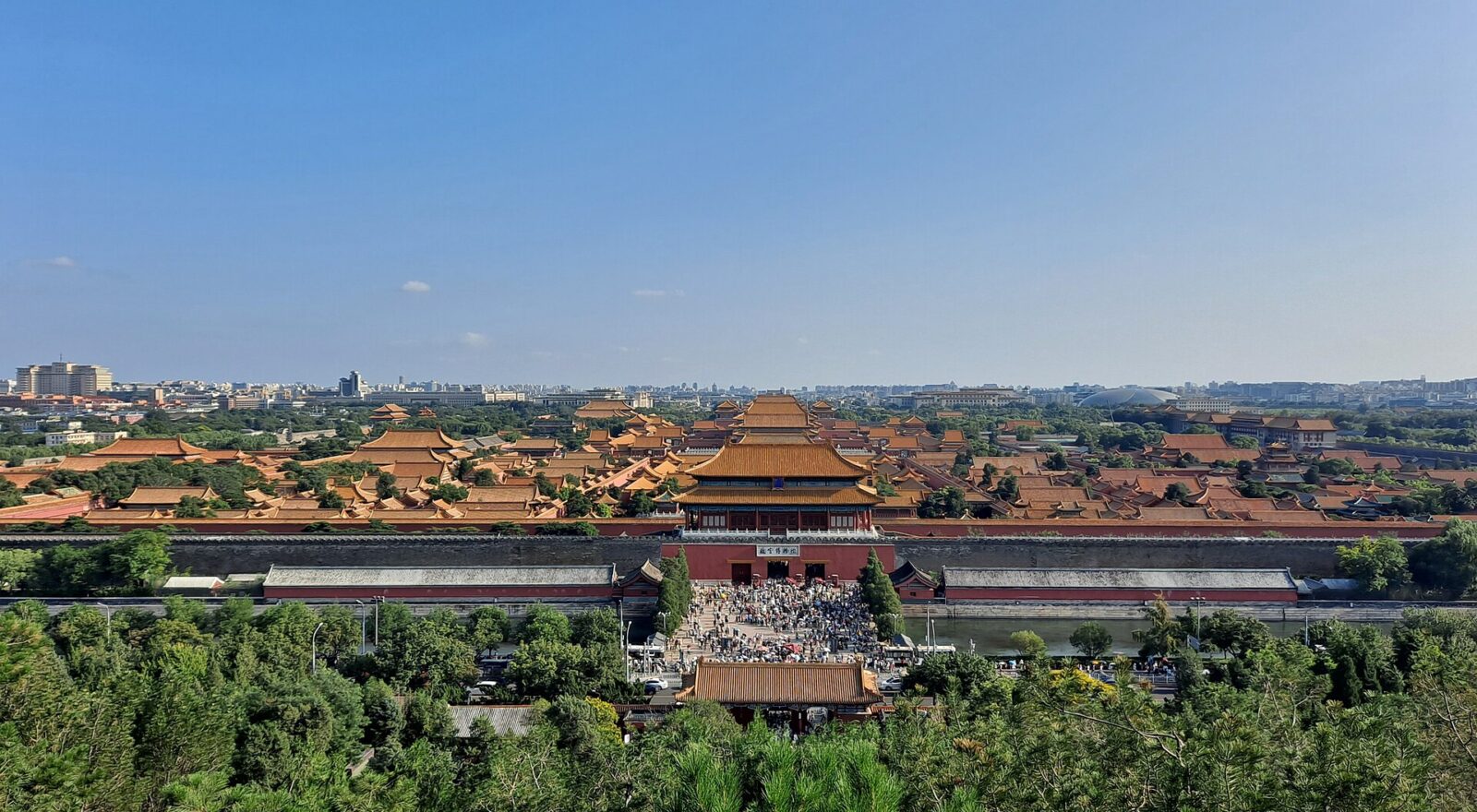
Directly across the road from the Forbidden City’s north exit. ¥2, and the best two yuan you will spend in China. The climb to the Wanchun Pavilion takes ten minutes and delivers the entire palace complex laid out below in receding ranks of gold roof, with the Western Hills behind it on a clear day.
Take the eastern path up, which is quieter than the direct central staircase. Forty-five minutes including the climb and a proper look. This is the moment the day’s geography makes sense — you can see the axis you have just walked. The park guide has more on the gates and the peony garden.
15:30 — Beihai or the lakes
Two options, both good.
Beihai Park is a five-minute walk west: a lake with a white Tibetan-style dagoba on an island, willows, and rowing boats from about ¥100 an hour. ¥10 in peak season, ¥20 for the through ticket that includes Jade Island. Calm, green, and the correct antidote to three hours of monumental architecture.
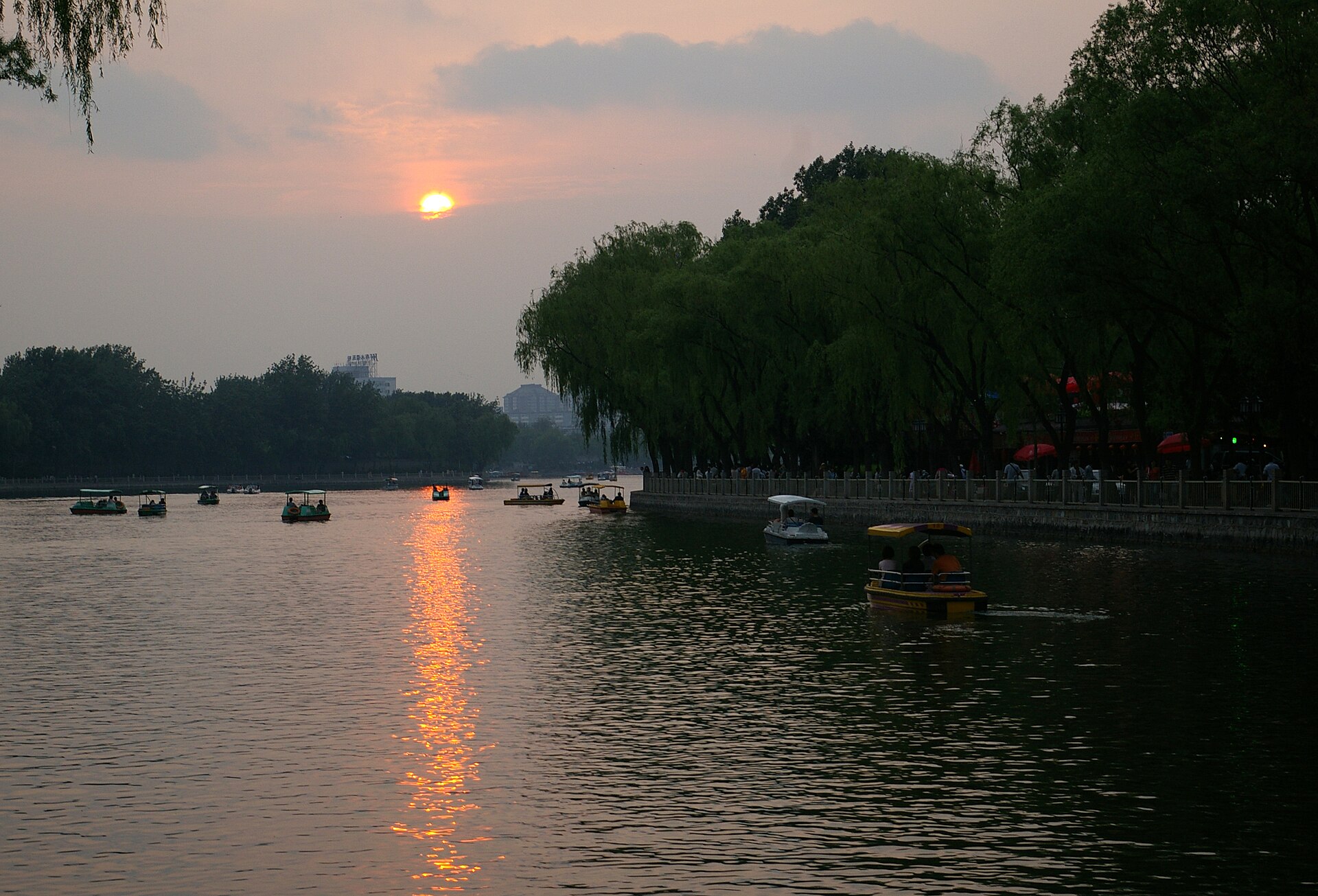
Shichahai is twenty minutes north on foot or one stop on Line 8. Three connected lakes, willows, hutongs running off in every direction, and a stone bridge at Yinding Qiao where the whole thing narrows. Walk the western shore of Houhai, which is residential and quiet, rather than the eastern side, which is bars and hawkers.
If you only have the energy for one, take Shichahai — it is the part of Beijing that is not a monument, and a day without it is a day of palaces.
17:30 — The Drum and Bell Towers
North from Shichahai on foot, or Line 8 to Shichahai station. The two towers face each other across a small square that is one of the most pleasant places in central Beijing to sit at the end of the day, and the alleys running east are full of small bars and noodle shops. Climbing the Drum Tower costs around ¥20–30 and the drum performances run through the day; if you are tired, the square below is enough.
18:30 — Peking duck
The one meal you should book. A whole duck carved at the table with pancakes, cucumber, spring onion and sweet bean sauce runs ¥250–400 depending on the house, and feeds two generously or three adequately. Siji Minfu and Duck de Chine are the usual recommendations and both need a reservation; the duck guide compares them and explains why the most famous name is not the best one.
If duck does not appeal, Ghost Street is a fifteen-minute taxi east — a kilometre of red lanterns where the speciality is málà crayfish eaten with plastic gloves on, and the restaurants run until 4am.
20:30 — Optional last hour
A drink on the western shore of Houhai, a walk back down through the hutongs, or an early night. You will have walked between fifteen and eighteen kilometres. Do not schedule an acrobatics show as well; you will sleep through it.
The layover version
If you are on a 24-hour visa-free transit — available to all nationalities at any Chinese airport, provided your onward flight is to a different country from the one you arrived from — the day is tighter and the priorities change.
- Leave your bags at the airport. Both terminals have left luggage. Do not drag a suitcase around the axis.
- Work out your airport first. Capital (PEK) is 45 minutes out on the Airport Express to Dongzhimen, ¥25. Daxing (PKX) is an hour, via the Daxing Airport Express to Caoqiao, and a taxi can take ninety minutes at the wrong time. The two airports are 70km apart with no quick link.
- Cut the Temple of Heaven if your window is under twelve hours. Start at Tiananmen instead.
- The core is Tiananmen, the Forbidden City, Jingshan. Four and a half hours, and it is the irreducible version of Beijing.
- Allow three hours for the return — three and a half from Daxing — plus the transfer. Work backwards from your flight and be ruthless about it.
A twelve-hour layover realistically buys you the palace, the hill and a meal. That is a genuinely worthwhile day and it is not a compressed version of a holiday.
The second-visit version, or the Monday version
If you have seen the Forbidden City, or your one day falls on a Monday when it is closed, the day looks completely different — and several people prefer it.
- 07:00 — The Forbidden City’s moat and the Jiaolou corner towers, from outside. Free, no ticket, no booking, and at dawn the water is still enough to reflect the whole structure.
- 08:30 — Yonghegong, the Lama Temple, in the first hour after opening when incense smoke fills the courtyards. Then the Confucius Temple and Guozijian a few minutes’ walk west, which is almost always empty.
- 11:00 — The Dongsi hutongs, a grid of numbered alleys that are still genuinely residential and see very few visitors.
- 13:00 — Lunch in the alleys, then a tea house for an hour. Choose one with prices posted.
- 15:00 — 798 Art Zone, or Beihai and a boat if you would rather stay central.
- 18:00 — Shichahai, and dinner in the hutongs behind the lakes.
Nothing in that list closes on a Monday.
If the Great Wall is the priority
Some people would rather see the Wall than the palace, and with one day that is a straight either/or. If it is the Wall:
Leave central Beijing at 6.30am for Mutianyu — ninety minutes by car, ¥900–1,400 for a private driver for the day, or 916快 from Dongzhimen plus a local bus for ¥12–20 each way but arriving considerably later. Entry ¥45, shuttle ¥20, cable car ¥140 return, toboggan ¥100.
Take the first gondola, walk east towards towers 20 to 23 where the crowd disappears, toboggan down, and be back in the city by two. That leaves you an afternoon for Jingshan and the lakes, and an evening for duck — which is, in truth, a better single day than the palace version for a lot of people.
What you give up is the Forbidden City, and it is a real loss. The longer itineraries exist precisely because one day forces this choice.
Practicalities that decide the day
Transport. The subway is fast, ¥3–8 a journey, signed in English, and has a bag scanner at every entrance. It is the only sensible way to move between clusters at peak times. A taxi across the centre at 6pm can take an hour; DiDi works well for short hops and removes the language problem.
Walking. Expect fifteen to eighteen kilometres. Tiananmen Square alone is 800 metres end to end and the Forbidden City is nearly a kilometre. Wear shoes you would walk a city in, not shoes you would sightsee in.
Air and weather. Check the reading before you commit to a full day outdoors. Anything under AQI 100 is fine; over 150 and you should be swapping park time for the Palace Museum galleries and the National Museum. Beijing’s air is far better than its reputation — a record-low 27 µg/m³ annual average in 2025 — but a hazy day flattens the view from Jingshan completely. The air quality guide explains what to look at.
Season. Late September to early November is the best window: dry, clear, around 20°C. Avoid 1–7 October, Golden Week, when the axis is at its most crowded. July and August are hot, humid and shadeless on the square; start earlier and take more water.
Toilets. Frequent and free in the parks and the palace, variable in quality, and often without paper. Carry tissues.
Scams. The one that targets single-day visitors is the tea ceremony: two friendly strangers near Tiananmen or Wangfujing practise their English, suggest a tea house, and the bill arrives at ¥2,000. Also the art-student gallery invitation. Both are covered in the safety guide. Beijing is otherwise a very safe city.
What one day cannot include
Being straightforward about this saves disappointment:
- The Great Wall, unless you swap it for the Forbidden City.
- The Summer Palace, which is in the north-west and needs half a day on its own.
- Any real time in the hutongs. You will pass through them; you will not spend an afternoon in them.
- 798, Panjiayuan or the modern city.
- A day trip anywhere — the Ming Tombs, Tianjin, Chengde.
- A show. Peking opera or acrobatics is a lovely evening and you will not have the energy.
If any two of those matter to you, the honest answer is that you need a second day. The trip-length guide works through where the returns fall off.
If a second day turns out to be possible — a delayed flight, a spare Saturday — the shape of the trip changes completely, because the Great Wall stops competing with the palace for the same daylight. Our hour-by-hour plan for two days keeps this axis route intact and gives Mutianyu a whole day of its own.
A version of this route squeezed between two flights is a different and much tighter proposition, since immigration and international check-in take four to five hours off the clock before you start. The layover version works through the timings and says which sites survive the compression.
If the single day turns out to be two or three, the arithmetic changes more than you would expect: a second day buys the Great Wall, a third buys the Summer Palace and an unhurried hutong afternoon. A Friday-to-Sunday trip and a three-day plan are both written up separately, and if you have walked the central axis before, the second-visit route skips it entirely.
Frequently asked questions
Is one day in Beijing enough?
Enough for the central axis — the Temple of Heaven, Tiananmen, the Forbidden City, Jingshan and the lakes — which is a genuinely good day and about eight kilometres of walking. Not enough for the Great Wall as well, and not enough for the Summer Palace, the hutongs at leisure or anything modern. Two days is the point at which a Beijing trip stops feeling truncated.
Can I see the Forbidden City and the Great Wall in one day?
No, not in any way worth doing. The Wall is ninety minutes each way to the nearest good section and the palace needs three hours. Combining them gives you a day of transport with two rushed visits. Choose one; if it is the Wall, go to Mutianyu, leave at 6.30am, and use the afternoon for Jingshan and the lakes.
What time should I start?
06:30, with street breakfast, and be at the Temple of Heaven for 07:00. The first two hours are when the park belongs to Beijing’s own residents and the coaches have not arrived. Every hour later costs you disproportionately.
What if my day is a Monday?
The Forbidden City and most state museums are closed. Use the second-visit itinerary: the palace moat and corner towers at dawn, the Lama Temple, the Confucius Temple, the Dongsi hutongs, a tea house, 798 or Beihai, and Shichahai in the evening. None of it closes.
How much does a day in Beijing cost?
About ¥330–500 per person excluding accommodation: ¥34 for the Temple of Heaven, ¥60 for the Forbidden City in high season, ¥2 for Jingshan, ¥10 for Beihai, ¥9–15 of subway fares, and ¥220–360 on three meals including a shared Peking duck dinner.
Do I need to book in advance?
Yes, and this is the thing most likely to spoil the day. The Forbidden City sells online only, releases seven days ahead, sells out in minutes on popular dates and has no gate sales. Tiananmen Square needs booking plus a passport and a security check. Carry the physical passports; scanners read the document.
Is the subway easy to use?
Very. Signed and announced in English, ¥3–8 a journey depending on distance, and it reaches everything on this route. There is a bag scanner at every entrance, which adds a minute. Line 5 for the Temple of Heaven, Line 1 for Tiananmen, Line 8 for Shichahai.
What should I eat?
A jianbing from a street cart for breakfast at ¥8–12, noodles or dumplings near the palace at ¥30–60 for lunch, and Peking duck for dinner at ¥250–400 for a whole bird between two or three. Book the duck. Avoid the restaurants immediately outside the Forbidden City’s north gate.
Is it worth it on a layover?
With twelve hours or more, yes. Leave your bags at the airport, do Tiananmen, the Forbidden City and Jingshan, and allow three hours for the return plus the transfer — three and a half from Daxing. The 24-hour visa-free transit requires your onward flight to go to a different country from the one you arrived from.
How much walking is involved?
Fifteen to eighteen kilometres on the standard day. The square is 800 metres long, the Forbidden City is nearly a kilometre end to end and is strictly one-way, and Jingshan is a ten-minute climb on top of that. Comfortable shoes matter more here than almost anywhere.
What is the single best thing to do with limited time?
Jingshan at the end of the afternoon. Two yuan, ten minutes of climbing, and the whole Forbidden City below you with the hills behind. If the day collapses and you can only do one thing after the palace, do that.