Beijing Itineraries
3 Days in Beijing: Axis, Great Wall and the Two Gardens
Three days done properly: the central axis, Mutianyu, then the Temple of Heaven at dawn and the Summer Palace — with an alternative day three, all four advance bookings, and 2026 costs.
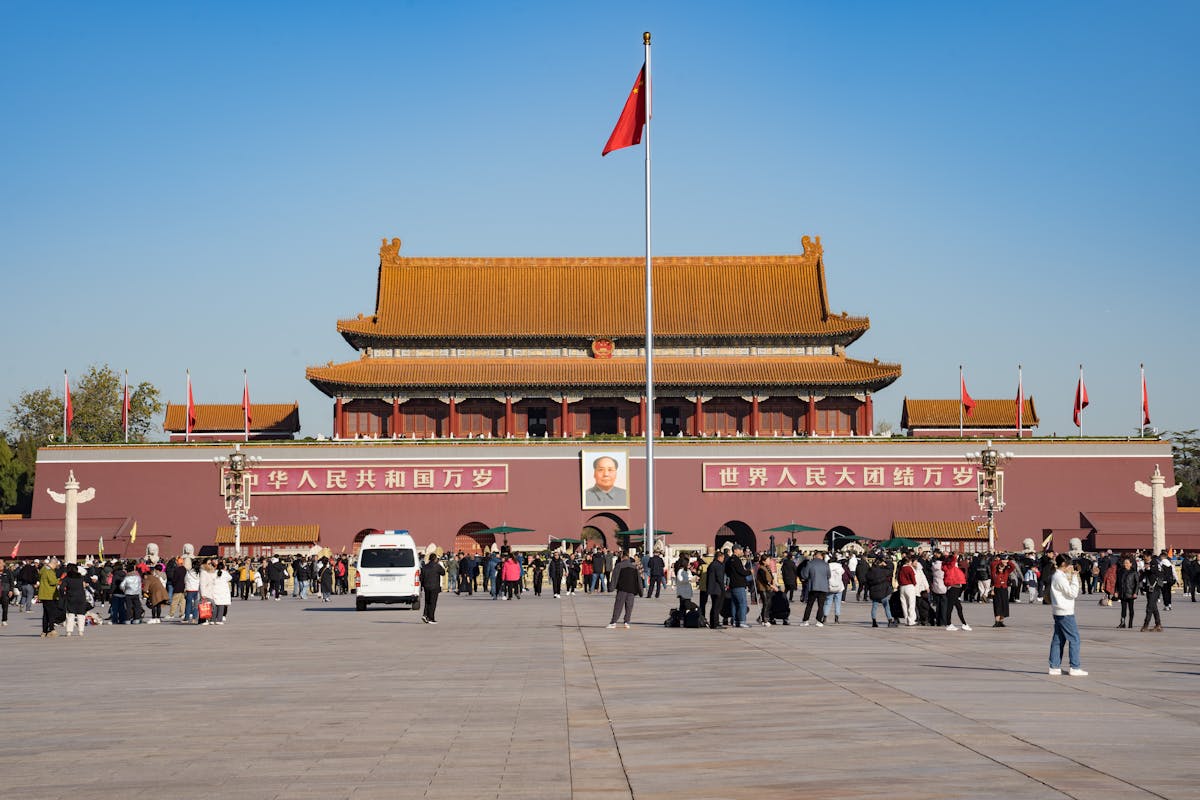
Three days is the first length at which Beijing stops feeling like a checklist. Two days forces a straight choice between the palace and the Wall; the third day buys back the Temple of Heaven, the Summer Palace and — more valuable than either — an hour or two where nothing is scheduled. This 3 days in Beijing itinerary uses that third day on the two great imperial spaces the short trips have to abandon, and it puts them in the order that the subway map actually rewards.
Below: an hour-by-hour route for all three days, the four things that must be booked before you land, what the whole trip costs, and the alternative day three for people who would rather not cross the city twice. Prices were checked in September 2026 — treat them as the right order of magnitude rather than a quote, because park through-tickets in particular change with the season.
The three days at a glance
| Day | Morning | Afternoon | Evening | Walking |
|---|---|---|---|---|
| One | Tiananmen, Forbidden City | Jingshan, Beihai | Shichahai, duck | 9–11 km |
| Two | Mutianyu Great Wall | Wall, then the bus back | Lama Temple or a show | 5–7 km, steep |
| Three | Temple of Heaven at opening | Summer Palace | Sanlitun or 798 | 8–10 km |
The logic is effort first, distance second. Day one is the longest walk but the shortest travel; day two is a three-hour round trip on a bus with three hours of steps in the middle; day three is two big sites at opposite ends of the city, which sounds worse than it is because both are on the subway and both are outdoors, so a slow start does not cost you a timed ticket.
If you can only start early once, start early on day two. If you can start early twice, make the second one day three — the Temple of Heaven before nine is a different place from the Temple of Heaven at eleven, and that difference is most of why it is on this list.
Book these four things before you fly
- The Forbidden City. ¥60 from April to October, ¥40 from November to March. Online only through bookingticket.dpm.org.cn or the WeChat mini-program, released seven days ahead, real-name against a passport number, five people maximum per booking. Popular dates disappear within minutes of release. There are no gate sales in any circumstance, and it is closed on Mondays.
- Tiananmen Square. Free, compulsory, real-name, booked one to nine days ahead in the official WeChat mini-program, and slot-specific: dawn, morning, afternoon or evening. Book morning for day one.
- The National Museum of China, if you want it as a wet-weather substitute. Free, but the reservation is mandatory, releases seven days ahead at 17:00 Beijing time, and you must arrive with the physical passport you booked with.
- The Mutianyu tourist bus from Dongzhimen in summer and over public holidays. Off-peak, walk-up is fine.
Install Alipay first and WeChat second. Alipay has the better English interface and takes a foreign Visa, Mastercard or Amex after in-app passport verification; WeChat matters because the booking mini-programs live inside it. Do both before you cross the border, along with a map that works in China — the app-by-app rundown is here.
What three days costs
Per person, entries and transport and food, no accommodation, using the subway and the tourist bus.
| Item | Cost |
|---|---|
| Forbidden City | ¥60 peak / ¥40 off, plus ¥10 Treasure Gallery |
| Jingshan | ¥2 |
| Beihai through ticket | ¥20 |
| Mutianyu entry, shuttle, cable car and toboggan | ¥265 |
| Tourist bus to Mutianyu | ¥80 return |
| Temple of Heaven through ticket | ¥34 peak / ¥28 off |
| Summer Palace through ticket | ¥60 peak / ¥50 off |
| Lama Temple | ¥25 |
| Subway, three days | ¥50–70 |
| Food, three days | ¥350–600 including one duck dinner |
| Realistic total | ¥950–1,250 (about US$135–180) |
The two places to spend more are a private car to the Wall — ¥800–1,500 for the vehicle, sensible for four people, poor value for two — and a guide for the Forbidden City morning, where the difference between a guided visit and an unguided one is real. The place not to spend more is a group day tour at ¥350–500 a head, which reliably includes a jade factory or a tea ceremony you did not choose.
Day one — the central axis
07:30 — Breakfast, then the square
Eat before the security queues rather than after. Jianbing from a cart or baozi and soy milk from a shop is ¥8–15 and ten minutes; the breakfast guide covers what is worth queueing for.
Tiananmen Square opens with two or three layers of passport and X-ray checks, and you need the physical document you booked with. The square is deliberately vast and forty minutes covers it unless you are going into the Mausoleum. The full square guide has the flag-raising ceremony, which is a dawn slot and a separate decision.
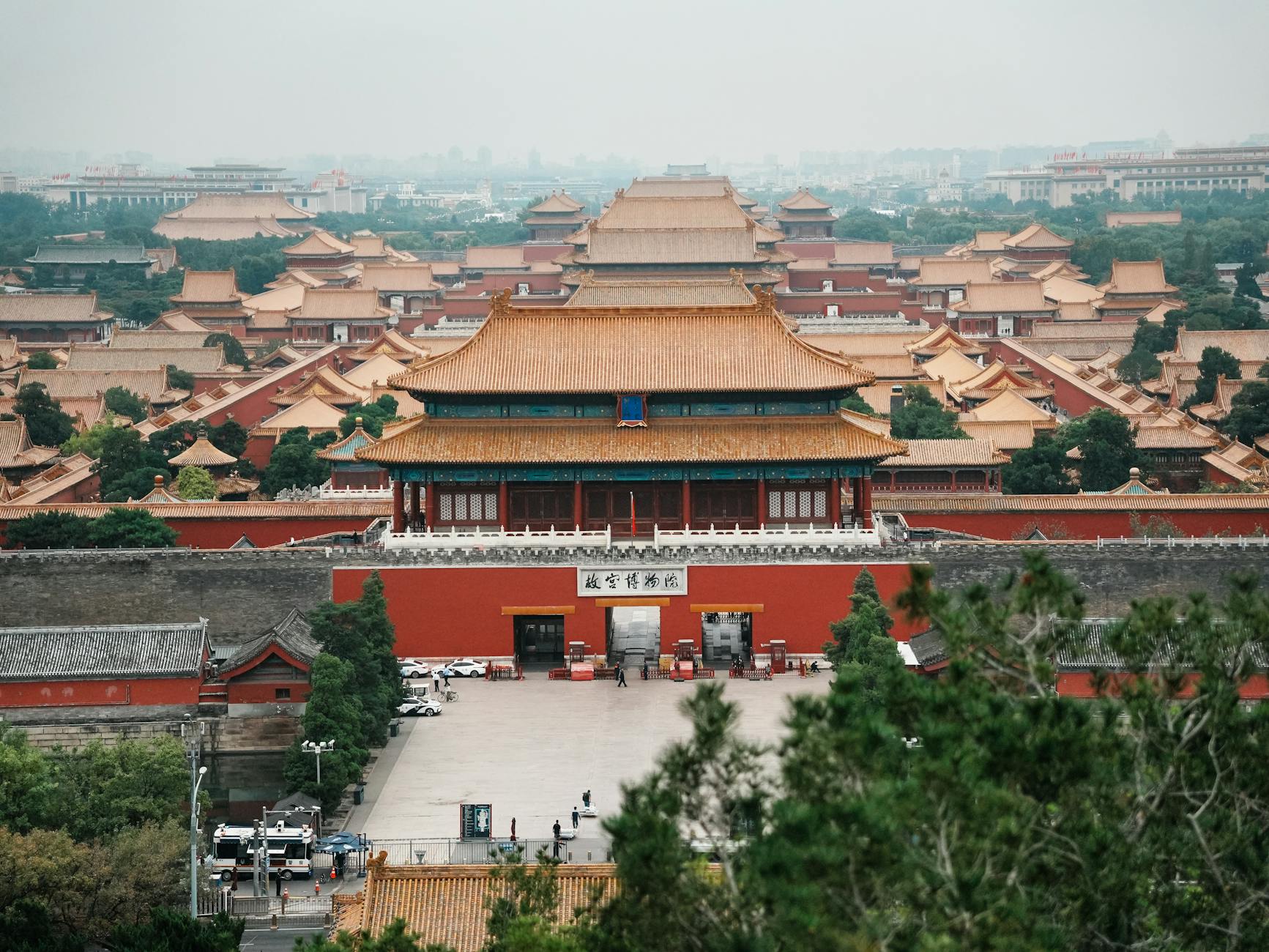
09:30 — The Forbidden City
In at the Meridian Gate, out at the Gate of Divine Prowess, one direction only. Three hours is the working figure and it covers the three great halls, one loop through the eastern palaces where the rooms are small enough to imagine living in, the imperial garden at the north end, and the Treasure Gallery for ¥10 more.
On the Clock Gallery, the honest verdict: the European automata are extraordinary and it is still the first thing to drop if you are running late, because you can see clockwork anywhere and you cannot see the Hall of Supreme Harmony anywhere else. The galleries ranked by what they are worth, and the route through the halls.
13:00 — Lunch, then Jingshan
Walk five minutes off Jingshanqian Street before you eat; the restaurants directly opposite the north gate charge tour-coach prices for ordinary food. Then ¥2 and a ten-minute climb up the artificial hill made from the earth dug out of the palace moat, for the best view in central Beijing: the whole Forbidden City in one frame with the axis running straight through it. Jingshan in detail.
15:00 — Beihai Park
Fifteen minutes north-west of Jingshan. The ¥20 through ticket adds Jade Island and the Round City to the ¥10 park entry, and the White Dagoba on the island is the shot everyone takes. In summer, a boat on the lake is ¥100–200 an hour plus a refundable deposit and is a genuinely good hour. On three days you can afford Beihai properly, which the two-day version cannot. Beihai Park.
17:00 — Shichahai and the Drum Tower
North from Beihai’s back gate into the lakes. Shichahai and Houhai in the hour before dark are the best free thing in Beijing: willows, swimmers or skaters depending on the month, and hutongs behind the bar strip that are still ordinary neighbourhoods. Skip the rickshaws — the circuits are a short loop sold as a tour. The Drum and Bell Towers close the axis a few minutes north; the drum performance runs roughly every half hour and the staircase is steep. More on the lakes.
18:45 — Peking duck
Siji Minfu at around ¥259 a whole duck, ¥159 a half, is the right call for a first duck dinner: consistently crisp, no tourist surcharge, and busy enough to need either a 17:30 arrival or a ticket and a wait. Li Qun is the hutong alternative at about ¥298. Quanjude is the famous one and the one your hotel will book, and at roughly ¥300 a head the quality has not matched the name for years. All of them ranked.
Day two — Mutianyu
Mutianyu, not Badaling. Badaling is closer and the G-train from Beijing North reaches it in 27 minutes for ¥30–80, which is genuinely tempting — and it is also the section that takes the coach fleets and the state visits, so on any holiday you are queueing on the ramparts. Mutianyu is 90 minutes each way, restored, wooded, has a cable car and a toboggan run, and is quiet enough to hear wind. On a three-day trip you have the time; spend it.
07:15 — The bus from Dongzhimen
Departures at 08:00 and 10:00, with a 12:00 added in peak season. Take the 08:00. ¥80 return for transport alone, ¥220–280 bundled with entrance and cable car, last bus back at 17:00 and 16:00 in winter. The DIY route — bus 916 Express to Huairou then local bus h23 — is ¥35–40 return and adds about 45 minutes each way plus a transfer to get right in Chinese. Every option is laid out in getting to the Great Wall.

09:45 — On the Wall
Shuttle from the car park to the base ¥20, entry ¥45. Cable car ¥100 one way or ¥140 return to tower 14; chairlift-and-toboggan combo ¥140 to tower 6; walking up is free and costs you 40 minutes of steps you will want later.
The route worth doing: cable car to tower 14, east to tower 20 where the restoration stops and the wall goes steep and wild, back west along the ridge to tower 6, toboggan down. Three hours, the best-preserved stretch, the most dramatic gradient, and a luge at the end that nobody regrets. The shorter version — tower 14 to tower 20 and back — is ninety minutes and still worth the day.
Bring water and eat at the base or from a bag; there is no good lunch on the ramparts. If crowds are the concern, the timings that work mostly reduce to catching the 08:00 bus. With children, the family version of the day is worth reading first. And if the Wall is the whole reason you came, the longer hikes are a different trip.
16:30 — Back at Dongzhimen
Two stops on Line 2 to Yonghegong and the Lama Temple, ¥25, free incense at the gate, and an eighteen-metre Maitreya carved from a single sandalwood trunk that is worth the detour on its own — but last entry is mid-afternoon, so this only works on a 15:00 bus. Check the closing time the same morning. If you are back too late, the alternatives are Nanluoguxiang and its side alleys, Ghost Street for late hotpot, or a show — Peking opera at ¥120–380 for a 70 to 90 minute tourist-circuit performance with subtitles, or acrobatics, which is the better bet with tired legs. Lama Temple in detail.
Day three — the two great gardens
This is the day that three days buys, and it is worth defending against the temptation to fill it with a day trip instead. The Ming Tombs, Gubei Water Town and Chengde are all real options and all of them turn day three into a second day of coach travel; the Temple of Heaven and the Summer Palace are both inside the city, both enormous, and both are places where local Beijing actually goes.
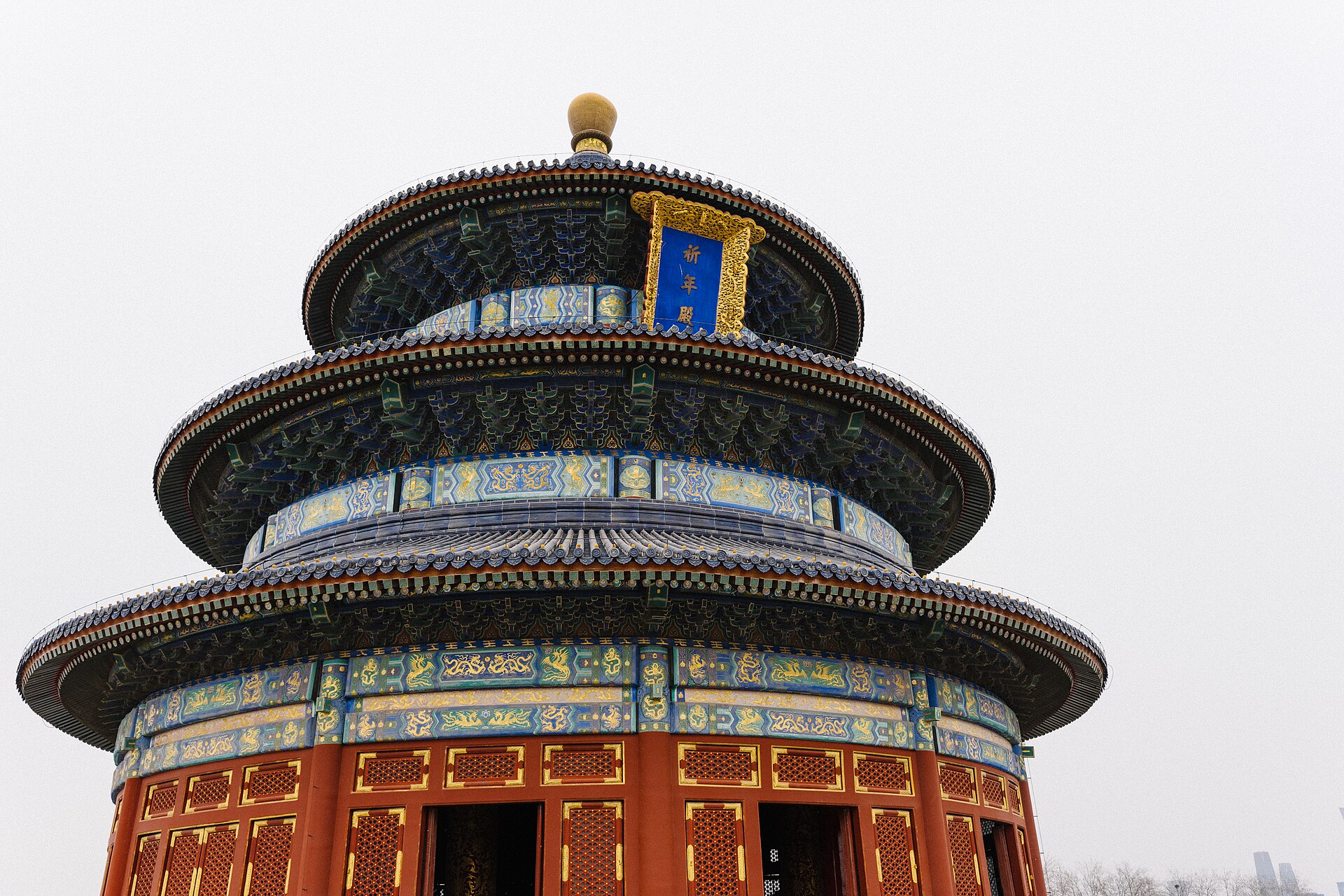
07:00 — The Temple of Heaven, at opening
Do not treat this as a monument visit. The park opens before the halls do, and for the first two hours it belongs to several thousand retired Beijingers doing tai chi, ballroom dancing, jianzi, water calligraphy on the paving, choral singing under the Long Corridor and card games at every table. It is the single most quietly astonishing hour in the city and it is over by about half nine.
Buy the through ticket — ¥34 in peak season from 1 April to 31 October, ¥28 off-season. The ¥15 park-only ticket does not include the Hall of Prayer for Good Harvests, which is the building on the postcard, so the cheap ticket is a false economy unless you are only here for the park life. Two and a half hours covers the Hall of Prayer, the Echo Wall, the Circular Mound Altar and a slow walk between them. Temple of Heaven guide.
10:00 — Cross the city
Line 5 north from Tiantandongmen, change at Dongdan for Line 1, change again for Line 4 north to Beigongmen. It is about an hour with the changes, ¥6 or so, and it is the longest single transit of the three days. Eat before you go in — the Summer Palace’s internal restaurants are captive-audience pricing. Subway guide.
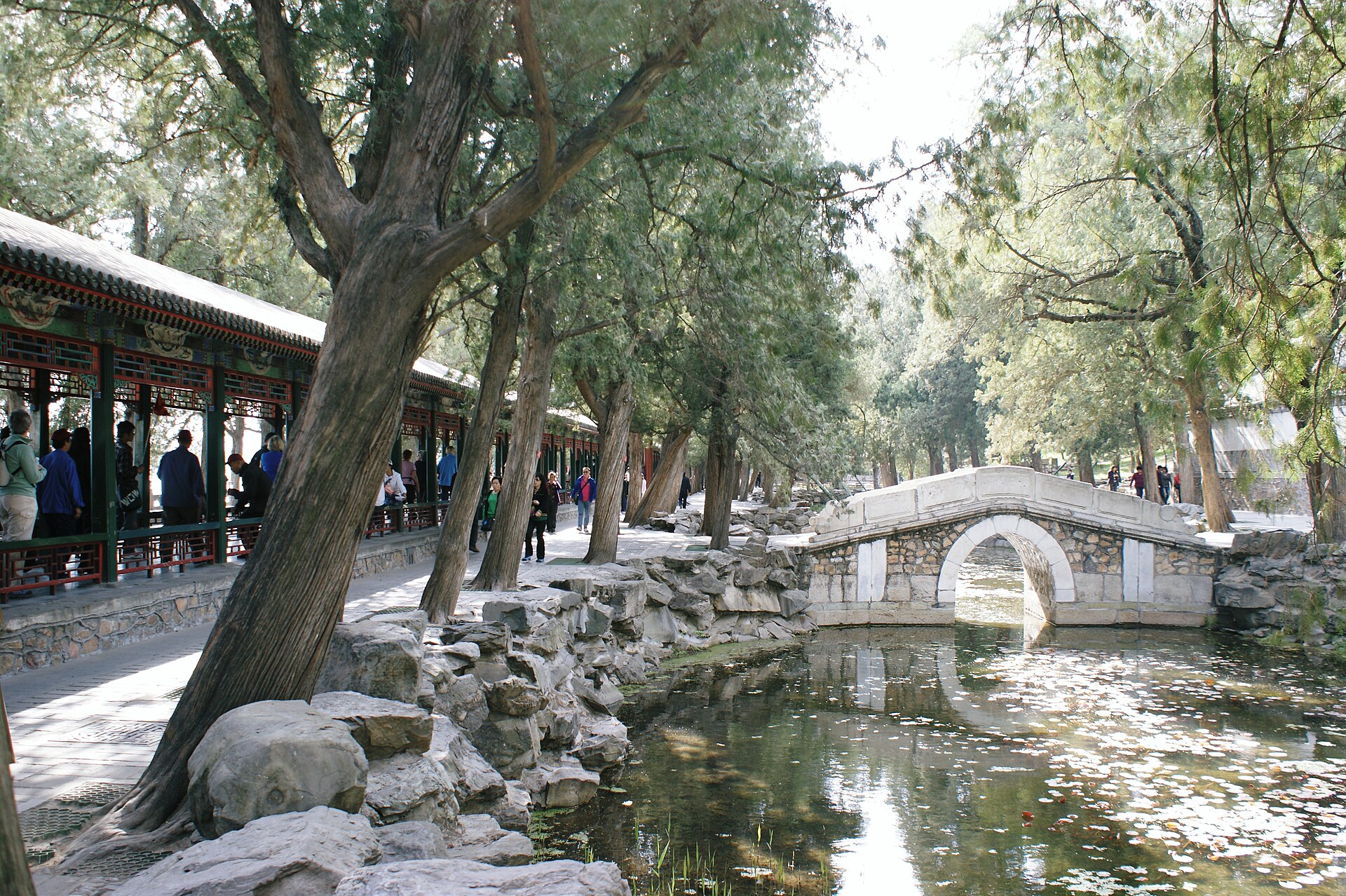
11:30 — The Summer Palace
Enter at Beigongmen, the north gate, rather than the east: you come in over Suzhou Street, climb the back of Longevity Hill, arrive at the Tower of Buddhist Incense with Kunming Lake opening below you, and then walk down and along the Long Corridor with the lake beside you. Entering at the east gate reverses that and puts the climb at the end, when you are done.
The through ticket is ¥60 in peak season, ¥50 off, and it covers the extras that otherwise nickel-and-dime you: the Tower of Buddhist Incense at ¥10, Suzhou Street at ¥10, the Garden of Virtue and Harmony at ¥5, the Summer Palace Museum at ¥20. Buy it. Four hours is right; three is rushed and five is possible if you take a boat, which rents from about ¥200 an hour with a ¥600 deposit, sales 08:30 to 16:30.
The honest verdict on the Marble Boat: it is a large stone folly that photographs well and takes four minutes. Do not walk the length of the lake to see it. The Seventeen-Arch Bridge and Nanhu Island at the far end, on the other hand, are worth the extra forty minutes if the light is good. Summer Palace guide.
16:30 — The evening
You come out tired at the wrong end of the city, so pick by what you feel like rather than by what is nearest.
- 798 Art District — Bauhaus factory sheds turned into galleries, free to walk, individual exhibitions ¥30–120, and most of it shuts around six. Only works if you leave the Summer Palace by four. 798.
- Sanlitun — the modern city, bars, and a version of Beijing that the first two days entirely omit. Worth an evening precisely because it is nothing like the rest of the trip. Sanlitun.
- A night market or Wangfujing — for the last shopping. Night markets, Wangfujing.
- Nothing. A third-day evening in a courtyard hotel with a beer is a legitimate use of a trip. You have walked about 28 kilometres.
The alternative day three
If crossing the city twice sounds like a poor use of a final day — and for some people it is — swap the Summer Palace for a compact northern loop and keep the whole day inside the second ring road.
| Time | Stop | Cost | Why |
|---|---|---|---|
| 07:00 | Temple of Heaven | ¥34 / ¥28 | The park at dawn is the point |
| 10:30 | Lama Temple | ¥25 | Working Tibetan Buddhist temple, incense included |
| 12:00 | Confucius Temple and Guozijian | Modest | Quiet, and about fifty metres from the Lama Temple |
| 14:00 | Nanluoguxiang and the side alleys | Free | Hutongs in daylight, which day one missed |
| 16:00 | Jingshan or the lakes again | ¥2 | The view at the right hour this time |
That version walks less, costs about ¥90 in entries rather than ¥120, and trades the Summer Palace — which is genuinely one of the great imperial gardens — for depth in one neighbourhood. It is the better day three for a second visit, for anyone travelling with small children, and for a rainy forecast. Confucius Temple, the Dongsi hutongs.
Adjustments you may need
If one of your days is a Monday
The Forbidden City is closed and there is no way round it. Put the Wall on the Monday and shuffle the other two days back. If your Monday is day three, run day three’s alternative version — the Temple of Heaven, the Lama Temple and the hutongs are all open — and move the axis forward.
If it rains, or the air is poor
Beijing’s air is much better than its reputation: 2025 averaged 27 µg/m³ of PM2.5, the lowest on record, with a single heavy-pollution day in the year. When a bad one lands, swap the Wall day for the National Museum of China, which is free with a compulsory advance passport reservation and will absorb three hours, plus the Forbidden City’s indoor galleries. Compare µg/m³ rather than AQI, since Chinese and US scales read the same particulate differently. Air quality in practice.
If you are travelling with children
Cut day one’s Beihai, cut day three’s Summer Palace back to the north gate and the lake shore, and keep the toboggan on day two — it is the thing they will talk about. Beijing with children.
If your dates land in Golden Week
1 to 7 October is the busiest week of the Chinese year, hotel prices roughly double, and every site on this itinerary is at capacity. If you cannot move the dates, book everything the moment it releases, start each day an hour earlier than written, and consider swapping Mutianyu for a quieter section. When to come.
Where to base yourself
One hotel, three nights, no moving. Dongcheng around Wangfujing puts day one on foot and days two and three one change away. A courtyard hotel in the Shichahai hutongs is slower to get out of and much more pleasant to come back to. Sanlitun and the CBD suit a longer trip and cost you transit time on a three-day one. Our neighbourhood comparison sets out the trade-off, and there is more on courtyard hotels and picking a base.
What three days still leaves out
Yuanmingyuan, the ruined Old Summer Palace next door to the intact one, at ¥25 and worth half a day. The Ming Tombs. Any day trip — Gubei Water Town, Chengde, Tianjin at 30 minutes and ¥55 by high-speed train. The 798 district properly rather than as an evening scrap. The Fragrant Hills in leaf season. Universal Studios, which is a whole day and ¥418–748. And the wilder Wall at Jinshanling or Jiankou, which is the single best reason to come back.
Three days is not short. It covers the Forbidden City, the Great Wall, the Temple of Heaven, the Summer Palace and two evenings in the hutongs, which is a complete first visit by any reasonable definition. What it does not have is slack — one bad-air day or one missed booking and something falls out. Build in the earliest starts you can bear on days two and three, and the rest holds together.
A fourth day changes this plan less than you would think in content and more than you would think in comfort: it lets the Great Wall float to whichever morning has the clearest air instead of being pinned to day two. The four-day version keeps these three days intact and compares five ways to spend the extra one. The main itinerary page compares every length side by side.
It is worth knowing what sits either side of three days. Two days drops the Summer Palace and the temples; five add a day trip and an afternoon with nothing in it. A weekend version reorders the same ground around Saturday opening hours, and the family plan re-paces the whole thing around children.
Frequently asked questions
Is 3 days enough for Beijing?
Yes, for a first visit. Three days covers the Forbidden City, the Great Wall, the Temple of Heaven and the Summer Palace with an evening in the hutongs on top. It does not cover a day trip out of the city or the Old Summer Palace, and it leaves no spare day if the weather turns.
What order should I do the three days in?
Axis, Wall, gardens — unless you arrive on the morning of day one, in which case do the axis at half pace that afternoon and give the Wall a full second day. The Forbidden City has a timed ticket and a one-way route, so it is the least forgiving of a late start.
Can I fit a day trip into three days?
You can, and it costs you the Summer Palace or the Temple of Heaven. Tianjin is 30 minutes and ¥55 each way by high-speed train and is the only day trip that does not eat the whole day. The Ming Tombs and Gubei Water Town do. On a first visit, keep the third day in the city.
Should I visit the Temple of Heaven or the Summer Palace if I can only do one?
The Temple of Heaven, and go at opening. The architecture is the more perfect of the two, it takes half the time, and the morning park life — tai chi, choirs, water calligraphy — is something the Summer Palace does not have. The Summer Palace is the better place to spend a whole afternoon if you have one.
How much does three days in Beijing cost?
Roughly ¥950–1,250 per person for entries, transport and food, about US$135–180, excluding accommodation. A private car to the Wall adds ¥800–1,500 for the vehicle; a group tour at ¥350–500 a head saves no money and adds a shopping stop. Checked September 2026.
What has to be booked in advance?
The Forbidden City, seven days ahead, online only, real-name, no gate sales, closed Mondays. Tiananmen Square, free but compulsory and slot-specific, one to nine days ahead. The National Museum if you want it, seven days ahead at 17:00 Beijing time. The Mutianyu bus in peak season.
How much walking is involved?
About 28 kilometres over three days: 9 to 11 km on day one, 5 to 7 km of steep uneven steps on day two, and 8 to 10 km on day three across two very large parks. Almost all of it is flat except the Wall and the climb up Longevity Hill.
Which Great Wall section should I choose?
Mutianyu for a three-day trip: 90 minutes each way, restored, wooded, with a cable car and a toboggan. Badaling is quicker by train and busier by a wide margin. Jinshanling and Jiankou are better walls for people who came for the Wall rather than for Beijing.
Do I need a guide?
For the Forbidden City, a guide or a good audio guide changes what you see, because the halls do not explain themselves. For the Wall, the Temple of Heaven and the Summer Palace, no — they are places to walk in. Tip a private guide ¥50–100 a day on top of the fee; tipping is otherwise not customary in China and taxi drivers may refuse it.
Can I use my own bank card in Beijing?
At subway gates, yes — foreign contactless Visa, Mastercard, JCB and Amex tap in directly. Everywhere else, use Alipay or WeChat Pay with your card added after in-app passport verification. Carry ¥200 in cash for street vendors and rural stalls near the Wall.
What is the best time of year for this itinerary?
Late September to early November, avoiding 1 to 7 October, and April to mid-May. October daytime temperatures run 21–22°C early in the month and drop under 20°C later, with about five wet days; autumn colour starts mid-October. Winter works and costs less, with shorter daylight and a 16:00 last bus from the Wall.
Is three days better spent in Beijing or split with another city?
Kept in Beijing. Shanghai is 4 hours 18 minutes and ¥553–663 away by train and Xi’an is 4 hours 17 minutes for ¥515–565, and either one turns a three-day trip into two rushed halves. Split a trip from five days upwards, not from three.