The Drum Tower and Bell Tower stand at the northern end of Beijing’s ancient central axis, two massive timber-and-brick towers that for centuries were the city’s official timekeepers — the great drums and the enormous bronze bell marking the hours for the entire capital. Today they’re the soul of one of Beijing’s best-preserved hutong neighbourhoods, and climbing them rewards you with a live drum performance and a sweeping view over a sea of grey-tiled courtyard rooftops. As of 2026, a combined ticket for both towers is ¥30 (Drum Tower ¥20, Bell Tower ¥15 individually), they open 9:30am–5:30pm in peak season, and drum performances run several times daily. It’s a short, atmospheric visit that drops you straight into old Beijing.
I love this corner of the city. After the imperial grandeur of the palaces, the Drum and Bell Towers feel intimate and lived-in — surrounded by alleys where locals still hang their washing and play chess on the doorstep. This guide covers the towers themselves and the drum performance, the steep climb and the rooftop views, tickets and timing, the surrounding hutong district and how to explore it, and the questions visitors ask. Combine it with a hutong wander and the nearby lakes, and you have one of the most rewarding half-days in Beijing.
Drum & Bell Towers at a glance
- Tickets: combined both towers ¥30; Drum Tower alone ¥20; Bell Tower alone ¥15.
- Hours: 9:30am–5:30pm peak (Apr 26–Oct 25); 9:30am–4:30pm off-season (Oct 26–Apr 25).
- Drum performances: roughly 9:30, 10:30, 11:30am and 1:30, 2:30, 3:30, 4:45pm — short and worth timing your visit around.
- The climb: about 70 steep stone steps up each tower; no lift.
- The view: panoramic rooftops of the surrounding hutongs; the Bell Tower offers a 360° walk-around.
- Nearest metro: Line 8 to Shichahai or Guloudajie.
- Time needed: 1–1.5 hours for the towers; longer with a hutong wander.
- Best for: hutong lovers, photographers, anyone wanting old Beijing atmosphere and a view.
How the city kept time
For more than five centuries, these two towers told Beijing the time. The Drum Tower, the southern and larger of the pair, once held 24 great drums (one main drum and 24 watch-drums) that were beaten to mark the night watches; the Bell Tower behind it housed a colossal bronze bell, cast in the early 15th century and weighing around 63 tonnes, whose deep toll could be heard across the old city. Drum and bell worked together in a precise nightly ritual that ordered the rhythm of imperial Beijing until the system was retired in the early 20th century with the arrival of Western clocks. Understanding that this was the city’s official clock for 500 years transforms the climb from a sightseeing stop into something closer to time travel.
The drum performance
The highlight of the visit is the short drum performance at the top of the Drum Tower, where performers beat the reconstructed drums in a vigorous, resonant display that echoes the original timekeeping rhythms. The shows run several times a day — typically on the half-hour through the morning and afternoon — and each lasts only a few minutes, so it’s well worth checking the schedule and timing your climb to catch one. Beside the drums you can see a surviving original watch-drum, its skin torn by foreign soldiers in 1900, and exhibits on ancient Chinese timekeeping devices including a water clock and an incense clock.
The climb and the rooftop views
Both towers demand a steep climb of around 70 stone steps on a single near-vertical staircase — there’s no lift, so this isn’t one for anyone with serious mobility issues. But the payoff is excellent. From the Drum Tower’s gallery you look out over the grey-tiled rooftops of the hutongs, the maze of courtyard homes spreading in every direction, with the Bell Tower close behind and the central axis stretching south toward Jingshan and the Forbidden City. The Bell Tower lets you walk a full 360 degrees around its gallery for views in all directions, and is usually quieter than the Drum Tower.
This is one of the best places in the city to grasp what old Beijing actually looked like — a low-rise sea of courtyard houses, before the towers and ring roads. Late afternoon light is loveliest, picking out the texture of the tiled roofs, and the towers are atmospherically lit after dark.
The surrounding hutong district
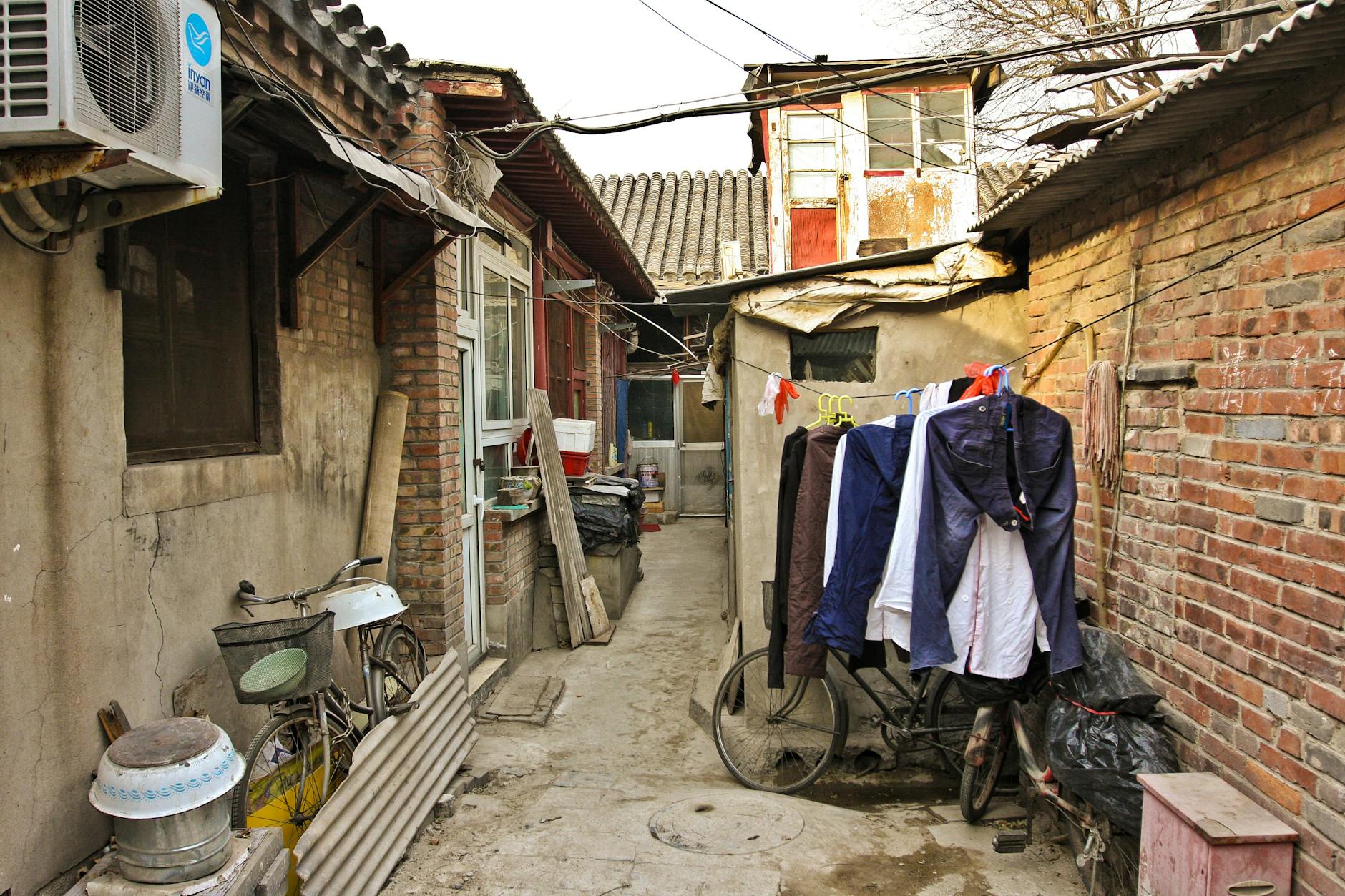
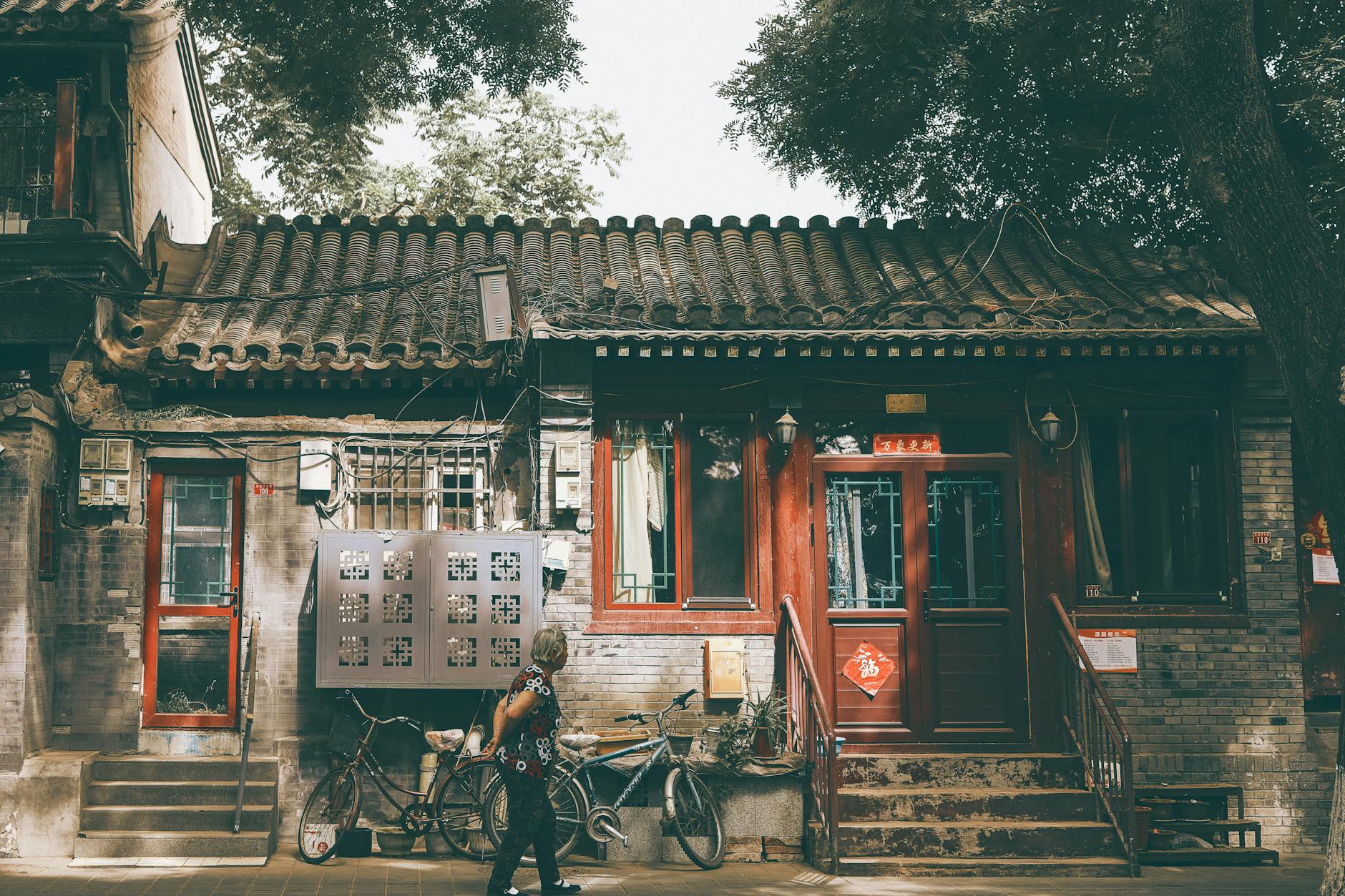
The towers are only half the experience — the neighbourhood around them is the other half. This is one of Beijing’s most atmospheric and best-preserved hutong areas, a warren of narrow alleys and traditional siheyuan courtyard homes. The little square between the two towers is a hub of local life, and the lanes radiating outward are full of small cafés, craft shops, courtyard bars and noodle joints. Just south and west lie the Shichahai lakes (Houhai), ringed with bars and willows, and the touristy-but-lively Nanluoguxiang alley. Renting a bike or simply getting lost on foot is the way to enjoy it. For a deeper dive into this world — the history of the courtyards, the best alleys, and how to explore respectfully — see our full Beijing hutongs guide.
Getting there and combining your visit
Take Line 8 to Shichahai or Guloudajie station, both a short walk from the towers. The area is also a pleasant (if longer) walk north from Jingshan along the central axis, or a quick taxi or DiDi. The full network is in our Beijing subway guide.
This corner combines beautifully into a half-day of old Beijing: climb the towers for the view and a drum performance, wander the hutongs, then stroll down to the Houhai lakes for a lakeside drink at sunset. It’s also walkable from Beihai Park and, a little further south, the Forbidden City and Jingshan — the towers mark the northern end of the same imperial axis. After dark, the Houhai bar district makes this a natural lead-in to a night out; see our Beijing nightlife guide.
Visitor tips
- Time your visit to a drum performance — check the schedule and aim to be at the top for one.
- Get the combined ¥30 ticket if you want both towers; the Bell Tower’s 360° view is worth the extra climb.
- The stairs are steep — about 70 near-vertical steps per tower, with no lift.
- Come late afternoon for the best rooftop light, then stay for sunset over the hutongs.
- Build in a hutong wander and a Houhai lakeside stop — the neighbourhood is the real draw.
- Rent a bike to explore the alleys; see our cycling in Beijing guide.
The legend of the bell
The giant bronze bell in the Bell Tower comes with one of old Beijing’s most enduring folk tales. The story goes that the bell-caster, struggling to produce a flawless casting for the Yongle Emperor and facing execution if he failed again, was saved when his devoted daughter threw herself into the molten metal, leaving only her embroidered slipper in her father’s hand. The next casting rang out perfect and pure — and Beijingers long said that the bell’s mournful tone carried the sound of the girl calling for her shoe (“xie!”). It’s a legend, of course, but it captures how deeply these towers were woven into the life and imagination of the old city. Standing beneath the great bell, with the tale in mind, the climb takes on an extra resonance.
Houhai, Nanluoguxiang and the living neighbourhood
The towers are the gateway to some of Beijing’s most enjoyable wandering. A few minutes southwest, the Shichahai lakes — Qianhai and Houhai — are ringed by willows, courtyard bars and restaurants; by day it’s tranquil, and by night the bar strip lights up and the area becomes a hub of Beijing nightlife. To the east runs Nanluoguxiang, an 800-year-old hutong now lined with boutiques, cafés and snack stalls — touristy but lively, and the side alleys off it are quieter and more authentic. Between and around these landmarks lies a dense web of siheyuan courtyard homes where ordinary Beijing life carries on. The best way to experience it is slowly and on foot or by bike; our hutongs guide maps out the most rewarding routes and explains the courtyard culture.
Photography and the best evening plan
For photographers, the rooftop views from either tower are best in late-afternoon light, when the low sun rakes across the grey tiles and brings out their texture; the contrast between the old courtyards in the foreground and the modern skyline beyond tells the story of the city in a single frame. At ground level, the square between the towers is liveliest in the early evening. My ideal plan: climb the towers in the late afternoon and catch a drum performance, wander the hutongs as the light fades, then settle by Houhai for dinner and a drink as the lakeside lanterns come on. It’s one of the most atmospheric evenings in Beijing, and it costs very little. A rented bike makes linking it all together effortless — see our cycling in Beijing guide.
A suggested walking route through the area
The Drum and Bell Towers are best experienced as the anchor of a half-day on foot through old Beijing. Here’s a route I love. Start at the Drum Tower in the early afternoon, timing your climb to a drum performance, then cross the little square to the Bell Tower for the quieter 360° view and the great bronze bell. From there, wander south into the hutongs — the lanes around Mao’er Hutong and Nanluoguxiang are full of courtyard architecture, small museums and cafés. Loop west to the Shichahai lakes, following the shoreline past the historic Prince Gong’s Mansion area, and finish at Houhai as the sun sets and the lakeside bars and restaurants come alive. The whole circuit is flat, walkable in an afternoon, and threads together the towers, the hutongs and the lakes into one of the most atmospheric experiences in the city.
If you’d rather cover more ground, this is prime cycling and pedicab territory — the flat hutong lanes are made for two wheels, and a rented bike lets you cover the lakes and alleys at a gentle pace. Pedicab tours run from the towers and Houhai, with drivers offering commentary (agree the price first). However you travel, the joy here is in the wandering: the area rewards getting slightly lost, peering down side alleys, and stumbling on a courtyard café or a hidden temple. Our cycling in Beijing guide has tips on renting bikes, and the hutongs guide maps the most rewarding lanes.
For food, the neighbourhood is a treat. Around the towers and Houhai you’ll find everything from old-Beijing snack shops selling fried dough and douzhi (fermented mung-bean drink) to trendy courtyard restaurants and lakeside bars. It’s one of the best areas in the city for an evening that blends history, atmosphere and good eating — see our Beijing food guide for specific recommendations.
The northern anchor of the central axis
The Drum and Bell Towers aren’t just a charming old-Beijing stop — they mark the northern end of Beijing’s historic central axis, the 7.8-kilometre line of symmetry that runs south through the Forbidden City and Tiananmen to the Yongding Gate, inscribed by UNESCO as a World Heritage Site in 2024. For centuries the towers were the timekeeping heart of this axis: the rhythm of the drums and the toll of the bell quite literally set the pace of life for the entire walled capital, regulating the city gates, the night watches and the daily routines of a million people. Visiting them, then, isn’t only about a view and a performance — it’s about standing at one terminus of the grand design that organised imperial Beijing.
That context is part of what makes climbing the towers so rewarding. From the top you can look south and trace the axis toward Jingshan and the Forbidden City, the same line the emperors’ city was built around. It also explains why the towers sit where they do, in what was once a bustling commercial district just outside the imperial precinct — a place where the ordinary life of the city met the machinery of the state. Today that meeting still feels alive in the surrounding hutongs, where centuries-old courtyard homes share the lanes with cafés and craft shops. Few spots in Beijing pack so much history, atmosphere and living neighbourhood into such a compact, walkable area.
If you only have time for one tower, make it the Drum Tower for the performance and the timekeeping exhibits; if you have the legs for both, the Bell Tower’s quieter 360-degree gallery is the perfect complement. Either way, leave plenty of time afterwards for the hutongs and the lakes — they are the real reward of coming all the way up here.
Drum & Bell Towers FAQ
Are both towers worth visiting?
Yes, if you have the time and legs for two climbs. The Drum Tower has the drum performance and timekeeping exhibits; the Bell Tower has the giant bronze bell and a 360° walk-around view, and is usually quieter. The combined ticket is ¥30.
When are the drum performances?
Several times daily, roughly on the half-hour through the morning and afternoon (around 9:30, 10:30, 11:30am and 1:30, 2:30, 3:30, 4:45pm). Each lasts only a few minutes, so check the day’s schedule and time your climb.
How hard is the climb?
Each tower has about 70 steep stone steps on a single staircase, with no lift. It’s a short but demanding climb — not suitable for those with significant mobility limitations.
How long should I budget?
About an hour to an hour and a half for both towers and a performance. Add time for the surrounding hutongs and Houhai lakes, which can easily fill a half day.
What else is nearby?
The Shichahai/Houhai lakes, Nanluoguxiang alley, countless hutongs, and Beihai Park are all within walking distance. It’s the northern anchor of Beijing’s central axis. See our hutongs guide to explore.
Is it nice at sunset?
Very. Late-afternoon light on the grey rooftops is the best of the day, and the towers are floodlit after dark. Pair it with a sunset drink at nearby Houhai.
The bottom line on the Drum & Bell Towers
The Drum and Bell Towers are a short, rich visit that plunges you into old Beijing: 500 years of the city’s official timekeeping, a stirring drum performance, and a steep climb to panoramic views over a sea of hutong rooftops. Time your visit to a drum show, take both towers if your legs allow, and — crucially — build in time to wander the surrounding alleys and the Houhai lakes, because the living neighbourhood is every bit as memorable as the towers themselves.
Explore the surrounding lanes with our Beijing hutongs guide, stroll over to Beihai Park, and see the full set of imperial landmarks in our guide to Beijing’s historical attractions. Planning the trip? Start with the complete Beijing travel guide.