Beijing Food Guide
Beijing Street Food Guide: Must-Try Snacks & Where to Find Them
Eat your way through Beijing's street food scene. Jianbing, tanghulu, lamb skewers, and 17 more must-try snacks with locations.
Beijing street food is some of the most rewarding eating in the city — cheap, fast, deeply local, and endlessly varied. From the sizzle of a jianbing crepe being folded on a hot griddle at dawn to the glistening rows of tanghulu candied hawthorns on a winter afternoon, the streets and hutongs are where Beijing really feeds itself. Snacks are cheap, payment is by phone almost everywhere, and the biggest challenge is simply knowing what to order and where to find the good stuff rather than the tourist-trap versions. This guide walks you through the snacks worth seeking out, where to find them, and how to eat like a local rather than a visitor.
The best street food isn’t always on the famous “snack streets”. Look for the stall with a queue of office workers, or follow a quiet hutong. This guide covers the must-try snacks (savoury and sweet), the best neighbourhoods to eat them, how ordering and payment work, hygiene and seasonal tips, and the questions first-timers ask. Come hungry.
Beijing street food at a glance
- Typical cost
- snacks are inexpensive, so a few different bites add up to a meal.
- Payment
- WeChat Pay or Alipay almost everywhere (both now accept foreign cards); carry a little cash as backup.
- Must-try savoury
- jianbing, lamb skewers, roujiamo, baozi, jian bing guo zi, chuan’r, liangpi.
- Must-try sweet
- tanghulu, aiwowo, lvdagun, tang’er gao, donkey-roll.
- Best areas
- hutongs around the Drum Tower, Huguosi Street, Niujie (Muslim quarter), Qianmen/Dashilan.
- Best avoided
- the scorpion-on-a-stick tourist photo-ops on the famous snack streets — overpriced and not what locals eat.
- Best time
- early morning for breakfast snacks; late afternoon and evening for skewers and sweets.
The must-try savoury snacks
Jianbing (煎饼) is the king of Beijing street food and the snack you should try first. A thin mung-bean-and-wheat crepe is spread on a hot griddle, an egg cracked over it, then it’s painted with sauce and chilli, scattered with scallion and coriander, folded around a sheet of crispy fried cracker (baocui), and folded again into a hot, savoury parcel. It is sold from carts and hole-in-the-wall windows, mostly in the mornings. No two vendors make it quite the same, and finding your favourite is part of the fun. It’s popular enough that a few Beijing cooking classes now teach a home version, griddle and all.
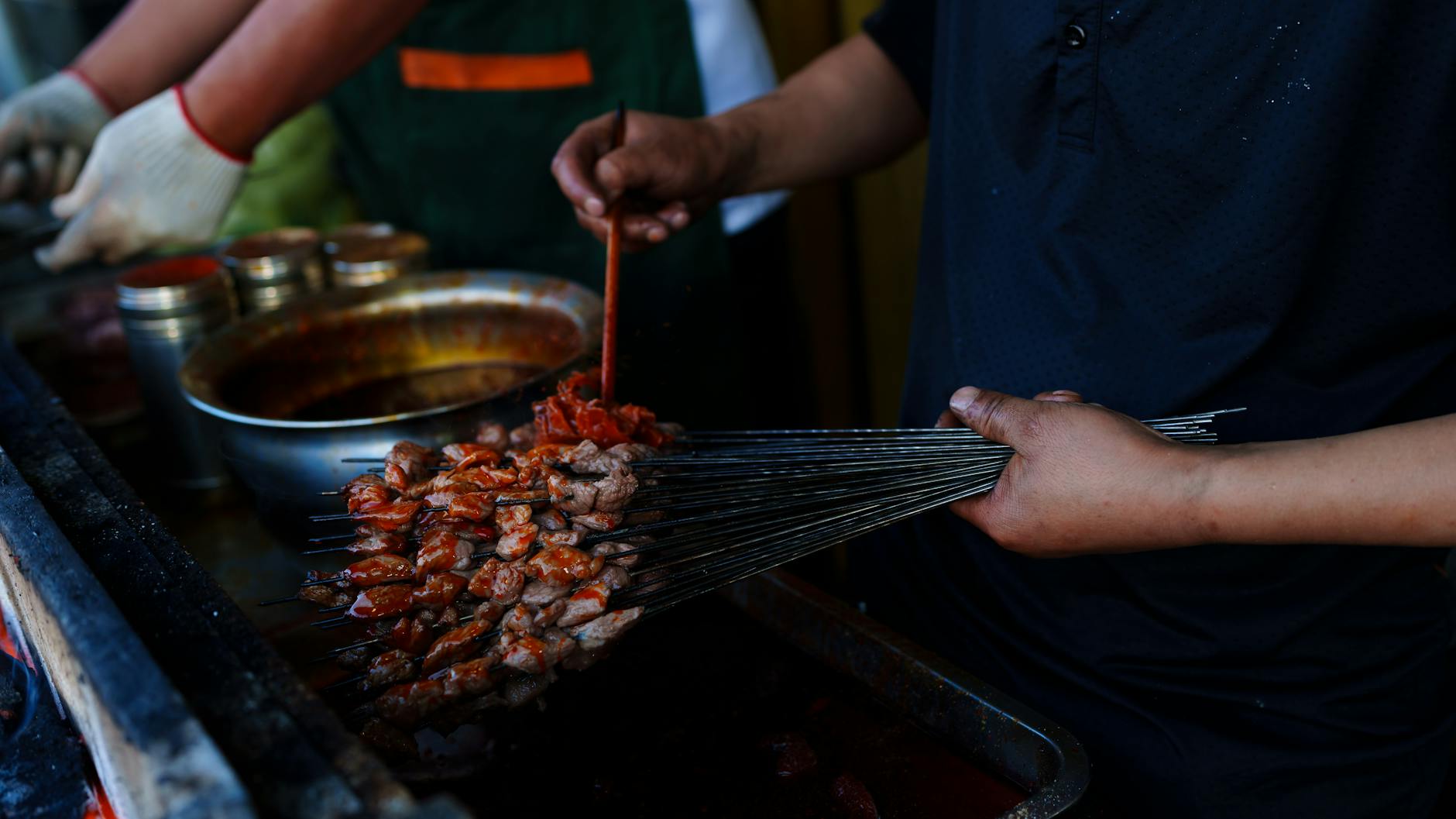
Lamb skewers (yangrou chuan’r, 羊肉串) are Beijing’s quintessential evening street food — cumin-and-chilli-dusted lamb grilled over charcoal, sold in bundles for a few yuan each. The smoky, late-night skewer scene is a Beijing institution, especially in the Muslim quarter and around the bar districts. Roujiamo (肉夹馍), sometimes called the “Chinese hamburger,” stuffs a crisp flatbread with slow-braised, finely chopped pork (or beef/lamb in halal versions) — rich, juicy and portable. Our guide for Muslim travellers explains how to read the qingzhen signage.
Other savoury essentials: baozi (包子), pillowy steamed buns stuffed with pork, vegetables or pork-and-chive, best from a steaming morning stall; chunbing (春饼), thin spring pancakes wrapped around shredded vegetables and meat; liangpi (凉皮), cold wheat or rice noodles in a tangy chilli-vinegar sauce, perfect in summer; baodu (爆肚), quick-boiled tripe for the adventurous; and luzhu huoshao (卤煮火烧), a hearty, offal-rich Beijing stew of simmered pork and bread that’s a true local institution — an acquired taste, but a window into old Beijing eating.
The must-try sweet snacks
Tanghulu (糖葫芦) is Beijing’s iconic sweet: skewered hawthorn berries (or strawberries, grapes, even orange segments) dipped in a glass-hard sugar shell that shatters with a crack and gives way to the tart fruit inside. It’s traditionally a winter treat — the cold keeps the sugar crisp — and you’ll see the bright-red skewers everywhere from Nanluoguxiang to Houhai. Beyond tanghulu, seek out the old Beijing palace snacks: aiwowo (艾窝窝), sweet glutinous rice balls with a fruit-and-nut filling; lvdagun (驴打滚) or “donkey rolls,” glutinous rice rolled in soybean flour around a red-bean filling; wandouhuang (豌豆黄), a cool, sweet pea-flour cake; and tang’er gao, steamed sweet cakes. These imperial-era snacks are sold at traditional shops like the famous Huguosi snack shops and are a delicious taste of old Beijing’s refined side.
Where to find the best street food
Here’s the insider truth: skip Wangfujing Snack Street. Yes, it’s famous, and yes, the scorpions-on-a-stick make a striking photo — but it’s a tourist spectacle, overpriced, and not where Beijingers actually eat. Go once for the sight if you must, then eat properly elsewhere. The real action is in these areas:
- Huguosi Street (护国寺小吃街) — the best one-stop spot for traditional Beijing palace snacks, with the historic Huguosi Snacks shop serving aiwowo, lvdagun, wandouhuang and more at honest prices.
- The hutongs around the Drum and Bell Towers — jianbing carts, baozi steamers and small eateries tucked into the lanes; pair it with our Drum & Bell Towers guide.
- Niujie (牛街) — Beijing’s Muslim quarter, the place for outstanding lamb skewers, halal beef pastries, and sticky sweet snacks from Niujie Qingzhen Chaoshi.
- Qianmen and Dashilan — historic shopfronts selling roujiamo, candied snacks and old-Beijing specialities just south of Tiananmen.
- Nanluoguxiang and Houhai — touristy but lively, good for tanghulu, grilled squid and a snack-while-you-stroll vibe; explore via our hutongs guide.
The single best strategy, though, is simpler than any list: follow the queues. A stall with a line of locals — office workers in the morning, families in the evening — is almost always better than one touting to tourists. Look for storefronts marked 早点 (zǎodiǎn, breakfast) or 小吃 (xiǎochī, snacks).
How to order, pay and eat
Street-food ordering is refreshingly low-pressure. Point at what you want, hold up fingers for quantity, and pay by scanning the vendor’s WeChat Pay or Alipay QR code — both apps now accept linked foreign credit cards, which has transformed how easy it is for visitors to eat on the street. Carry a small amount of cash as a backup, since the occasional old-school vendor still prefers it. A few useful words: yí ge (one), liǎng ge (two), bú yào là (no chilli), duōshǎo qián (how much). For more on bridging the language gap, see our notes on what to do when nobody speaks English.
On hygiene: Beijing street food is generally safe, and the busy stalls turn over ingredients fast, which is your best guarantee of freshness. Favour vendors who are clearly popular and cooking to order over hot food that’s been sitting out. If you have a sensitive stomach, ease in gradually and stick to thoroughly cooked items at first. Tap water isn’t drinkable, so stick to bottled or boiled drinks. None of this should put you off — eating on the street is one of the great joys of Beijing, and a little common sense is all you need.
Street food by season
Beijing’s street food follows the seasons. Winter is tanghulu season (the cold keeps the sugar shell crisp) and the time for hot roasted sweet potatoes (kǎo hóngshǔ) sold from oil-drum ovens, roasted chestnuts, and steaming bowls of soup. Summer brings cooling dishes — liangpi cold noodles, douzhi (the famously sour fermented mung-bean drink that’s an acquired Beijing taste), and fresh fruit. Spring and autumn, with their mild weather, are the most pleasant times to wander and graze. Skewers and jianbing are year-round constants. For more on timing your trip, see our rundown of which months suit a visit.
The story behind Beijing’s snacks
Beijing’s street food is a delicious record of the city’s history. As an imperial capital for centuries, Beijing developed an elaborate culture of palace snacks (gongting xiaochi) — delicate, sweet, beautifully made morsels like wandouhuang and aiwowo that trickled down from the Qing court into the city’s teahouses and snack shops. Layered on top of that is the hearty, no-nonsense food of old working-class Beijing — luzhu, baodu and chaogan (stewed liver), dishes born of thrift and the cold northern winters. And woven through it all is the influence of the Hui Muslim community, centred on Niujie, whose halal traditions gave the city its beloved lamb skewers, beef pastries and sticky sweets. When you graze your way around Beijing, you’re tasting all three of these strands at once — imperial refinement, working-class grit, and Silk Road spice.
That history also explains why so much of the “real” street food has retreated into the hutongs and dedicated snack shops. Decades of modernisation, redevelopment and hygiene regulation cleared away many of the old roving carts and famous night markets (Donghuamen closed in June 2016 after hygiene and noise complaints). What survives does so in the alleys, the Muslim quarter, and institutions like the Huguosi snack shops — which is precisely why eating well on the street now rewards a little knowledge rather than just wandering the headline tourist strips.
A few more snacks to hunt down
Once you’ve covered the icons, keep an eye out for these. Chaogan (炒肝), a thick, garlicky stew of pork liver and intestine, is a classic Beijing breakfast eaten with a side of baozi — far tastier than it sounds. Mian cha (面茶) is a savoury millet porridge drizzled with sesame paste, a warming winter breakfast. Zhagao (炸糕) are crisp fried sweet rice cakes; tang huoshao are sticky sesame-syrup pastries. For something refreshing, suan mei tang (酸梅汤), a chilled sour-plum drink, is the traditional Beijing thirst-quencher in summer. And the bravest eaters should try douzhi (豆汁) at least once — the fermented mung-bean drink is famously pungent and divides even locals, but trying it (with a side of crispy jiaoquan rings) is a genuine rite of passage.
Part of the pleasure is that street food rewards repeat grazing. Rather than one big meal, the local approach is to snack little and often — a jianbing on the way out in the morning, a couple of skewers in the afternoon, a tanghulu while you walk, a bowl of something hot at night. Spread across a few days, this is how you build a real picture of Beijing flavour, and it costs a fraction of sit-down restaurant dining.
Practical tips for street-food grazing
- Carry tissues and hand sanitiser — street stalls rarely provide napkins, and many public toilets don’t stock paper.
- Eat where the locals are, ideally cooked to order; high turnover means fresher food.
- Go early for breakfast snacks (jianbing, baozi, chaogan) — many vendors sell out or pack up by mid-morning.
- Save sweets and skewers for the afternoon and evening, when the snack streets and night spots come alive.
- Learn a few numbers and “no chilli” in Mandarin, or use a translation app, to order with confidence.
- Pace yourself — the joy is in grazing many small things, not filling up on the first stall.
A sample street-food day in Beijing
Here is one way to thread the best of it together into a single delicious day. Morning: start in the hutongs near the Drum Tower for breakfast. Order a jianbing folded fresh off the griddle, grab a couple of pork baozi from a steaming basket, and — if you’re feeling brave — a bowl of garlicky chaogan with a warm sesame-paste mian cha to wash it down. Late morning: walk west to Huguosi Street and work through the traditional palace snacks at the Huguosi Snacks shop — aiwowo, lvdagun, wandouhuang and a slice of sweet pea-flour cake, all for pocket change.
Afternoon: stroll the Houhai lakeside and Nanluoguxiang with a tanghulu in hand, watching the city go by, and pick up a roujiamo if you’re peckish. Evening: head to Niujie, the Muslim quarter, for lamb skewers — order them by the dozen, dusted with cumin and chilli, straight off the charcoal — plus halal beef pastries and sticky sweets. Late night: if you’ve still got room, the spicy-crayfish and grilled-fish stalls of Ghost Street run until the small hours. That’s a full day of eating across the whole spectrum of Beijing street food, and it needn’t cost much.
If you’d rather have a local do the navigating — and explain what you’re eating as you go — an evening in the alleys with someone who knows the stops is the most efficient way to taste a lot in one evening, and a great option on your first night before you strike out on your own. Either way, the key is to treat street food as a moveable feast spread across the day rather than a single sitting.
Above all, stay curious and don’t be afraid to point at something you don’t recognise — some of the best discoveries come from ordering the mystery item that the person next to you is enjoying. Beijing’s street food is welcoming, cheap and forgiving of beginners, and a few days of grazing will teach you more about the city than any guidebook.
Beijing street food FAQ
Is Beijing street food safe to eat?
Generally yes. Stick to busy stalls cooking to order, favour thoroughly cooked items, and drink only bottled or boiled water. The high turnover at popular vendors keeps ingredients fresh. Ease in gradually if you have a sensitive stomach.
What is the most famous Beijing street food?
Jianbing, the savoury breakfast crepe, is the signature street snack. Lamb skewers (chuan’r) and tanghulu (candied hawthorn skewers) are the other two icons you shouldn’t miss.
How do I pay at street stalls?
Scan the vendor’s WeChat Pay or Alipay QR code — both now accept foreign credit cards. Carry a little cash as a backup for the occasional cash-only vendor.
Should I go to Wangfujing Snack Street?
Only for the spectacle. It’s touristy and overpriced, and the scorpions-on-a-stick aren’t what locals eat. For authentic snacks, head to Huguosi Street, Niujie, or the hutongs around the Drum Tower instead.
How much should I budget for street food?
Very little — snacks are cheap, and a few of them make a full meal. It’s some of the best-value eating in the city.
Is there vegetarian street food?
Yes — plain jianbing (skip the meat), vegetable baozi, tanghulu, sweet rice snacks, roasted sweet potatoes and chestnuts are all vegetarian. See our vegetarian and vegan guide for more.
The bottom line on Beijing street food
Beijing street food is cheap, delicious and the most direct route into how the city really eats. Start with a jianbing, work through lamb skewers and roujiamo, save room for tanghulu and the old palace sweets, and pay with your phone as you go. Skip the tourist spectacle of Wangfujing in favour of Huguosi Street, Niujie and the Drum Tower hutongs — and above all, follow the local queues. A few yuan and an empty stomach are all you need.
Go deeper with a hutong food tour, eat after dark at the night markets, or start your morning with our Beijing breakfast guide. For the full overview, see our guide to the city’s food scene as a whole.